The Body Is the First Witness: After the Sirens
Resilience is the Jewish origin myth – it’s the communal narrative through which all interpersonal stories must ascend and is perhaps our greatest moral expectation. We have come to define ourselves by how well we recover from trauma, our capacity to love after unimaginable loss, and our ability to triumph against adversity: it is both our virtue and our legacy.
It is the woman who immigrates to America in 1977 with only the most basic grasp of the language, yet becomes one of the few women in her department at Stanford to complete a PhD – all while raising two children. We recount these stories in our synagogues and use them as guidebooks for integrity, work ethic, and intelligence – not just of the person standing before us, but of the community that bore them. Yet, resilience is an inheritance that, to me, often feels less like a benefit and more like the vestige of a curse.
The concept of a familial maternal curse runs so deep in our family that some of the women have struggled, in vain, for an antidote. We speak of resilience like it is sacred, but then where is the sanctuary for collapse? The myth closes in so tightly that those cracked by the pressure of pain become spiritual orphans, seeking healing in psychic readings, superstitions, spiritual cleansings – anything but therapy, which feels too clinical, too revealing. And so the cycle persists: psychic pain left untreated, daughters held at a distance, and emotional collapse mistaken for failure rather than the body’s cry for care.
There is a moment in my childhood that imprinted itself onto the blueprint of my maternal identity. I was a little girl, hiking at dusk with my mother, when she froze at a sound in the woods. Believing it to be a bear, she dropped my hand and ran. I was too young to recognize the danger – in all of its forms – that evening. Over the years, self-effacing jokes were made about what happened on that hike. I never dwelled on it, beyond an adolescent sense of the generalized anxiety and shame it seemed to mask. So, I refused to be led by anxieties. I made a choice – my own joke – that if death comes for me, I will run towards it head on.
So, perhaps for that reason, I brought my children to Israel for a vacation – during the longest military conflict in the country’s history. The week prior, we had been on a journey through Sefarad – Jewish Spain – touring the towns where Jews had once thrived, but were eventually, systematically murdered over centuries before a final wave of pogroms and royal expulsion. In perhaps the most absurd expression of Jewish motherhood, I told my tired, hot and emotionally overwhelmed children: “Once we have finished this great tour of Jewish martyrdom and tragedy, we will finally get to rest in Israel,” – a country that has been under constant attack from Iran and its proxies for over 600 days.
But I was right. We had one beautiful day in Tel Aviv. After nearly a millennium of death and despair, this was it, our tiny stretch of beach. An afternoon in the water, dinner in Jaffa, and cocktails named after a released hostage from Gaza.
And then it was June 12: the beginning of the Israel’s bombing of Iranian military and nuclear sites. For three days, we endured sirens and the sounds of the Iron Dome unlike anything I had experienced – despite spending nearly a third of the past year in Israel. We ran through the streets when the sirens blared. I held my youngest as he trembled when the Iron Dome boomed. We knew the sunset meant twelve hours of sirens – the IRGC intent on making sure Israel would not sleep. I made jokes. I reassured family in America. I remained clear. And yet, I was quietly surprised: this was not like other times. Still, I patted myself on the back for meeting the narrative – I was resilient. I did not panic.
And then it was June 16.
Unable to sleep after nights of constant sirens, my body stuck in an off-kilter rhythm, I sat in bed working…and waiting.
A message came in from a friend in America.
2:07 a.m.
So, is everyone waiting and no alarms…
I had also wondered. Was it over? It would follow past patterns of IRGC aggression: strike hard, save face, retreat. Perhaps now, finally, we could rest.
Always a wrecked sleeper, I turned back to the work I had neglected since we arrived. My boys slept.
4:07 a.m.
Did you get it?
4:07 a.m.
Yes
[He meant the siren alert. That was the moment I realized this was different. It sounded like an IAF fighter jet were patrolling the neighborhood – a fantasy I clung to.]
4:08 a.m.
I can hear a plane outside
It sounds very low
4:08 a.m.
Yes. It is missiles
It is in the air
4:09 a.m.
You have 12
Alarms are going to sound any minute now
4:13 a.m.
You have the alarm now
4:13 a.m.
I am in the shelter now. Those aren’t planes?
Oh wow, it’s very loud.
4:13 a.m.
I see the iron dome was activated in TLV
4:13 a.m.
It sounds like a jet. But the booms are very loud, like last night.
4:14 a.m.
That is the iron dome in action
4:14 a.m.
I don’t normally hear the jet sound.
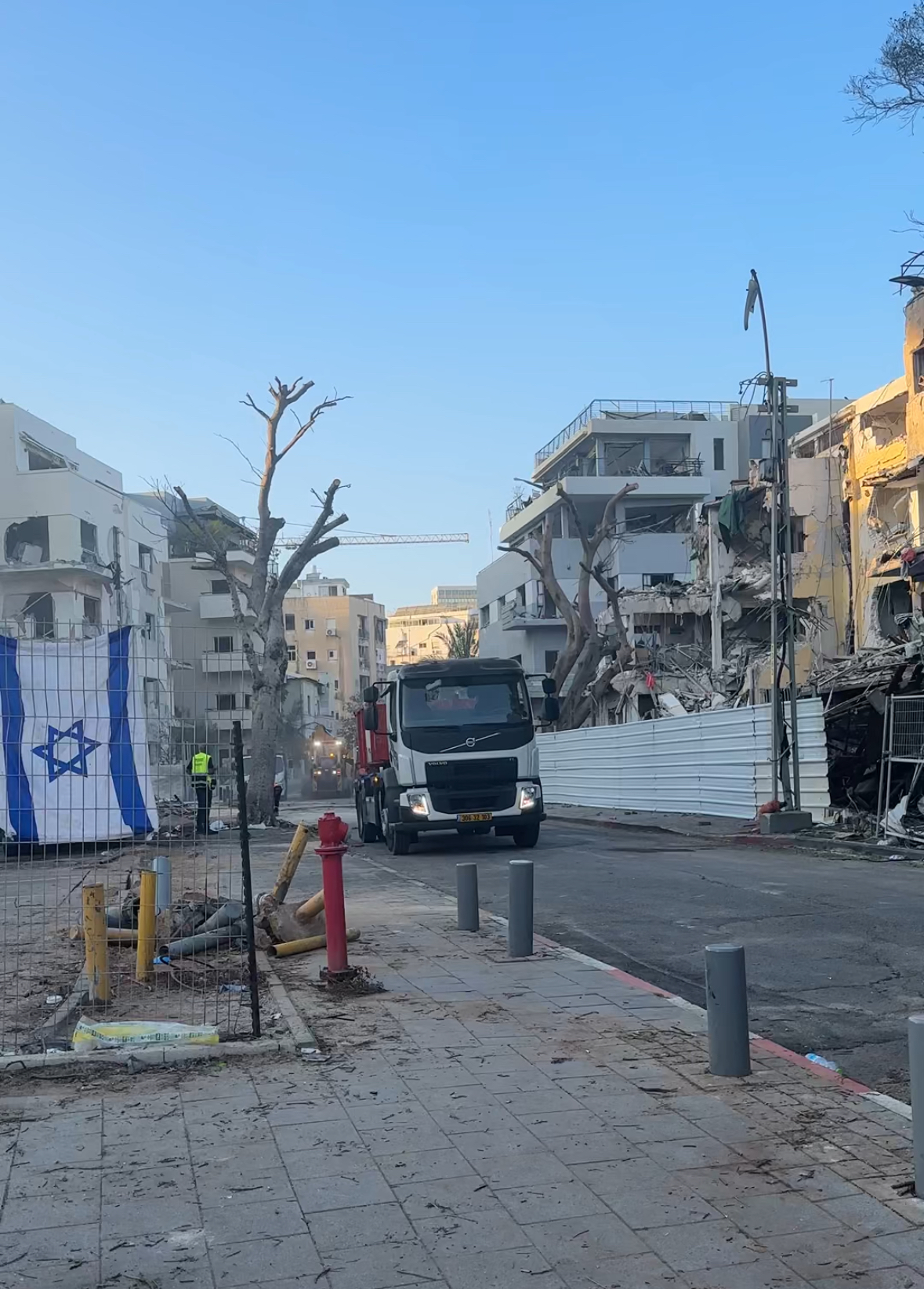
It hit our building.
It hit our building.
4:14 a.m.
What do you mean?
4:14 a.m.
What do we do?
4:14 a.m.
Just stay in
For now
4:15 a.m.
Could be shrapnel
Want to call me?
I have replayed those eight minutes so many times – wondering how I could have managed it better. On the page, it reads calm. But in that moment, there was only abject fear.
In the shelter – the dark, windowless room sealed by a steel door – outside noise arrives muted and distant, as if filtered through cotton. Then the acoustics shift: the Iron Dome stops absorbing and steel on impact starts conducting sound, turning the room into a resonant chamber. One more boom and you realize you are one layer of metal away from a live burial. In those moments, you see nothing, but hear everything. I felt as if we were fish in a barrel, the booms ricocheting.
Worse: my children were wide-eyed, staring at me. When I fell off the bed and scrambled to the shelter door – blown open from the blast – my only thought was: they don’t know they’re about to die.
It was overwhelming, the certainty that I had no ability to protect them. I could only stare at them and feel gutted by grief so deep that I was already mourning the living. As parents, we curate so many of their firsts – because there is no greater joy than introducing something you love to your child. We take delight in the freedom of their first bike ride, their affection for a new puppy, the thrill of chasing waves at the beach. It had never occurred to me that I might also be there to witness their end.
I called my friend because I needed him to witness my grief. He answered immediately, and I felt like I was drowning in sobs – I am still not sure if any sound came out.
As humans, we are wired for survival, and as much as we say we would die if we lost our children, our brains are designed otherwise. My brain settled on the worst outcome, not to paralyze me, but to prepare me. It was milliseconds of anticipatory grief.
My older son had also fallen off the bed during the blast. He braced himself, repeating, “Oh my God, oh my God, oh my God,” like a mantra, trying to anchor himself. He thought the floor was collapsing. So did I.
My friend, bless him, tried to calm me, “Are you with your children?” He knew the answer and I understood what he was trying to say: They are watching you. They need your strength. He was too gracious to say it outright.
I knew what was expected of me, but the grief and rage inside me surged. I wanted to shout into the phone, “They are going to die, and I cannot stop it from happening.”
So I sobbed.
And then, in a quiet reversal of the past three nights – when I held him through the sirens at 3 a.m. – my youngest calmly said to me, “Mommy, it’s going to be okay. It’s going to be okay.”
And that is what it took, I gathered myself and realized, the building was not collapsing, we would get out of this.
Speaking about this later with a neuroscientist, I learned that what surfaces in moments of acute trauma is not the revelation of the moral self, but rather a reflex initiated by genetics, conditioning and the autonomic nervous system. A failure to meet the moral narrative of our community is not a failure of character, but the nervous system overriding our self-mythologies.
My youngest, in his cognitive limbo, was expressing a need to regulate himself through me. His young brain had no ability to categorize what was occurring – it was too surreal. So he sat emotionally paralyzed, a trauma phenomenon known as emotional flooding without schema. Without a neural framework to process the scene, he reached back to my language and offered it to me. He became the anchor to reprioritize presence over panic. This is the divine mercy our brain grants us in trauma – when love can briefly override terror, and sometimes that is all it takes to shift.
I have asked myself: Did I live up to the narrative? Did I fail? Or, did I survive exactly as I was born and conditioned to be? Each of us carries a different ledger of experiences that shapes how we will respond to acute trauma. I know mine; others carry their own. In a country as heterogenous as Israel, with immigrants carrying histories of state violence, genocide, war, displacement, family rupture, neglect and generations of trauma – there is no universal “Israeli response to acute trauma.”
In moments of extreme danger, we do not act according to our values – we act according to our bodies. One mother might dissociate so completely that she no longer registers her own identity, including the part that says, “I am a mother,” – this is her survival mechanism. This is not abandonment, but a collapse override of her body. A protective measure born from a childhood of neglect, abandonment or abuse. At some stage in development, she learned that the only way to protect herself was to dissociate and escape. The tragedy is not her reaction, but what she lived through that made this reaction inevitable.
We don’t always get to be the mothers we imagined, but sometimes, being seen by our children – even in collapse – is what saves us. Trauma may reveal our wiring, but love can rewire us back. A love that says: I see your pain, and I am here, I will stay with you in this moment.
This is what we need to offer Israelis now.