A Searcher for Truth and Meaning
The Body Remembers: From Survival to Healing
Healing the Survival Brain: Tools for Resilience
Understanding how trauma lives in the body — and practical tools to help your nervous system return to calm during times of stress and uncertainty.
We live in a world that often feels like it is moving too fast, too soon, and with far too much to process. Whether it is the collective stress of global conflict or the personal weight of individual loss, we are all navigating a landscape of high-level stress and trauma. But before we look at how to heal, we must understand what we are dealing with.
Trauma is a fact of life, but as Dr. Peter Levine, the founder of Somatic Experiencing, says: “It doesn’t have to be a life sentence.” The problem isn’t just the event itself; it’s when the stress piles up—bit by bit, layer by layer—until it overwhelms our system.
Where Trauma Lives
Contrary to what many of us were taught, trauma doesn’t just sit in our brains. It isn’t just a memory or a thought. Trauma lives in the body. It is excess energy that gets stuck in our systems. Our nervous systems are naturally designed to heal and discharge this energy, but when an experience is too fast or too much, our system shuts down, leaving a “backlog” of stress trapped within us.
To understand why this happens, it helps to look at the “Hand Model of the Brain,” a concept popularized by Professor Daniel Siegel.
- The Prefrontal Cortex (The Thinking Brain): This is the part of the brain behind your forehead. It is logical, analytical, and creative. It’s the part of you that managed to show up on time today for an appointment or plan a vacation.
- The Limbic System (The Emotional Brain): Deep inside is the seat of our emotions. It contains the amygdala , which registers fear and danger, and the hippocampus , which tells us when and where things happened. When emotions become too overwhelming, the hippocampus can shut down. This is why a 30-year-old might react to a barking dog with the same raw terror they felt when they were six—the brain thinks the danger is happening now because the “time and place” stamp was never applied.
- The Reptilian Brain (The Survival Brain): This is the brain stem. It’s the same brain animals have, and it organizes our most basic functions: breathing, digestion, sleep, and our trauma responses— Fight, Flight, Freeze, or Fawn.
Learning from the Impala
In the wild, animals experience life-threatening stress daily, yet they don’t suffer from PTSD. If a leopard chases an impala and the impala realizes it cannot escape, it will drop to the ground and “fake death.” Once the leopard loses interest and leaves, the impala doesn’t just get up and keep running. It shakes . It trembles violently to discharge that massive surge of survival energy. Then, it gets up and goes off to eat lunch.

The body experiences the trauma, holds it, and—crucially—knows how to release it. We, as humans, often suppress that release. We “push through.” We stay composed. We bury what is too difficult to face. And in doing so, we keep the trauma locked inside.
The Language of the Body: The Felt Sense
The survival brain doesn’t speak in words; it speaks in sensations . This is what we call the Felt Sense .
Think about it:
- If you’re angry, you feel it in a clenched jaw.
- If you’re scared, you feel your heart racing.
- If you’re grieving, you might feel a “knot” in your stomach or a “gripping” in your throat.
This brain checks in four times every second, asking: Am I safe? When we hear an ambulance siren, our body reacts before our mind even processes what is happening. Once we see the ambulance is on the other side of the road, our body discharges that energy—perhaps through a yawn, a shiver, or a deep, spontaneous sigh. That “breath of relief” is your body’s way of returning to balance.
The Healing Vortex vs. The Trauma Vortex
Imagine an infinity sign. One side is the Trauma Vortex — a downward spiral of “too muchness” where we can get lost. The other side is the Healing Vortex . To heal, we have to learn how to move towards the healing side by using our “resources.”
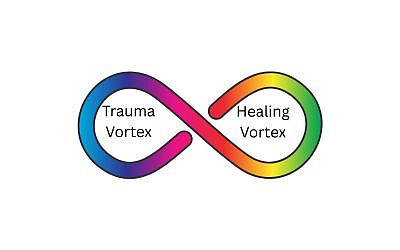
A resource is anything that makes you feel good, safe, or regulated. It can be external (the beach, sport, a favorite song, a cup of tea, a pet) or internal (your faith, your creativity, a happy memory)
When you sit with a happy memory and truly engage your five senses—noticing what you were wearing, the smell of the air, the sound of a voice—your body responds. Your shoulders drop. Your breath slows. This isn’t just “thinking happy thoughts”; it is a physiological shift. The body remembers the good just as vividly as the difficult.
The Story of the Bereaved Parent
I remember working with a father who had tragically lost his son, a soldier, in the midst of this war. Whenever he stood in public to speak about him, he would become completely choked up, the words physically stuck in his throat. Like so many of us, his instinct was to push through—to force the story out despite the pain. I invited him to stop pushing and instead simply notice that terrible ache, the sensation that felt like it was strangling them. I said, ‘Let’s just stay with the grip of that pain and see what happens next.’ By choosing to witness the sensation rather than fight it, the physical constriction finally settled, and he could repeat it by himself whenever it arose again. It is a powerful reminder that our pain doesn’t need to be ‘fixed’ immediately; it needs to be seen and felt before it can move through us.”
Staying in Your Lane
In times of crisis, we often find ourselves overwhelmed by things we cannot change. Dr. David Kessler speaks about “three lanes” we can drive in:
- My Lane: My reactions, my self-care, my
boundaries, what I take responsibility for, where I can effect change. - Your Lane: What other people are doing or saying.
- God’s Lane (or the Universe’s Lane): The grander scheme, global events, the unknown future.

We spend so much time worrying about “Your Lane” and “God’s Lane” that we abandon our own. But “My Lane” is the only place where we have any power. You cannot control the news, but you can control whether you watch it right before bed. You
cannot control the “unknown,” but you can control your breathing in this moment. Viktor Frankl’s most iconic quote on change is: “When we are no longer able to change a situation (Your Lane or G-d’s Lane), we are challenged to change ourselves.“
The True Meaning of Self-Care
Self-care isn’t just about bubble baths and chocolate. As one of my colleagues says: “Self-care is about creating a life that you don’t regularly have to escape from.” It involves looking at several realms of our lives:
- Physical: How are you feeding the “vehicle” that carries you? Are you moving? Are you sleeping?
- Mental/Emotional: Are you sharing your burden? Trauma thrives in silence. When someone enters your pain and simply witnesses it without trying to fix it, healing begins. We need to be “felt” before we can be “fixed.”
- Spiritual/Intellectual: Are you making space for prayer, meditation, or learning something new just for the sake of it?
- Social: Are you connecting with people who “get” you? Even a video call can bridge the gap of isolation.
Tools for the Moment: Reclaiming Regulation
When the world feels like it is spinning, or when a panic attack begins to rise, we need practical ways to bring our “Thinking Brain” back online. Here are a few tools you can use anywhere:
1. The Butterfly Hug
Cross your arms over your chest so your hands rest on your shoulders. Alternately tap your shoulders—left, right, left, right. This isn’t just a comfort gesture; it stimulates the vagus nerve on both sides of the body, signaling to your nervous system that it is time to regulate. If you are in the middle of a panic attack, tap faster and more firmly.
2. The “4×4” Grounding Technique
If you feel yourself “flipping your lid” (where the thinking brain shuts down), you need to force your logic centers to engage. Look around the room and find:
- 4 Circles (or any specific shape)
- 4 Blue Things (or any specific color)
- 4 Different Textures (touch them if you can—wood, fabric, glass)
- Count out of sequence: Count from 1 to 30, but skip around (eg, 2, 17, 5, 29…). You cannot count out of sequence without your Prefrontal Cortex. It forces the “Thinking Brain” back into the driver’s seat.
3. Havening and Containment
Gently stroke your arms from shoulder to elbow, or lightly stroke your forehead and under your eyes. This “Delta wave” touch is incredibly soothing to the system. If you feel scattered or “uncontained,” wrap a scarf tightly around your shoulders or simply grab your own clothing and pull it towards you. Feeling the “boundary” of your body helps the nervous system feel secure.
One Sensation at a Time
Healing from trauma doesn’t happen all at once. It happens one sensation at a time .
When a difficult feeling arises, try not to push through
it. Instead, give it 90 seconds of your attention. Say to yourself, “I notice this tightness in my chest. I’m just going to stay with it and see what happens next.” When we witness our own sensations with compassion rather than judgment, the energy begins to dissipate. Like the imp
ala, we shake it off and return to the present.
A Resource Meditation to try
“To practice building your healing vortex, try this simple visualization: Close your eyes and bring to mind a happy memory—one that feels pure and unmixed with stress. Perhaps it’s a sunny afternoon, a special celebration, or a quiet moment with a loved one. As you hold the image, begin to engage all five senses. What were you wearing at that moment? What was the weather like on your skin? Can you recall a specific scent in the air or the sound of a certain voice? Allow these details to fill your body rather than just your mind. Notice if your shoulders begin to drop or if your breath grows deeper and more spacious. Stay with this ‘felt sense’ of joy for at least sixty seconds. This is your internal sanctuary, a resource you can return to whenever the world feels like too much.”

We have come through so much, and there is still so much that remains unknown. But your body is designed to look after you. It is a beautiful, resilient system. By learning its language and staying in our own lane, we can find a sense of peace—not because the world has stopped being chaotic, but because we have learned how to find the “Healing Vortex” within ourselves.
If you’re looking for a safe space to process your experiences or want to learn more about the felt sense, you can find further information and get in touch with me at dkwellness.co.il
Related Topics
Related Posts