A Thriving Survivor
The Book of Life: Where do the Shunned Belong?
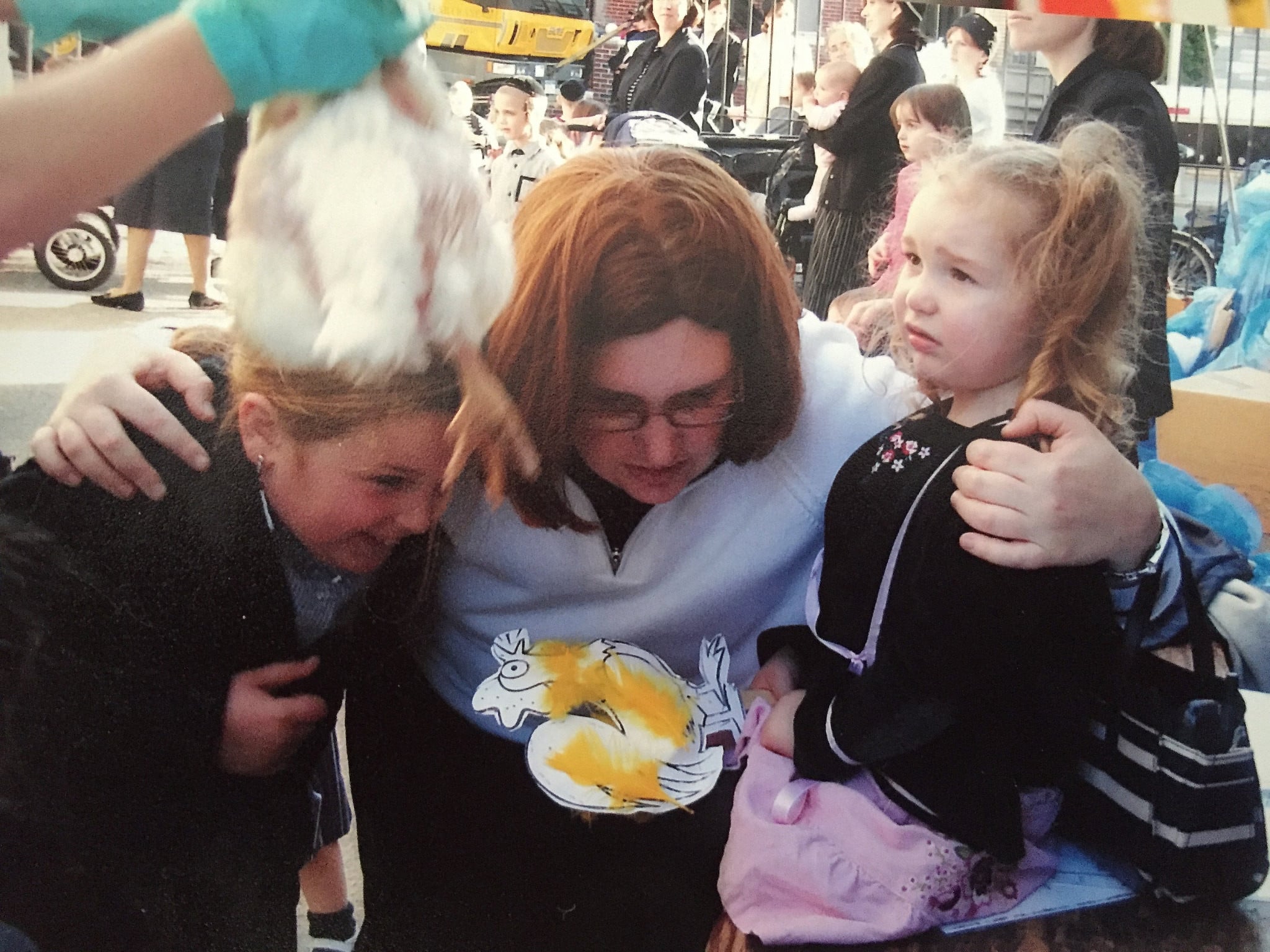
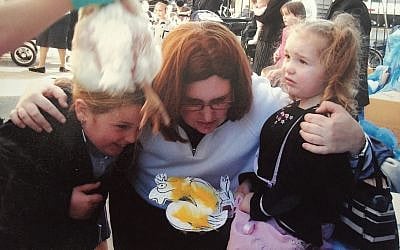
Henny Kupferstein, wearing a sheitel over her shaved head, holds her children during kapparot, as a chicken is waved over their heads in the symbolic atonement ritual practiced by many Chassidim before Yom Kippur.
I am an Ex-Chassid, and as such, a survivor of a forced arranged religious marriage. This is still the custom of my family, who are Holocaust survivors living in New York City. The “ex” part doesn’t mean I voluntarily left the world behind. I was excommunicated from it.
My parents aren’t the only survivors. I am one of those who survived the nightmare of being vomited out of my community, forbidden from seeing the children I bore. Few of us are still alive. Most have ended our lives.
When Rosh Hashanah season comes around, the demons relentlessly assault my daylight consciousness and toss me into a battle of the will to live. I don’t mean metaphorical demons. People who have actively participated in my banishment throughout the year suddenly call to atone.
You see, when the season of forgiveness arrives, I somehow become necessary again, briefly, as the person whose forgiveness might quiet somebody else’s conscience. This year, my unconscious apparently decided that subtlety was unnecessary. Two surgeries in ten days will do strange things to the border between the body and the mind. There is the anesthesia, the inflammation, the exhaustion, the strange psychological death train of surrendering consciousness to strangers and then trying to inhabit yourself again afterward. There, there, the white light. No, no. Don’t go.
Last night, I dreamed that I had been prosecuted for whistleblowing — which in the Chasidishe world is akin to being an informant — and sentenced to seven years in a white-collar prison. When my sentence ended, I returned to Borough Park, Brooklyn. I did exactly what a dutiful former prisoner was supposed to do. I went straight to the police station to check in and register my return to the community.
There was only one problem. The Chief of Police had to process my case before I could officially return. Except I was the Chief of Police. So there I sat, stranded in a grey industrial chair at the corner of the receptionist’s desk, pretending to read safety brochures while employees kept stealing glances at me through a side door leading into the back hallways. Meanwhile, Chassidim hurried in and out of the station through a shortcut granting access to the next block. The foot traffic was constant. I had returned to the geographic center of an old world, yet I was invisible inside it. The Chassidim didn’t recognize me, while the detectives couldn’t stop looking at me.
Eventually another ex-Chassidic friend Joy came to rescue me. As a longtime NYPD detective, I reasoned, she knew the laws. I expected, perhaps, another procedural solution. Instead she suggested that we leave and get something to eat.
She had her dog Zeus in a Silver Cross stroller and asked whether I wanted a turn pushing it. Suddenly I wasn’t standing beside a dog stroller. I was back inside another life: a kept wife and captive mother, pushing a double stroller through the streets of Brooklyn, my body conscripted into a role from which there seemed to be no exit. I couldn’t push the stroller. It was too much.
Joy didn’t debate me. She didn’t tell me it was only a stroller, ask me to overcome it, or make me prove why it hurt. She simply maneuvered us away from the pain radiating from the stroller’s handlebars. We went to a deli. We chose happiness.
Then I woke up.
The dream arrived precisely as the apologetic phone calls of the season began to arrive. Teshuvah is usually translated as “repentance,” though its language contains the idea of return. After my shunning, I find myself wondering what exactly I am being asked to return to. I have no desire to return to every person who remembers an earlier version of me, to put old clothes back on, or answer a telephone call because someone else has reached the season of The Guilty Conscience. It certainly does not require taking hold of the stroller again to demonstrate that I have overcome what it represents.
None of these are my problems to fix. Every day, women in Borough Park push strollers they didn’t ask for, caring for children they had no choice but to bear. Perhaps one day the Chasidishe world will reckon with what they’ve wrought. I’m not optimistic.
As for me, the return I am interested in now is a return to myself. I can grieve a community without going back to it, miss people without calling them, accept the sincerity of an apology without rebuilding the relationship that preceded it. Another person’s teshuvah belongs to them. Mine may be the recovery of a life that no longer needs to organize itself around either exile or return.
There was no shofar in my dream to interrupt ordinary consciousness, to awaken something that has fallen asleep. Instead, sitting in the Chief’s chair allowed me to discover that the official whose permission I had been waiting for was me.
Being the Chief is not a fantasy of power. It feels more like recovering authorship after years spent believing that freedom would eventually arrive in the form of somebody else’s decision. More revealing is discovering that nobody is coming to grant it. The paperwork may never be processed correctly. The people behind the door may continue whispering, and the people from the old neighborhood may continue walking past without recognizing me. None of that prevents me from standing up.
Those of us who have spent a long time surviving can become accustomed to imagining healing as a monumental event: the verdict, the apology, the explanation, the acknowledgment, the day somebody finally understands. My life has contained enough courts, institutions and fights for recognition to know the seduction of waiting for that moment. After an elaborate dream about imprisonment, authority, exile and belonging, freedom turns out to be almost offensively ordinary: being a woman with agency over her body, allowed to choose the clothes she wears, how she styles her hair, what to order at a deli counter, where all the comforts and delights are appetizingly displayed. You don’t need to know how to pronounce cholent, kugel, and shlishkess. (Or taharas haMishpoche, for that matter.) You can smile and point, and be served.
The dream offered me something small but useful. An unfinished argument can remain unfinished while lunch still happens. A stroller can remain untouched. Old clothes can remain unworn. Someone trustworthy can notice distress and quietly turn away from it with me. Pleasure does not have to wait until every injustice has been adjudicated.
This is the teshuvah I want to carry into Rosh Hashanah. I can return without going backward. I can allow an old door to remain open without walking through it. I can understand another person’s desire for forgiveness without surrendering jurisdiction over who has access to me. There are prisons made of walls, and there are prisons sustained by the lingering belief that the people who once confined us continue to possess jurisdiction over our lives. I want my sentence suspended.
A community is more than a collection of people who share beliefs. It is the invisible infrastructure underneath a life. It is who remembers your childhood, who expects you at a table, who understands a reference without explanation, who recommends you for work, who appears when you are sick, who knows your children, who introduces you to somebody new, who notices when you disappear. It’s why shunning is so violent. It removes all of that infrastructure at once. The resulting vacancies persist long after a person has built a life she loves.
This is what I wish the greater Jewish community would understand when another story about someone shunned an insular Jewish community reaches the newspapers. Please remain interested after the escape story is over. Ask us how we are. Help us build community and put down roots. Invite us into ordinary friendship and Jewish life. Accept us as we arrive. Read our work, support our interests, introduce us to people, invite us to your Sukkah.
If you’re interested in Yiddish life, we are open to sharing our story. It’s all we have: it’s the only content of our existence that continues to live. Remember us when there is no headline reminding you that excommunicated Jews exist. Help us become contributing members of a community rather than permanent refugees from one. Help us build our Family of Choice by becoming a part of it.
Go with us when we go outside, too. For a community supposedly devoted to the miracles of God’s world, Chassidishe folks live remarkably interior lives, between yeshivas and houses. I have come to appreciate the sanity of a natural world vastly larger than the social world that once rejected me. Trees have no interest in whether I am still recognizable as the girl who grew up in Borough Park. Roots accommodate damaged ground. New growth does not require pretending that nothing was cut away. I am Autistic and do not socially include myself without a safety plan.
My dream left me with the image of myself still sitting in that lobby long after the sentence had been served. The old uniform no longer fits. The stroller can remain where it is. My childhood friend is waiting, there is food somewhere outside the building, and another year is beginning. I am the Chief now, which means I no longer need to wait for her to arrive. I can leave the lobby and choose happiness. The King is in the Field.
Related Topics
Related Posts