Geopolitical Analyst: Bridging Somaliland & Israel to the world
The Boy Who Cried Al-Shabaab: How Mogadishu Replaced the Pandora Warning
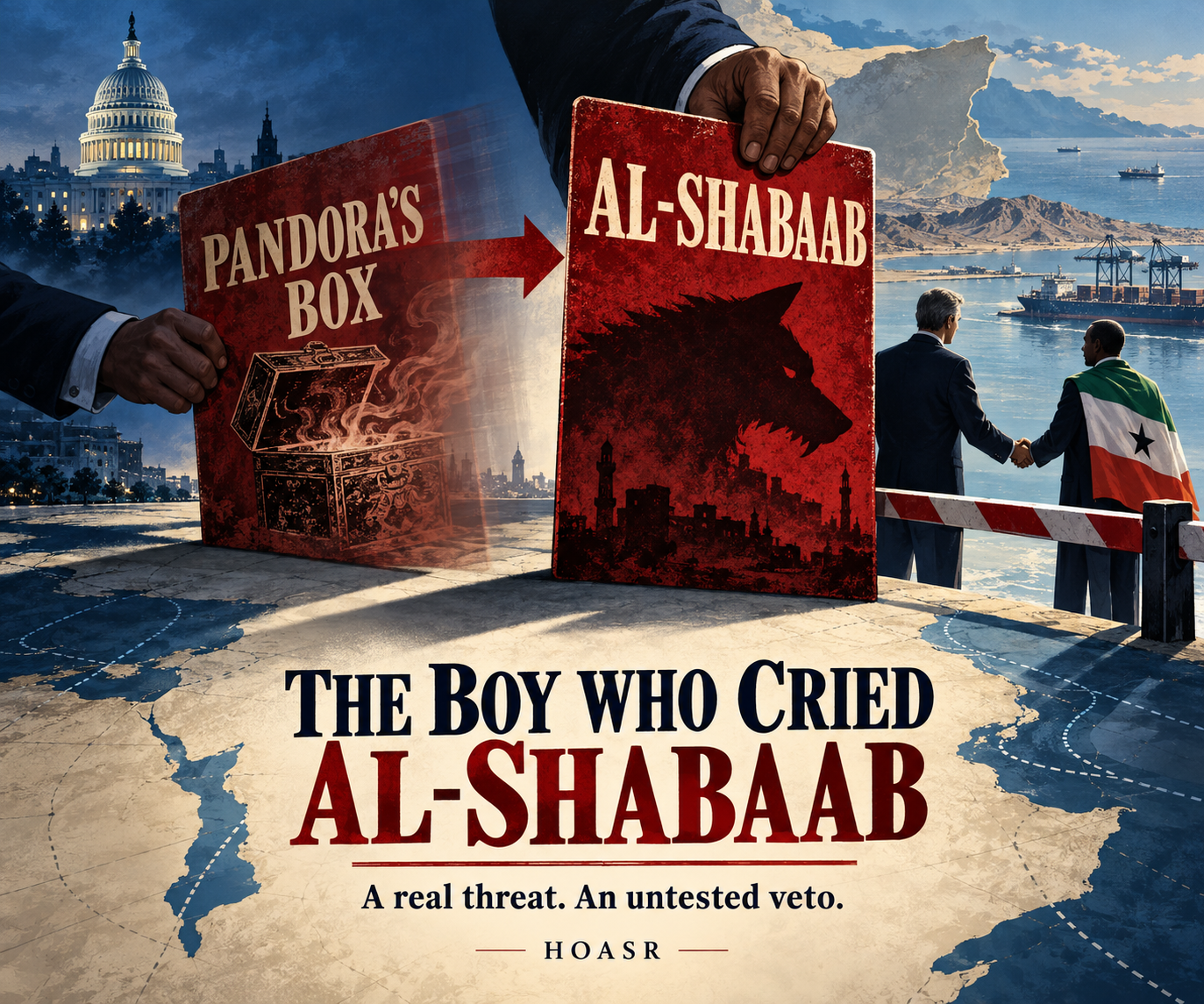
Mogadishu’s warning has shifted from “Pandora’s box” to Al-Shabaab. A real threat. An untested veto. Original HOASR Infographics Artwork
Why Washington Needs a Separate Somaliland Policy
Washington does not have to choose between abandoning the fight against Al-Shabaab and accepting Mogadishu’s permanent veto over Somaliland. It can deepen a direct working relationship with Hargeisa, use Berbera for negotiated maritime and counterterrorism cooperation, and continue operations with Somalia. That approach would test Mogadishu’s latest warning against Somaliland recognition rather than allowing an unproven threat to freeze American policy.
The argument inside Washington has changed
For most of the modern recognition debate, Somaliland was blocked by a warning rather than a serious examination of its case. Recognition, diplomats and African governments argued, would open a Pandora’s box of separatist claims across the continent. The phrase made delay sound prudent even when Somaliland’s history did not fit the analogy.
The African Union’s own fact-finding mission weakened that objection in 2005. After examining Somaliland’s history and political conditions, the mission described its search for recognition as historically unique and self-justified. It concluded that the case should not be connected to the notion of opening a Pandora’s box. The mission was referring to a former British protectorate that became independent on 26 June 1960, entered a troubled union with the former Italian territory, and restored its sovereignty inside the same colonial borders in 1991. This was not a recommendation to recognize every separatist movement. It was an instruction to judge Somaliland on its own record. (African Union Fact Finding Mission)
The Pandora argument has since lost much of its force. Israel recognized Somaliland in December 2025 without producing the predicted continental cascade. Somaliland’s borders remain the borders of the former protectorate, and most African territorial disputes still lack its specific legal and historical background. Washington’s debate has therefore moved toward a different concern: whether recognition, or even a deeper separate relationship with Hargeisa, would damage American counterterrorism cooperation with Mogadishu.
Evidence of an internal policy division should be described carefully. The State Department has not published a memorandum identifying rival factions. Yet the public signals point in different directions. The department continues to affirm Somalia’s sovereignty and territorial integrity, while Congress, Pentagon-linked advocates and several policy institutions press for closer relations with Somaliland. The Guardian reported in 2025 that the Trump team was divided and that some officials wanted to abandon the one-Somalia policy. In September 2026, Michael Rubin reported that resistance remained in senior State Department and National Security Council offices because officials feared recognition would undercut counterterrorism cooperation with Somalia. These reports do not prove a settled bureaucratic map, but they do document a genuine policy struggle. (The Guardian; Middle East Forum)
From the Pandora Box to the Al-Shabaab card
Mogadishu’s latest argument is more serious than the old precedent warning because Al-Shabaab is a real and dangerous organization. The group has killed Somali civilians, attacked neighboring countries, taxed communities under its control and survived repeated military campaigns. A decision affecting counterterrorism cooperation must therefore be tested against operational evidence, not dismissed as propaganda.
The problem arises when the threat is used to close every policy option. Somalia’s position increasingly suggests that recognition of Somaliland would inflame nationalism, aid extremist recruitment and force Mogadishu to reconsider security cooperation with Washington. If accepted without examination, this gives Somalia the same veto once supplied by the Pandora argument. The rationale changes, but the policy outcome remains permanent delay.
There is evidence that some American officials share the concern. A Washington Post opinion article by Joshua Meservey acknowledged that members of the administration feared Somalia could cut counterterrorism cooperation in retaliation for recognition. He also identified the weakness in that logic: a partner prepared to withhold action against a terrorist organization that threatens its own survival is not exercising leverage responsibly. The United States would be allowing tactical dependence to determine an unrelated diplomatic question. (Washington Post)
A measured American policy would take the risk seriously while refusing the false choice. Washington can maintain intelligence sharing, military coordination and strikes against Al-Shabaab and Islamic State targets in Somalia. At the same time, it can establish direct diplomatic, economic and security channels with Somaliland. The two relationships involve different authorities, different territories and different missions. Treating them separately reflects how power is already organized across the Somali peninsula.
The Somalia centered model has not delivered security
Mogadishu’s counterterrorism warning would carry more weight if the existing model had produced a steady transfer of security responsibility to Somali institutions. The record shows repeated tactical gains followed by reversals, continuing dependence on foreign troops and unresolved political conflict inside the federal system.
The European Union says it has provided almost 2.8 billion euros to successive African Union missions in Somalia since 2007. Those missions evolved from AMISOM to ATMIS and then AUSSOM, but the central purpose remained broadly consistent: protect population centers, support Somali forces and degrade Al-Shabaab while the federal government developed the ability to secure the country. Nearly two decades later, an African force of almost 12,000 personnel still depends on outside financing and United Nations logistics. (Council of the European Union)
The United States has reached a similar conclusion about the results. In July 2026, a State Department spokesperson said Washington had supplied nearly $2 billion in assessed contributions to the UN support operation and its predecessor. The spokesperson said Somalia had been unable to sustain progress against Al-Shabaab or assume most of its own security functions. A diplomatic note reviewed by Reuters also blamed internal rivalries and political infighting for weakening the campaign. Washington later allowed an additional year for the support structure to wind down, but the diagnosis did not change. (Reuters)
American assistance extends beyond peacekeeping assessments. The USAID Office of Inspector General reported that the U.S. government obligated $1.2 billion in humanitarian and other assistance to Somalia in fiscal year 2023 and $420 million in 2024. The same evaluation examined a $126 million governance and stabilization portfolio intended partly to reduce Al-Shabaab’s influence. It found incomplete performance data, limited use of the official management system and missed opportunities for stronger financial oversight. Its background assessment stated that the Somali National Army’s 2022 gains collapsed by late 2023 and that Al-Shabaab had regained territory. (USAID Office of Inspector General)
These figures do not show that all assistance was wasted. Humanitarian funding has saved lives, and African troops have prevented Al-Shabaab from capturing major institutions in Mogadishu. Somali units and local communities have also fought bravely. The evidence shows something narrower and more relevant: continued funding cannot be treated as proof that the policy is succeeding, and Somalia’s dependence cannot automatically justify control over Washington’s Somaliland policy.
Oversight failures require evidence and precision
The strongest criticism is not that every aid program is corrupt or that every official in Mogadishu profits from insecurity. Such claims would exceed the available evidence and would weaken a legitimate demand for accountability. The documented problem is that large flows of assistance have entered a conflict environment where diversion, weak monitoring and political capture are persistent risks.
In March 2026, the U.S. Government Accountability Office cited a 2023 United Nations assessment that found widespread and systemic diversion of aid in Somalia, primarily involving cash assistance. Beneficiaries reported being coerced into surrendering significant portions of their support to camp managers and others. GAO also identified broader weaknesses in fraud training, partner screening and oversight of sub-awardees across American foreign-assistance systems. (U.S. Government Accountability Office)
The policy response should therefore be conditionality, transparency and separation of functions. Emergency food and medical assistance should not be confused with open-ended security subsidies. Counterterrorism funding should be tied to measurable performance, audited procurement, verified payrolls and clear command responsibility. Programs intended to strengthen governance should publish indicators that show whether institutions can operate after foreign support ends. This is a demand for better policy, not collective punishment of the Somali population.
Territorial Integrity Has Not Resolved the Constitutional Crisis in Somalia
Washington has often treated support for Somalia’s territorial integrity as a contribution to state-building. Yet formal unity has not produced constitutional consensus among Somalia’s own federal authorities. Puntland, Jubaland and South West have each suspended or severed relations with the federal government at different points over constitutional amendments, elections and the division of power.
In March 2026, Somalia’s parliament approved constitutional changes that could extend the president’s term and delay elections. Reuters subsequently reported that South West became the third federal member state to break with Mogadishu, following disputes involving Puntland and Jubaland. Fighting later erupted in the capital between government forces and opposition-aligned militias, while the United Nations called for restraint and political dialogue. (Reuters on constitutional changes; Reuters on federal tensions)
This record does not mean Somalia should be abandoned. It does show that denying Somaliland recognition has not delivered unity south of the former British protectorate. Mogadishu’s constitutional crisis arises from unresolved disputes over power, elections and federalism. Somaliland’s international status did not create those disputes, and keeping Hargeisa diplomatically isolated will not solve them.
A separate Somaliland relationship can begin before recognition
The most practical American response is a phased policy short of recognition. It would expand cooperation with Somaliland now while leaving the formal recognition decision for a later stage. This is not a substitute for Somaliland’s sovereignty claim. It is a way to prevent the absence of recognition from blocking policies that already serve both countries.
President Abdirahman Irro’s September visit created an opening. His delegation reported contacts with the State Department, Pentagon, Treasury, Department of Energy and National Security Council, while members of Congress continued to press for financial access and closer ties. Irro also made an American diplomatic post in Hargeisa or Berbera a priority. The Associated Press reported that the administration had already provided Somaliland with $6.2 million in counterterrorism, security and humanitarian assistance while maintaining its existing recognition policy. (Associated Press)
Washington can build on that foundation through an official liaison presence, regular senior-level dialogue, separate travel and security guidance, direct development programs, coast-guard training and improved access to banking and insurance. It can also negotiate transparent arrangements for maritime-domain awareness, logistics, evacuation planning and counterterrorism support from Hargeisa or Berbera. Any operational access should be based on Somaliland’s consent, clear legal terms, civilian oversight and measurable benefits for local security and infrastructure.
Berbera would not replace every American facility in Djibouti, Kenya or Somalia. Its value lies in diversification. The port and airfield sit on the Gulf of Aden near the approaches to Bab el-Mandeb, across from Yemen and beside a government that has shown interest in cooperation with the United States, Taiwan and Israel. Limited access could improve maritime surveillance, protect commercial routes and give American planners another option during crises without requiring an immediate permanent base.
The Taiwan comparison requires care. Somaliland can learn from Taiwan’s ability to build deep practical ties without universal diplomatic recognition, but it should not accept indefinite unofficial status as the final settlement. A phased U.S. relationship should be a bridge that tests cooperation and prepares institutions for recognition. It should not become a comfortable mechanism for Washington to obtain strategic access while postponing Somaliland’s political status forever.
A Policy Test for the Al-Shabaab Warning
A separate U.S.–Somaliland relationship would allow Washington to test Mogadishu’s Al-Shabaab argument in practice. The United States could notify Somalia that counterterrorism cooperation will continue on its merits and that closer relations with Hargeisa are not directed against the Somali population or Somalia’s federal member states. Washington would then proceed with a diplomatic presence and negotiated security cooperation in Somaliland while maintaining existing operations against extremist groups elsewhere.
If Mogadishu continues cooperating, its claim that a separate Somaliland policy would destroy the counterterrorism partnership will have been disproved. If it obstructs operations against Al-Shabaab to punish Washington, it will reveal that the relationship is being used as leverage rather than as a shared security responsibility. Either outcome gives the United States better information than another decade of postponement.
The approach also reduces the immediate risks associated with recognition. Mogadishu and its partners would have time to adjust to a relationship that already reflects conditions on the ground. Somaliland and the United States could demonstrate whether direct cooperation produces reliable intelligence, safer maritime routes and accountable use of assistance. Recognition would then be judged against observed results rather than predictions of chaos.
Washington should stop financing a veto
Somalia faces a genuine terrorist threat and deserves support that protects civilians and weakens Al-Shabaab. That obligation does not require Washington to finance the federal government without limits, overlook documented oversight failures or permit Mogadishu to decide America’s relationship with Somaliland. Counterterrorism cooperation is a policy instrument. It should not become a permanent veto over recognition or a guarantee of funding detached from results.
The old Pandora argument is fading because Somaliland’s case has remained exceptional and because the catastrophe predicted by opponents did not follow Israel’s recognition. The Al-Shabaab warning is the new wild card. It is more emotionally powerful because the danger is real, but it becomes misleading when it claims that Washington must choose between Hargeisa and counterterrorism.
Washington has another option. It can continue fighting Al-Shabaab with willing partners in Somalia, establish a separate working relationship with Somaliland, and develop maritime and security access through Hargeisa and Berbera under transparent agreements. It can demand audited results from programs in Mogadishu while protecting humanitarian assistance from political bargaining. Most importantly, it can stop allowing each failed objection to return under a new name.
Recognition may still require political preparation. A direct Somaliland policy does not. The United States can begin now, measure the results and decide the final diplomatic step from a position of evidence rather than fear.
Selected Sources:
- African Union Fact Finding Mission to Somaliland 2005
- Foreign Policy The Iran War Might Be Somalilands Chance for Recognition 23 September 2026
- Reuters Somalia peacekeeping mission at risk as US blocks UN support 2 July 2026
- Council of the European Union Support for AUSSOM 21 April 2026
- USAID Office of Inspector General Somalia governance portfolio evaluation 2 July 2025
- U.S. Government Accountability Office Foreign assistance fraud risk 17 March 2026
- Middle East Forum U.S. counterterrorism officials and Somaliland 15 September 2026
- New Lines Magazine Somalilands uphill struggle for recognition 16 September 2026
- The Washington Post Israel recognized Somaliland and America should too 12 January 2026
- The Guardian Somaliland recognition and divisions in Washington 30 May 2025
Related Topics
Related Posts