

Geopolitical Analyst: Bridging Somaliland & Israel to the world
President Irro and The “Somalia Opposition Alliance” That Has Yet to Be Proven
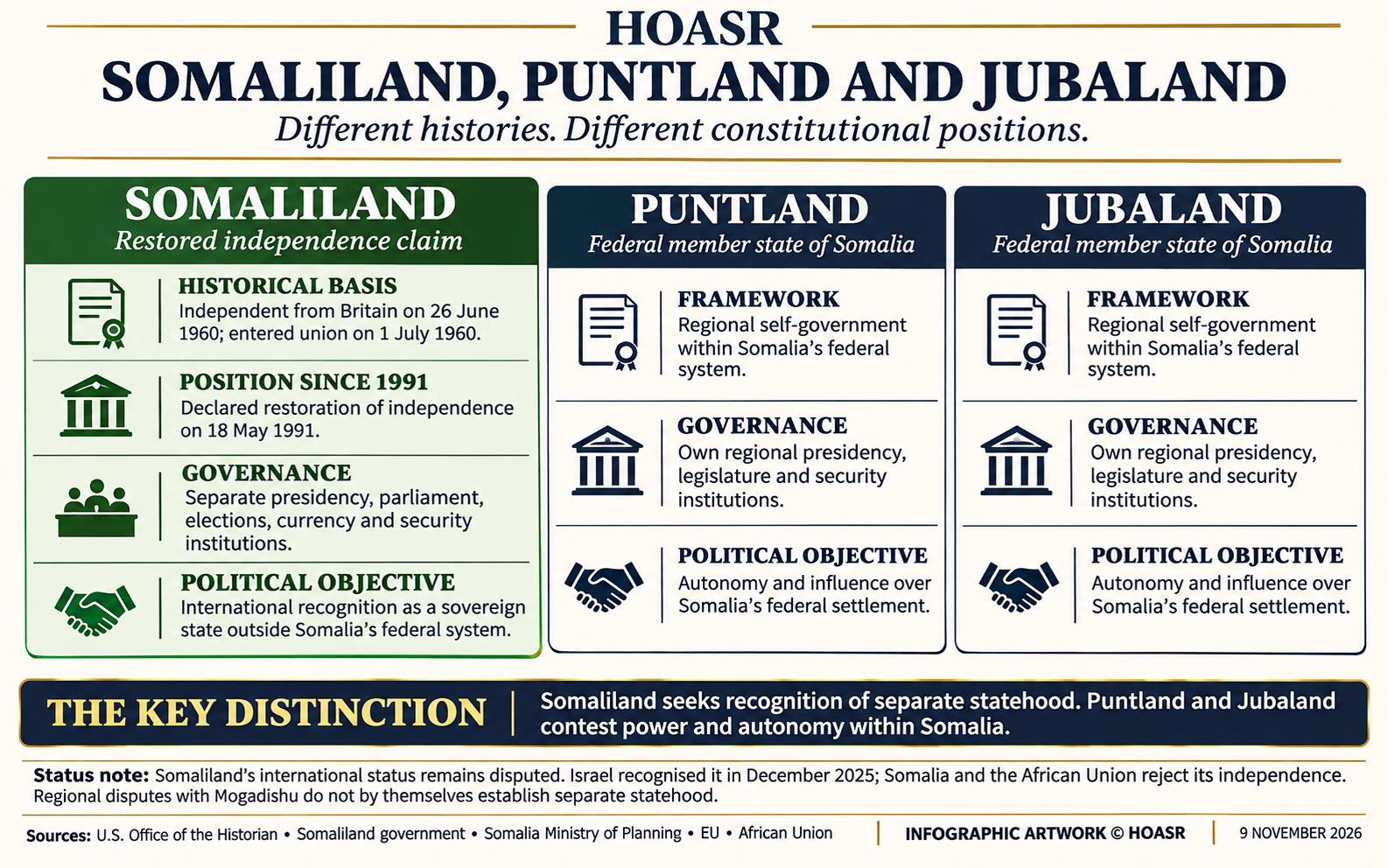
Somaliland seeks recognition of separate statehood, while Puntland and Jubaland pursue autonomy within Somalia’s federal system. Infographic artwork © HOASR.
As Somalia’s political disputes spread from Mogadishu to Beledweyne, a former intelligence chief has drawn Somaliland’s president into allegations of a regional opposition alliance. The controversy raises a larger question about sovereignty, political influence and the limits of Mogadishu’s authority.
Somaliland President Abdirahman Mohamed Abdullahi Irro has found himself at the centre of an unusual political controversy originating not in Hargeisa, but in Somalia’s increasingly fractured political landscape.
Abdullahi Mohamed Ali Sanbaloolshe, the former director of Somalia’s National Intelligence and Security Agency, claims to have discussed an alliance against President Hassan Sheikh Mohamud with Irro and the leaders of Puntland and Jubaland during meetings in the United Arab Emirates. His account has generated speculation about an emerging political front connecting Hargeisa, Garowe, Kismayo and Abu Dhabi.
The allegations have been circulating since late October, but their renewed prominence follows the political and security confrontation in Beledweyne. In its 9 November investigation, Horn Observer links the controversy to tensions in Hiiraan, where Sanbaloolshe has become involved in opposition to the Hirshabelle regional administration. The resulting narrative places Somaliland’s president alongside federal member-state leaders seeking political change in Mogadishu.
However, the available record from both publications, does not establish that these leaders formed an alliance or agreed to finance or support armed action.
That is important because Somaliland’s participation in regional diplomacy carries a different constitutional meaning from that of Puntland or Jubaland. Irro leads a republic that declared the restoration of its independence in 1991 and has since maintained separate political institutions.
In contrast, Deni and Madobe govern administrations whose disputes concern their relationship with Somalia’s federal government. Their political interests may occasionally overlap, but their constitutional positions are not interchangeable.
What Sanbaloolshe Actually Alleged
According to Hiiraan Online’s report of 26 October, Sanbaloolshe claimed to have met Irro, Deni and Madobe in the UAE to discuss forming a political alliance against Hassan Sheikh Mohamud.
He described discussions about bringing together forces opposed to the Somali president and determining their next steps. His statements were consequential because he identified the political leaders by name.
Yet identifying participants is different from establishing an agreement. No jointly issued declaration, signed arrangement or confirmed commitment by the leaders has emerged from the reporting.
Sanbaloolshe’s own account is the principal basis for the allegation. Even if meetings took place, their occurrence alone would not establish that those present accepted his objectives or authorised actions on his behalf.
These allegations became especially relevant when the Somali Future Council, an opposition coalition associated with figures opposed to Mogadishu’s constitutional and electoral agenda, publicly rejected allegations of an armed opposition plan on 29 October. Council secretary Abdullahi Arab also stated that Sanbaloolshe was not a member.
His denial does not independently establish what happened in Abu Dhabi, but it challenges the suggestion that the former intelligence chief was necessarily speaking for the broader opposition.
Somaliland Is Not a Federal Opposition Movement
The controversy becomes politically misleading when Somaliland is placed in the same category as Somalia’s federal opposition. Puntland and Jubaland have challenged Mogadishu over constitutional amendments, electoral arrangements and the distribution of federal authority. Their disagreements concern the structure and leadership of a state of which they remain constituent administrations.
Somaliland’s position is different. It claims that its sovereignty was restored on 18 May 1991 following the collapse of the 1960 union. Hargeisa maintains its own presidency, legislature, armed forces, electoral institutions and foreign relations. Although Somalia disputes Somaliland’s independence, Somaliland’s government does not recognise Hassan Sheikh Mohamud as its president.
That qualification has direct implications for interpreting any reported contact between Irro and Somali opposition figures. A conversation between the president of Somaliland and the leader of Puntland would not, by its existence, establish Somaliland’s participation in Somalia’s federal political process.
Governments and political leaders engage counterparts across disputed borders. Commerce, trade and constitutional disagreements without necessarily accepting one another’s political frameworks.
Nor would an interest in developments in Mogadishu be surprising. Decisions taken by Somalia’s federal government can affect Somaliland’s diplomatic, economic and security interests. Mogadishu continues to oppose international recognition of Somaliland and asserts authority over matters Hargeisa considers exclusively its own.
Therefore, political developments within Somalia have consequences for Somaliland, irrespective of whether the two governments recognise each other’s claims.
There is, however, a difference between observing or engaging political actors and participating in a campaign to overthrow another government. The former can fall within ordinary political diplomacy.
The latter would raise separate questions about responsibility, security and international relations. The allegations concerning Irro have not established that such a campaign was agreed upon.
Why Abu Dhabi Appears in the Story
The United Arab Emirates provides an important setting for understanding the political relationships involved. Abu Dhabi maintains substantial commercial and security interests across the Horn of Africa, including investments and partnerships involving Somaliland, Puntland and Jubaland. Those relationships have repeatedly created friction with Somalia’s federal government.
In January 2026, Mogadishu announced the cancellation of its agreements with the UAE, including arrangements involving Berbera, Bosaso and Kismayo. The federal authorities justified the decision on sovereignty grounds. Yet the three ports operate under different local administrations, and the announcement exposed the gap between Mogadishu’s territorial claims and the practical authority exercised by the governments concerned.
The economic consequences were particularly clear in Somaliland. Reuters reported on 13 January that Dubai-based DP World intended to continue its Berbera operations despite Somalia’s announcement. Somaliland’s government likewise defended its relationship with the Emirates.
The UAE consequently has established relationships with political actors whose interests do not always coincide with Mogadishu’s. That provides a context for meetings or consultations involving leaders from the region. It does not establish that Abu Dhabi sponsored a common political front or organised an “opposition alliance” in an effort to remove Somalia’s president.
The deeper issue is the growing divergence between Somalia’s assertion of central authority and the independent relationships maintained by administrations and political actors across the region.
From Abu Dhabi to Beledweyne: Two Political Disputes Become Entangled
The allegations have acquired greater prominence because Sanbaloolshe is also involved in the political confrontation in Hiiraan. The dispute concerns the leadership of Hirshabelle, the distribution of political authority between Hiiraan and Middle Shabelle, and longstanding grievances over representation and administrative control.
On 7 November, Hiiraan Online reported rising tensions in Beledweyne following the arrival of Sanbaloolshe and newly elected Hirshabelle Vice President Abdifatah Hassan Afrah, both accompanied by armed supporters. The confrontation reflects political disagreements that predate the alleged Abu Dhabi discussions.
This matters because the involvement of armed personnel has encouraged interpretations that connect separate developments into a single regional conspiracy. Sanbaloolshe’s political activities in Hiiraan, Somalia’s disputes with Puntland and Jubaland, and Somaliland’s recognition campaign all involve opposition to particular decisions made in Mogadishu.
But overlapping disagreements do not automatically establish a shared organisation, financing arrangement or military objective.
There are serious security implications if political disputes in Hiiraan develop into armed confrontation. Community defence forces have played important roles in counterinsurgency operations against Al-Shabaab, and divisions among local authorities could complicate that work.
Those risks warrant attention on their own merits without attributing responsibility to leaders for whom no operational connection has been demonstrated.
What Would Somaliland Gain From Mogadishu’s Political Crisis?
The controversy raises a broader geopolitical question. Would political change in Mogadishu advance Somaliland’s international recognition campaign?
Hassan Sheikh Mohamud’s government has actively opposed Somaliland’s recognition and challenged its diplomatic relationships, including Israel’s recognition in December 2025. Another Somali administration might employ different diplomatic methods or pursue negotiations under different conditions.
However, opposition to Somaliland’s independence extends across much of Somalia’s political establishment and cannot be assumed to disappear with a change of president.
Somaliland’s recognition campaign rests on a separate historical and legal argument: its independence on 26 June 1960, the subsequent union, the restoration of sovereignty in 1991 and the institutions developed since then. Those claims would remain substantially the same regardless of who occupied Somalia’s presidency.
A political alliance designed primarily around removing Hassan Sheikh Mohamud would therefore involve objectives different from Somaliland’s stated diplomatic campaign. It could also create uncertainty about Hargeisa’s relationship with a future Somali administration, particularly if Somaliland became associated with one faction in an internal political struggle.
There may be circumstances in which dialogue with regional political leaders offers opportunities for reducing tensions, facilitating commerce or addressing shared security concerns. Irro meeting with Deni or Madobe does not mean participation in Somalia’s domestic contest for power.
The Scoop: Political Opposition Is Not Proof of a Common Alliance
The controversy surrounding Irro illustrates how quickly political differences can be interpreted as evidence of a coordinated regional strategy. Sanbaloolshe has made a serious allegation involving three prominent leaders. Somalia’s disputes with its federal member states are substantial. The UAE’s regional relationships are well established, and the confrontation in Beledweyne has introduced immediate security concerns.
These developments interact politically, but the evidence does not yet connect them to the alleged unified alliance described in both publications.
Puntland and Jubaland are negotiating their positions within Somalia’s federal system. Hiiraan’s political actors are contesting the authority and composition of Hirshabelle’s administration. Somaliland continues to pursue sovereign recognition outside that system. Their differences with Mogadishu arise from separate histories, institutions and political objectives.
For Somaliland, the most important difference is between defending its own sovereignty and becoming a participant in another state’s internal political struggle. Its diplomatic relationships can be examined without reducing its presidency to a faction of Somalia’s opposition.
Sanbaloolshe’s claim has brought President Irro into a controversy whose evidence remains incomplete accusations. The record establishes a public allegation but not an agreed alliance involving Somaliland.
Until further evidence emerges, the political significance of the accusation should not be mistaken for proof of its substance.
Related Topics
Related Posts