
The Broken Spell that will Save Us
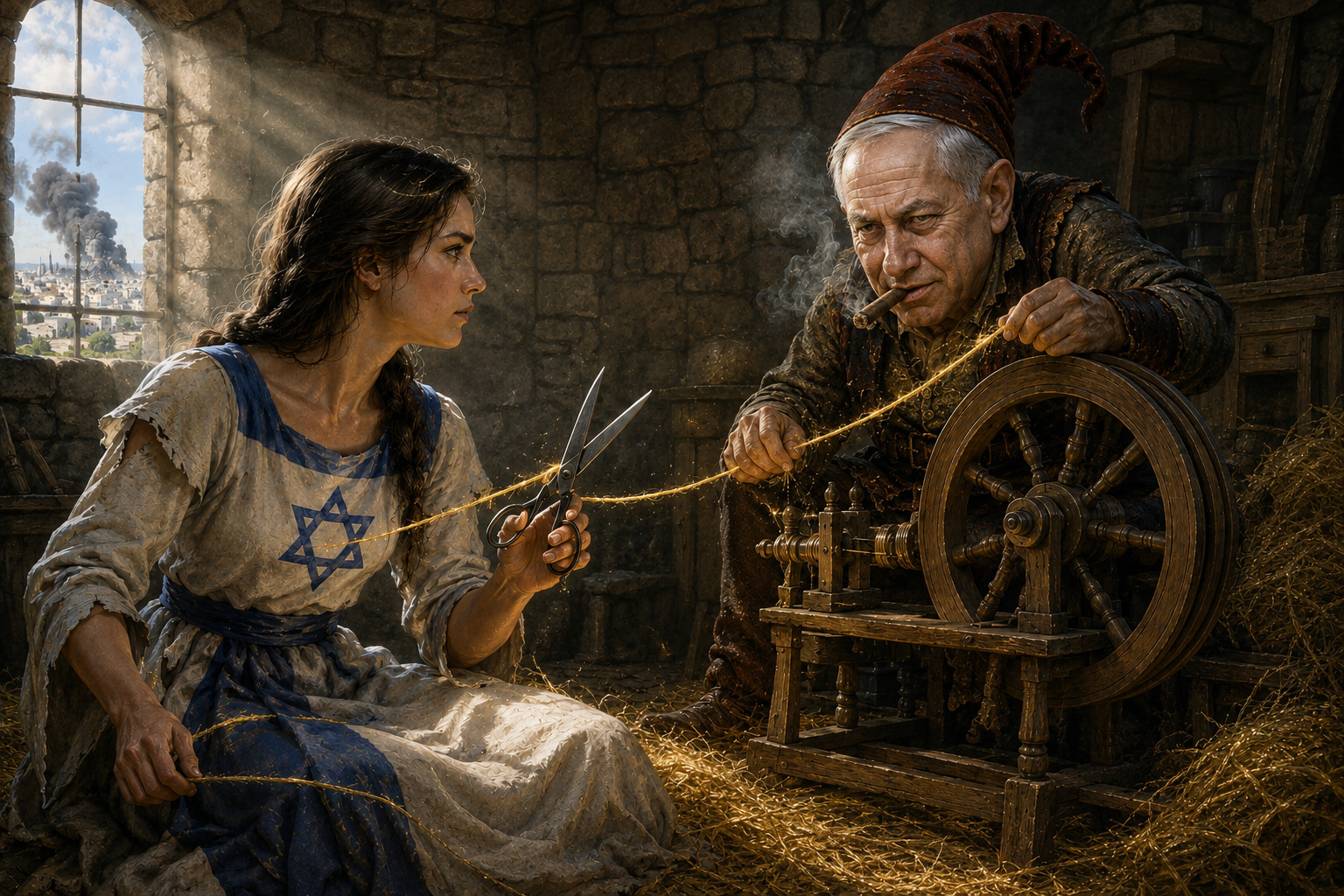
Allegory Inspired by Rumpelstiltskin
In a sunny, ancient and restless land in the Middle East lived a tiny, old-new nation called Haaretz, vibrant, quarrelsome, inventive, wounded and hopeful. She spoke in many voices at once, argued with herself in the marketplace, and dreamed loudly of being both safe and free.
One day, in a moment of fear and pressure, a boast escaped her lips. “I can spin straw into gold,” she declared though she knew no such thing. The boast reached those in power, and they demanded she deliver. Locked in a chamber filled with dry, brittle straw, Haaretz sat trembling, under the weight of impossible promises. Then, just as despair closed in, he appeared. A small man, purple-haired and sharp-eyed, with an uneven smile. His voice was smooth, authoritative and cold.
“I can help you,” he said. Haaretz hesitated. “At what cost?” “Oh,” he answered, “something small. Something you won’t miss.” Desperate, she agreed. By morning, it looked like the straw had turned into gold. Haaretz, exhausted and relieved, did not question it. And so began the bargains.
Each time Haaretz faced fear, threat, or impossible demands, he returned. Each time, his price grew. First a necklace. Then a ring. Then cigars, champagne, a billion-dollar plane. And then less tangible things, like trust, independence, freedom, democracy, separation of powers, unity. Pieces of her core identity began to disappear.
Each time, it appeared as if the straw turned into gold again, and each time, he made sure she understood who deserved the credit. “You see?” he would say. “Without me, you are nothing but straw, weak, exposed, alone. I am the one who turns it into gold.”
He always spoke of necessity. He always spoke of survival. He always made it seem as though there was no other choice. And slowly, parts of Haaretz began to believe that the straw turned into gold and that he alone made it happen.
Years passed. The room grew larger, but the windows narrower. The apparent gold piled high but was heavy with fear, corruption and decay.
Time passed, and through her wisdom and ingenuity, Haaretz grew stronger in many ways. She became more resilient and determined. Yet he continued to claim the full credit and the bargains continued. Until one night, after yet another crisis had been resolved with his “help,” he made his final claim. “The next thing you produce,” he said, “belongs to me.” Haaretz froze. “What do you mean?” He leaned closer. “Your future.”
Her future. He came for her future.
“No,” she said, clutching it tightly. “Not this. Anything but this.” Something had shifted. In her arms she held something new, fragile, full of possibility, no longer shaped by fear.
He smiled. “A deal is a deal. Without me, you have nothing.” But this time, Haaretz looked at him differently. Not as a savior. Not as a necessity. As he was. Small. Restless. Manipulative. Hungry for control.
“Who are you really?” she asked. He stiffened. “You don’t need to know,” he snapped. She could see the pattern clearly now: how he thrived on fear, how he tightened his grip whenever she doubted herself, how every solution he offered left her more dependent, how he refused to answer her questions and provided only empty words and slogans, and how he always claimed any success she achieved as his own and any failure as the result of her not consulting with him.
“You lied to me,” she said quietly. “You took credit for what was never yours alone. You only had power because I believed I needed you,” she said. “Because I was afraid to stand without your promises. You told me I couldn’t survive without you. But I did. You told me I needed you to be strong. But I became strong despite you,” she said. “Without you, I will finally learn who I am.”
She now understood he had built his entire hold on her by concealing who he really was, hiding behind clever manipulations, endless bargains, and a constant rewriting of truth, always ensuring he remained indispensable.
Haaretz pieced together whispers, contradictions, fragments of truth hidden beneath layers of performance.
And with that, the hold was broken. The spell cracked.
Not cleanly. Not easily. The belief in his power to turn straw into gold will not vanish, nor will the scars. The habits of fear and dependence will not disappear overnight. But something fundamental had changed.
Haaretz would no longer mistake control for protection. She would no longer confuse manipulation with strength. She would no longer hand over her future or her Jewish, liberal, democratic identity in exchange for short-term relief. And though the small man may not disappear entirely, as figures like him rarely do, he will be diminished, which, in the end, is where Haaretz’ real freedom will begin.