It’s Time To Tell Their Stories
Featured Post
I thought I knew my father’s story; then some untranslated letters came to light
He was the only Jew to survive the entire war at the Sachsenhausen concentration camp, but he shouldn't have been there at all
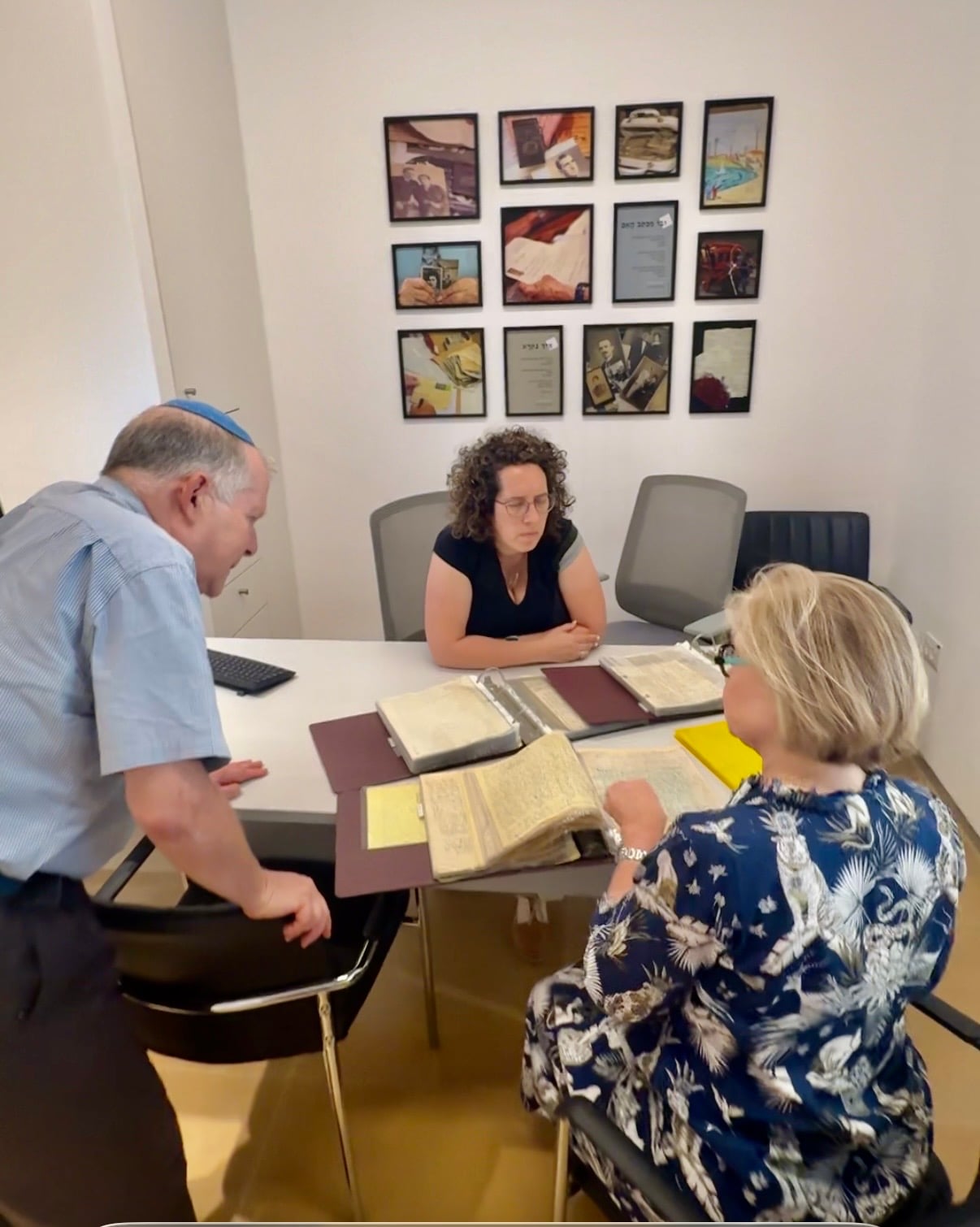
Nina Kampler and Mark Kampler deliver Kampler Holocaust-era letters to Yad Vashem, June 17, 2026. (courtesy)
I have told my father’s story so many times, it has become my own.
He was stateless in Nazi Germany because his parents, though he was born in Frankfurt, had been born in Poland. In September 1939 he and his father were arrested and sent to Sachsenhausen. By June 1942, he weighed 85 pounds, and he intentionally laid his leg across a train track so a lorry would break the bone — chasing the impossible odds that a workplace injury would earn him a bed in the camp’s showcase Red Cross infirmary instead of a bullet. He was, ultimately, the only Jew to survive that camp for the entire war. He sailed to America in 1947. He built a beautiful life. He raised a family. He died more than 20 years ago, and I thought I knew this story completely. But last month, I unearthed a brand-new chapter.
* * *
The letters are on old thin paper, the handwriting dense and cramped edge to edge, sentences turning sideways up the margins whenever they needed to squeeze in a few more words. There are over 400 of them, written between 1938 and 1942 — from my father in Frankfurt; from his parents; from his sisters, first in Frankfurt and then after they escaped to Manchester; from his brother Josef, hiding in Belgium and then France before he was deported to Auschwitz and, astonishingly, survived; and from the family of Fred’s wife, another Frankfurt Jewish family swept into the same preserved correspondence. All of them addressed to one brother, Fred, who had already made it out to New York.
After Fred died in 1986, his only child — a cousin I did not know well — found the box among his belongings, all of it immaculately preserved. She had every letter translated in 1993 and shared copies with cousins around the world.
I remember reading them for the first time on the earth-toned couch in our family room, its walls painted yellow, staying up the entire night while my three young children slept — my fourth not yet born. I was entirely overwhelmed by my father’s palpable, aching despair, jumping at me from every page. I had no idea that he had struggled so hard to get out. It was agonizing. I remember crying over the desperation transmitted to me on xeroxed pages, in the approximated English the 1993 translator had given his original German. Then the original letters disappeared for decades, misplaced somewhere between moves and cleanouts. My cousin found them again only recently, and we knew it was time to pass them forward, where they would be preserved for posterity.
Last month, I stood with my husband at our kitchen table in Jerusalem, carefully packing up the letters — carried with us on the previous day’s El Al flight from Newark — to bring to Yad Vashem, when I picked up six dense pages dated August 24, 1939, and a second letter dated September 6th, and realized I didn’t recognize them. Not the handwriting — that was unmistakably my father’s — but the content. The dates didn’t match anything I knew.
Somehow, in 1993, my father’s final two letters — written just days before his own arrest that September — had slipped through, untranslated. I photographed the pages on my phone and ran them through an AI translator, and understood, almost instantly, that my father had come far closer to escaping than I had ever known.
My father had written to his brother in New York that his departure for England was now firmly scheduled. His domestic permit was in order. His tax clearance was stamped. His ship passage was paid for. He was to leave Frankfurt on Sunday morning, September 3rd.
“Sowie ich auf englischem Boden bin, werde ich Euch sofort ein Kabel senden.” As soon as I am on English soil, I will send you a cable, so you don’t have to worry. From then on, he wrote, his letters would be “made in England” — he would finally be able to write without a censor looking over his shoulder.
“Ihr könnt Euch nicht vorstellen, was für ein Gemisch von Gefühlen mich erfüllt.” You cannot imagine the mix of feelings that fills me, he wrote — relief at finally escaping the trap, and heartbreak at leaving his parents behind, who were helping him pack his crates and pretending they weren’t afraid.
Tomorrow, my father wrote, was Friday. It would likely be his last Shabbat in Germany. The customs inspectors were coming the next day to search his crate and seal it shut. “Es ist eine erniedrigende Prozedur,” he wrote — a humiliating procedure. They would go through every pocket, every drawer, to make sure he wasn’t smuggling out a silver spoon or a few Reichsmarks. You are stripped of everything, he wrote, before you are allowed to walk away.
I read that line about the cable standing in my kitchen and thought: What cable? There was no cable. He did not get out to England. In the version of the story that I have understood my entire life, my father never secured a passage out.
September 3, 1939, is the morning Britain declared war on Germany. It is the morning the shipping lanes closed and the borders froze and every document my father had spent a year assembling — the permit, the tax stamp, the paid passage — turned to dust in his hands, overnight. He didn’t know that yet when he wrote those words.
He never once mentioned any of this to us. Not the ticket, not the date, not how close he came to walking out of Germany. Maybe he forgot. Or maybe six dark, unrelenting camp years simply eclipsed 11 days in August when a door stood halfway open before it slammed shut in his face. Does it matter which? The letters had been sitting in a box for over 80years, waiting to tell me something my father never did.
* * *
The cable he promised to send must be contextualized by knowing what transpired the previous year. My father had examined every potential escape route, considered any country that might possibly accept him. Cuba. Argentina. Australia. Canada. Palestine. Italy. Shanghai, for one desperate stretch, when a visa there did not require a waiting list. And Poland, briefly, before Poland itself became the trap. And always, underneath all of it, America — the one destination that could never move fast enough, because the American quota queue was measured in years, not weeks, and by 1939, they had completely run out of time.
He bought a typewriter just to keep up with it all, writing to his brother that he was “baptizing” the machine with that day’s letter, because he had taken over all of the family’s foreign correspondence and needed to move faster than his own hand could write. In another letter, exasperated by how little Fred in America seemed to grasp the urgency, he asked him, almost naively: Can’t you go to the White House? Wouldn’t Roosevelt welcome you?
There’s a scrap of paper from November 11, 1938, the day after Kristallnacht, with none of the careful formality of his other letters — just his handwriting, fast and broken: “Schon 2 Tage nichts gegessen u. geschlafen.” For two days, we have eaten nothing and have not slept.
There’s a letter from March 1939 where he asks his brother to find $200 from any relative who has it — the deposit needed for that Shanghai visa. There’s a line in that same letter that he would write again almost word for word in April, as if it were the only sentence that could hold what he was feeling: “Wie kann man ruhig warten, wenn einem der Boden unter den Füßen brennt?” How can one wait calmly when the ground is burning under one’s feet?
By May, his sister Rosa had gotten out to England through a domestic-service visa. By June, his sister Ida followed, and Bertha not long after — all three landing in Manchester, in placements my father spent months chasing from Frankfurt: letter after letter to committees and contacts in London, pushing each application forward until each sister was safely on a boat. His brother Josef crossed illegally into Belgium on foot in the middle of the night, and the family didn’t hear whether he had survived the crossing for two agonizing weeks. In August, my father himself was released after nine weeks of being held by the Gestapo in a Frankfurt jail, accused of bribing customs officials — a fascinating chapter, the full scope of which only came together a few years ago through German judicial records my brother discovered. But that is not today’s story.
Fifteen days after his release, on August 24th, it finally seemed to be his turn: the permit, the ticket, the crate, the promise of a cable — just 11 days before Germany was sealed off by war.
* * *
The cable never came. Instead, on September 6th, three days after the borders shut, my father sat down to write again — and this time there is no more planning, no more strategy, none of the careful hope of the letter before it.
“My departure, which was firmly scheduled for Sunday morning, September 3rd, is completely ruined. On that exact day, England declared war. The borders are shut tight, train lines to the west are cut, and the British Consulate here closed its doors overnight. My permit, my ship ticket, my sealed moving crates — everything is now useless.”
“Die Falle ist im letzten Moment zugeschnappt.” The trap has snapped shut, right at the last moment.
It is almost the same image he’d been using all year — the ground burning under our feet — except now there is nothing left to escape toward.
Their apartment on Ullestrasse, already crowded, had been turned into what the Nazis called a Judenhaus — a forced collective house — 14 people now sleeping on mattresses lined across the floor. My father wrote that they were completely cut off from his sisters in England; no mail could cross a wartime border anymore. His brother in America was, suddenly, their only link to the outside world at all.
And in this same letter, in the same breath: they were sharing what little food they had left, holding onto each other, sending blessings and a thousand kisses to a brother across an ocean, and begging not to be forgotten. Where does a person find the strength to write something so tender, while sitting in a room with 14 people, cut off from the entire world?
And then, the last line he wrote before the record itself goes quiet, swallowed by the war:
“Wir müssen uns einfach unserem Schicksal fügen.” We simply have to submit to our fate.
Eleven days earlier, he had a ticket, a permit, a date. Now he had 14 people on a floor and one sentence that admits, for the only time in 400 letters, that there was nothing left to try.
What happened next is the story I already knew. Sachsenhausen. The broken leg. Six years of starvation. The world at war, while the Jews were being slaughtered.
* * *
Last month, my brother — who moved to Israel when he was 17 — met me at Yad Vashem, and together, on behalf of the entire Kampler family — our sister, our father and his siblings, our cousins, and the grandparents we never knew whom we are named for — we delivered over 400 letters there to be preserved for eternity. Everything my father, his siblings, and his parents had written, saved by an uncle, found by a cousin, lost again, and finally brought home to Jerusalem for safekeeping in the Jewish homeland.
Getting there took me about 11 hours. I packed the letters, boarded a flight, flew 35,000 feet in the air, and crossed a dozen borders without a single thought about any of them — no permit, no consulate, no waiting list, no committee to plead my case. My father spent 1938 and most of 1939 trying to leave Germany. Today, I can go just about anywhere, whenever I choose.
We thought we were delivering the story that the letters told. In the weeks before that trip, I had posted pieces of it online — the visas, the arrest, the six years — the same version I’d been telling my whole life. I didn’t know, while I was writing it, that I still didn’t see the whole arc.
And as I was finishing my coffee before we headed to Yad Vashem, my father told me something new — a revised version. That he thought he was 11 days from freedom. That he packed a crate and sat through what he believed might be his last Shabbat at home, on Ullestrasse, with his parents. A story he had never once told his own children.
Ten days after his family was nearly deported to Poland and turned back at the border, in 1938, the fire he had been describing as a feeling became literal. Synagogues burned across Germany on Kristallnacht, and his own family’s world was reduced, within hours, to that scrap of paper that said they had eaten nothing for two days.
* * *
Today is Tisha B’Av, the day on the Jewish calendar when we mourn the Temples that once stood in Jerusalem — both of them burned, both of them destroyed, more than six centuries apart, tradition holds, on this same date. Tisha B’Av does not ask us to relive one fire. It asks us to hold all of them at once: the Temples, the pogroms, every door that slammed shut in 1939, and the box of letters that was almost lost, twice, before it finally came home.
Jews do not forget our story. We are a people of memory, a people of the book. We write it down. We keep the box. We get on a plane and carry documents to the destination our parents couldn’t access in 1939, when no one in the world would let the Jews in.
Throughout the six years my father was struggling to survive Sachsenhausen, he never stopped believing that Hitler would be defeated and that a Jewish state would be established. He did not live to see his letters delivered there. But my father’s words finished their journey this summer. They now rest in Jerusalem, evidencing the horrors of the Holocaust. And Israel — the safe haven he believed in before it existed, the one that did not exist when he needed it most — is where they will be forever alive.
Related Topics