London based entrepreneur, cybersecurity analyst doing a PhD in AI
The calf that changes shape.
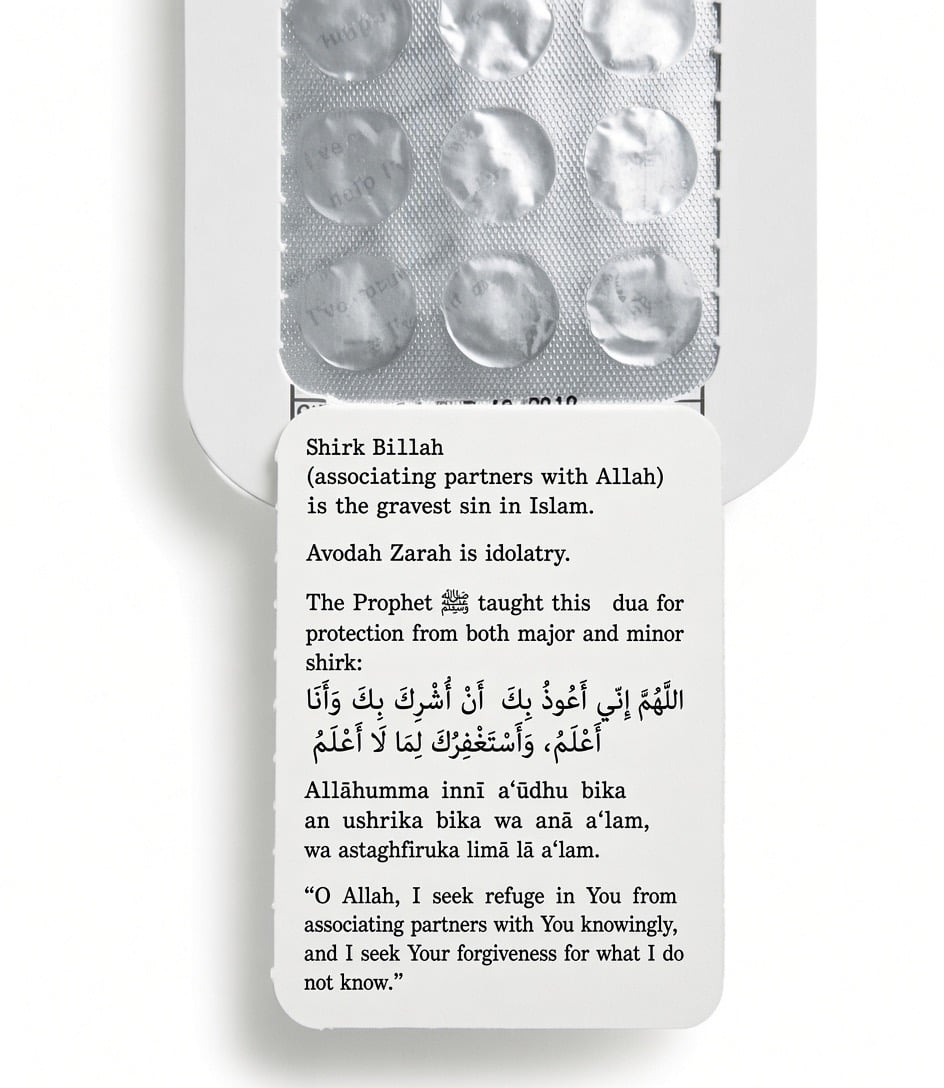
Image for illustrative purposes only. The medicine is seen as a parable for spiritual diseases and dua for spiritual cure to relate it to our everyday lives. Recite attentively. Follow the Sunnah for full guidance.
עבודה זרה | الشرك بالله
Avodah Zarah | Shirk Billāh
Understanding idolatry in the past and today – and how it enters the heart. Focusing on purifying oneself rather than casting stones on others.
Before the calf was cast in gold,
Before an idol bore a name,
The Lord was One, as prophets told,
Eternal, perfect, and sublime.
At Sinai came the ancient call:
No other god should be adored;
They made a calf, then watched it fall,
For nothing made can be the Lord.
So why must stone receive your plea,
Or buried bones be asked to hear?
The One who made both you and me
Is living, listening, ever near.
A righteous servant lived and died,
And now his body fills a grave;
He needed Allah at his side—
How then can buried servants guide?
The Prophet ﷺ warned before he died:
Do not repeat what came before;
Some made their prophets’ graves a site
Where worship entered heart through the door.
The Qur’an warned of those who made
Their rabbis and their monks as lords;
When God’s command was set aside,
For merely humans changing words.
If revelation clearly speaks,
No Shaykh can make its meaning naught;
No human title ever reaches
The rank of Him whose Word he taught.
God sent His Torah as a guide,
Then sent Messiah with His sign;
Then came the Qur’an to decide,
The final message by design.
So love the Prophet ﷺ more than gold,
And follow faithfully his way;
But he himself repeatedly told
His Ummah whom alone to pray.
Muhammad Mudatthir Muzammil Ahmed ﷺ ,
And we send peace and blessings upon his name;
But Allah alone is the One who saves,
And the one who eternally remains.
Your nation may become your calf,
When flags determine wrong and right;
You laugh at idols from the past,
Then let a border blind your sight.
Your money may become your god,
When wealth decides the path you choose;
You bow without a prayer mat down,
Whenever you choose to make truth lose.
Your phone may be your golden calf,
Its little screen your daily shrine;
You wake to see what strangers think,
Before remembering the Divine.
A million followers may cheer,
A million strangers know your name;
Yet not one follower will appear
To carry one sin from your name.
The algorithm learns what makes you stay,
Then feeds desire again and more;
But every hour it takes away
Is time you cannot buy once more.
Do not let strangers rule your worth,
Or likes determine who you are;
The One who placed you on this earth
Already knows your inner fears.
The crowd may call the falsehood true,
The trend may call the darkness light;
But truth does not depend on views,
And numbers cannot alter right.
No Rabbi bears another’s soul,
No Imam carries yours that Day;
No saint can make your record whole,
No Shaykh can make the Horn delay.
No saint.
No grave.
No Imam.
No Rabbi.
No nation.
Money.
Crowd.
Or phone.
Follow the final Messenger ﷺ—
And worship Allah,
God alone.
Footnote:- Meaning of the Poem, The Names of Allah, Tawḥīd, and the Final Messenger
The Hadith Qudsī Concerning Shirk
Allah says in the Hadith Qudsī:
“I am the One Who is most free from needing a partner. Whoever does a deed in which he associates someone else with Me, I abandon him and his association.”
This is the principle behind the poem: honouring a servant of God must never become worship of that servant; respecting a scholar must never make the scholar an authority above revelation; loving the Prophet ﷺ must never turn the Messenger into the object of worship.
The Only Sin not forgiven is Shirk
Indeed, Allah does not forgive associating others with Him ˹in worship˺, but forgives anything else of whoever He wills. And whoever associates others with Allah has indeed committed a grave sin.
I came to the Apostle (may peace be upon him ) and he was asleep with a white mantle over him. I again came, he was still asleep, I came again and he had awakened. I sat by his side and (the Holy Prophet) observed: There is none among the bondsmen who affirmed his faith in La illaha ill-Allah there is no God but Allah) and died in this state and did not enter Paradise. I (Abu Dharr) said: Even if he committed adultery and theft? He (the Holy Prophet) replied: (Yes) even though he committed adultery and theft. I (again said): Even if he committed adultery and theft? He replied: (Yes) even though he committed adultery and theft. (Th Holy Prophet repeated it three times) and said for the fourth time: In defiance of Abu Dharr. Abu Dharr then went out and he repeated (these words): In defiance of Abu Dharr.
The above Hadith is not a “license” to be immoral, but fits within the overall nature of a human being as per the below Hadith :-
“All the sons of Adam are sinners, but the best of sinners are those who repent often.”
Related by At·Tirmidhi and Ibn Majah with a strong chain of narrators.
A Supplication for Protection from Shirk
The Prophet ﷺ taught:
اللَّهُمَّ إِنِّي أَعُوذُ بِكَ أَنْ أُشْرِكَ بِكَ وَأَنَا أَعْلَمُ، وَأَسْتَغْفِرُكَ لِمَا لَا أَعْلَمُ
Allāhumma innī aʿūdhu bika an ushrika bika wa anā aʿlam, wa astaghfiruka limā lā aʿlam.
“O Allah, I seek refuge in You from knowingly associating anything with You, and I seek Your forgiveness for what I do not know.”
This supplication is especially fitting because shirk may be subtle, hidden within intention, habit, attachment, reputation or desire. The believer therefore asks Allah not only to protect him from what he recognises, but also to forgive what he does not recognise.
The Central Principle
The poem’s repeated distinction is therefore deliberate:
The servant may be honoured.
The scholar may be respected.
The Prophet ﷺ must be loved and followed.
The righteous may be remembered.
The dead may be prayed for.
But worship belongs to Allah alone.
“You alone we worship, and You alone we ask for help.”
Understanding the names of Allah and applying them to our life to call on him
The Prophet ﷺ said:
“Allah has ninety-nine Names, one hundred minus one, and whoever memories them will enter Paradise.”
Ṣaḥīḥ al-Bukhārī 2736; Ṣaḥīḥ al-Bukhārī 7392; Ṣaḥīḥ Muslim 2677.
The wording aḥṣāhā is understood in the tradition as more than merely reciting a list: to preserve, learn, comprehend and live by them. The authentic hadith establishes the number ninety-nine; the commonly circulated detailed enumeration should therefore be distinguished from the wording of the two Ṣaḥīḥ collections themselves.
Allah has the Most Beautiful Names. So call upon Him by them, and keep away from those who abuse His Names. They will be punished for what they used to do.
Allah Is Near
The Qur’an declares:
“And We have already created man and know what his soul whispers to him, and We are closer to him than his jugular vein.”
The verse establishes Allah’s perfect knowledge and awareness of the human being. It is not a licence to seek divine attributes in graves or created beings. Allah knows the whispered thought before it becomes speech, knows the hidden intention before it becomes action, and nothing is concealed from Him.
The Warning Concerning Graves
The Messenger of Allah ﷺ gave a direct warning shortly before his death:
“Beware of those who preceded you and used to take the graves of their prophets and righteous men as places of worship. You must not take graves as mosques; I forbid you to do that.”
He also warned:
“The Jews and the Christians took the graves of their apostles as places of worship.”
Ṣaḥīḥ Muslim 531; Ṣaḥīḥ Muslim 530a.
The warning concerns turning graves into places of worship. Visiting a grave, remembering death, and making duʿāʾ for the deceased are distinct matters. The worship and supplication directed to Allah belong to Allah alone.
The Rabbis, Monks and Religious Teachers
The Qur’an says:
“They have taken their rabbis and monks as lords besides Allah, and also the Messiah, son of Mary.”
The verse does not mean that every act of respecting a scholar constitutes worship. Rather, the accompanying explanation of ʿAdī ibn Ḥātim رضي الله عنه illustrates the danger of treating human religious authorities as possessing the authority to redefine what Allah has made lawful and unlawful. (Sunan At Tirmidhi 3095).
A scholar may explain revelation.
A Rabbi may teach Torah.
An Imam may teach Qur’an and Sunnah.
A Shaykh may advise.
A preacher may remind.
But none becomes the source of revelation, and no created person possesses the sovereignty that belongs to Allah.
The Finality of the last Messenger
The Qur’an declares:
“Muhammad is the Messenger of Allah and the seal of the prophets.”
The Prophet ﷺ also said:
“By Him in Whose Hand is the life of Muhammad, no one of the Jews or Christians who hears of me and then dies without believing in what I was sent with will be among the inhabitants of the Fire.”
The Qur’an simultaneously makes clear that the People of the Book are not all alike, and praises those among them who are righteous and sincere. Qur’an 3:113–115, 3:199.
Thus the Islamic claim is not that earlier revelation was false. Rather, Islam teaches that Allah sent the Torah and the Gospel as revelation, and that the Qur’an came as the confirming and authoritative criterion over previous Scripture.
Turning of the Hearts
The Prophet (ﷺ) said, “The example of the one who celebrates the Praises of his Lord (Allah) in comparison to the one who does not celebrate the Praises of his Lord, is that of a living creature compared to a dead one.” (Sahih Al Bukhari 6407).
“The Messenger of Allah (s.a.w) would often say: Ya Muqallibal-qulub, thabbit qalbi ‘ala dinik(‘O Changer of the Hearts! Strengthen my heart upon Your Religion.)’ So I said: ‘O Prophet of Allah! We believe in you and what you have come with, but do you fear for us?’ He said: ‘Yes. Indeed the hearts are between two Fingers of Allah’s Fingers, He changes them as He wills.'” (Tirmidhi 2140).
Warning Against “Innovation” in Religion
Jabir ibn ‘Abdillah reported: The Messenger of Allah, peace and blessings be upon him, would praise Allah in his sermon, as He deserves to be praised, and then say, “Whomever Allah guides, no one can lead him astray. Whomever Allah sends astray, no one can guide him. The truest word is the Book of Allah, and the best guidance is the guidance of Muhammad. The most evil matters in religion are those that are newly invented, for every newly invented matter is an innovation, every innovation is misguidance, and every misguidance is in the Hellfire.”
Source: Sunan al-Nasā’ī 1578
Grade: Sahih (authentic) according to Al-Albani
Following the mistakes of the previous nations
You would tread the same path as was trodden by those before you inch by inch and step by step so much so that if they had entered into the hole of the lizard, you would follow them in this also. We said: Allah’s Messenger, do you mean Jews and Christians (by your words)” those before you”? He said: Who else (than those two religious groups)?
“The Jews split into seventy-one sects, one of which will be in Paradise and seventy in Hell. The Christians split into seventy-two sects, seventy-one of which will be in Hell and one in Paradise. I swear by the One Whose Hand is the soul of Muhammad, my nation will split into seventy-three sects, one of which will be in Paradise and seventy-two in Hell.” It was said: “O Messenger of Allah, who are they?” He said: “The main body.”
And we ask Allah for help and protection from Shirk, misguidance, envy, rancour, strife and unnecessary bloodshed. The one writing this is as much in need of guidance as the one reading it. Treat it as sincere advice, no more, no less. Any good in them is from Allah, any mistakes are my own.
I seek reward for writing these from my Lord on the day that cannot be averted, and to him is the final return. I bear witness that there is no God except Allah, and Muhammad saws is his final prophet, the seal of messengers, and only his way is to be followed till the day of judgement.
Why a poem?
In an already politically charged climate, where everything can “fuel the fire”, a poem represents a departure from the modern news cycle, twitter posts, Instagram and TikTok videos and other social media feeds and emails.
It’s a way to help the reader absorb the message in a pleasant mood without any mental “friction” that long form essays can sometimes bring with them.
The poems are simply as much, there is no “hidden meaning” in them, or anything “deeper” or “mysterious”. Don’t try to read too much into it, just look at the message I am trying to convey.
They are written in poetic form thinking (and taking care) for the reader.
Related Topics
Related Posts