
Peacemaker, Motivational Speaker
The Case for Condemnations: Can the Son of Hamas Awaken Our Conscience?
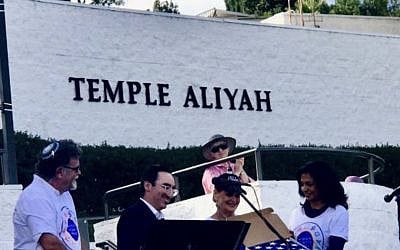
Photo: Taken by Soraya at the interfaith solidarity march-
Los Angeles .
Muslim leaders were quick to condemn Mosab Hassan Yousef for his words spoken at the Jewish American Summit in Los Angeles . Now I want to ask: When will we become equally serious about standing with the Jews of Los Angeles?
Let me begin with something that should not be controversial:
Mosab Hassan Yousef’s call for Muslims to leave America was wrong.
Muslim Americans are Americans. We belong here. We have built businesses, raised families, served in the military, practiced medicine, taught in universities and contributed to every part of American life. No one should be telling an entire religious community to leave its own country.
Muslim organizations were right to condemn those remarks.
But condemnation cannot be where the conversation ends.
Because while we were issuing statements, Jews in Los Angeles were asking a much more immediate question: Are we safe?
That question deserves our attention.
What about the Jews of Los Angeles?
Since October 7, Jewish families in Los Angeles have lived with a level of fear that many Muslims simply do not understand.
Synagogues require security.
Parents worry about their children.
Jewish students have told me how difficult it has become to openly identify as supporters of Israel on college campuses. Some feel they must explain, qualify or defend their Jewish identity before they are accepted into a conversation.
Some Jewish Americans no longer feel comfortable wearing a Star of David.
Some have been told, explicitly or implicitly, that they are acceptable only if they distance themselves from Zionism.
This is not an abstract accusation. When a group of us Muslims organized an event in Los Angeles to bring Jews and Muslims together, the Islamic Shura Council of Southern California and CAIR condemned our gathering and attacked us by calling us “Zionists.” That experience affirms what Jewish students have been saying: when Jews and their allies refuse to accept the demonization of Israel or insist on Jewish safety and dignity, they can be labeled, excluded, and silenced. This is precisely the climate we must confront—not by silencing Muslim voices, but by refusing to excuse antisemitism when it comes from within our own communities.
So why do we tolerate it when Jews are subjected to it?
A Jewish American should not have to pass a political test to be welcomed by an American Muslim.
And supporting Israel’s existence does not make a Jewish American an extremist.
For many Jews, Zionism is inseparable from the historical experience of a people that learned, repeatedly and painfully, what happens when Jews have nowhere to go.
Muslim leaders need to understand this—not as a political concession, but as an act of human empathy.
And this is where Mosab’s story forces us to look in the mirror.
Mosab Hassan Yousef is not simply another political commentator.
He grew up inside Hamas. He witnessed and experienced its brutality. His father was a senior Hamas leader. He ultimately broke with the organization and cooperated with Israel.
His personal experiences have clearly shaped his profound rejection of Hamas and his hostility toward Islam.
His conclusion—that Muslims should leave America—is wrong.
But we should not use the offensiveness of his conclusion to avoid examining the questions that produced it.
Hamas did not hide the religious language it used.
On October 7, Hamas terrorists invoked “Allahu Akbar” as they carried out the massacre.
Hamas’s founding charter contains explicitly Islamic language and frames its struggle in religious terms.
That does not mean Hamas represents Islam.
It does mean Muslim leaders have a responsibility to explain—clearly and publicly—why Hamas’s ideology is a distortion and why the murder of Jews cannot be justified through Islam.
We cannot simply say, “Hamas doesn’t represent us,” and move on.
We must deconstruct the religious arguments extremists use to recruit, radicalize and justify violence.
There are hundreds of thousands, perhaps millions, of Americans who are asking difficult questions about Islam because they have watched violence repeatedly carried out in its name.
Muslim leaders cannot respond to every uncomfortable question by calling the questioner an Islamophobe.
Sometimes the answer must be education.
Sometimes it must be theological courage.
And sometimes it must be the humility to say: Yes, there are serious problems within our theologies and our communities that we must confront.
That is not Muslim fragility.
That is Muslim responsibility.
We cannot ask Jews to understand our pain while refusing to understand theirs.
This is where our interfaith work has sometimes failed.
We have become very good at dialogue.
We organize panels, issue joint statements, take photographs…
We say the right words.
But real solidarity is measured when standing beside the other community becomes uncomfortable.
Muslim organizations should not simply condemn antisemitism when it is convenient.
They should actively build partnerships with Jewish organizations.
Yes—even organizations with which they disagree.
Yes—even organizations such as the ADL.
You do not have to agree with an organization on every political issue to recognize its work on Jewish safety and antisemitism.
Jewish organizations have spent decades teaching Jewish history, educating K–12 students, documenting antisemitism, protecting synagogues and advocating for Jewish safety.
Where is the equivalent urgency from Muslim institutions to educate our children about Jewish history and Jewish vulnerability?
Where are the Muslim programs teaching our children about the Holocaust?
Where are the lessons explaining why October 7 reopened historic Jewish fears?
Where are the sustained Muslim-Jewish partnerships that continue after the cameras disappear?
We cannot demand that Jews learn about our history while refusing to learn theirs.
Ahmed Fouad Alkhatib is asking Muslims to confront another uncomfortable reality.
Gazan activist Ahmed Fouad Alkhatib, who has spoken publicly about losing members of his family, has challenged anti-Zionism as a political framework that offers Palestinians no realistic path forward.
His argument is important precisely because it comes from someone who knows the Palestinian experience intimately.
Israel is not going anywhere.
He asserts, there is no realistic future in which Jews are “de-Zionized” or Israel simply disappears.
If Muslims genuinely care about Palestinian dignity, then we need strategies that actually improve Palestinian lives—not ideologies that guarantee another generation of war.
That means being able to say two things at the same time:
Palestinians deserve dignity, freedom and a future.
Jews deserve security, self-determination and a future.
These are not contradictory propositions.
And Hamas does not get to decide the future of either people.
Muslim America must step up.
This is my challenge to Muslim organizations across Los Angeles and America:
Stop treating Jewish safety as somebody else’s issue.
Stop making solidarity conditional.
Stop reducing Jewish organizations to political caricatures.
Stop saying “we condemn antisemitism” while remaining distant from the Jewish community.
Show up.
Visit a synagogue.
Build a relationship with a Jewish organization.
Invite Jewish educators into Muslim schools and community centers.
Teach our children Jewish history.
Talk honestly about the Holocaust.
Talk honestly about October 7.
Talk honestly about Hamas.
Talk honestly about the religious language extremists have used.
And when a Jewish community is threatened, don’t wait for someone to ask you to come.
Go.
That is what we ask from Jews when Muslims are targeted.
We should expect the same from ourselves.
This is bigger than Jews and Muslims.
Los Angeles cannot become a city where communities retreat behind increasingly higher walls.
We have an opportunity to choose something different.

Photo – Taken by Soraya
An Invitation ……
On October 15, fifty women will gather in Beverly Hills to launch the LA Women’s Multi-Faith Leadership Alliance.
We are coming together because we refuse to accept a future defined by suspicion, stereotyping and permanent conflict.
We want Muslim women, Jewish women, Christian women and women of every background to build something together.
We especially invite women who have spent decades working tirelessly to build Muslim-Jewish relationships, particularly—leaders such as Aziza Hasan and Andrea Hodos of NewGround, who in their condemnation of Mosab wrote – “Join us in this work. Stop choosing animosity. Choose instead to interrupt it. The safety of our children and grandchildren depends on whether we continue to build higher walls, or commit to building resilient bridges.”
Come.
Bring your disagreements.
Bring your questions.
Bring your pain.
But bring your willingness to build.
Because this is the moment when we need less performance and more courage.
Less lip service. More solidarity.
Muslim leaders were right to condemn Mosab Hassan Yousef.
Now let us ask something harder of ourselves.
Will we stand with the Jews of Los Angeles when they need us?
Not because we agree on everything.
Not because we have resolved the Israeli-Palestinian conflict.
Not because someone has earned our political approval.
But because Jewish safety is our responsibility, too.
And if we truly want our Muslim neighbors protected from hatred, we must be willing to protect our Jewish neighbors from it as well.
We are in this together.
The future belongs neither to those who demand conformity nor to those who cultivate division.
It belongs to those courageous enough to interrupt hatred—and build something better in its place.
Related Topics
Related Posts