
The Centrifuges Are in Pickaxe Mountain for a Reason
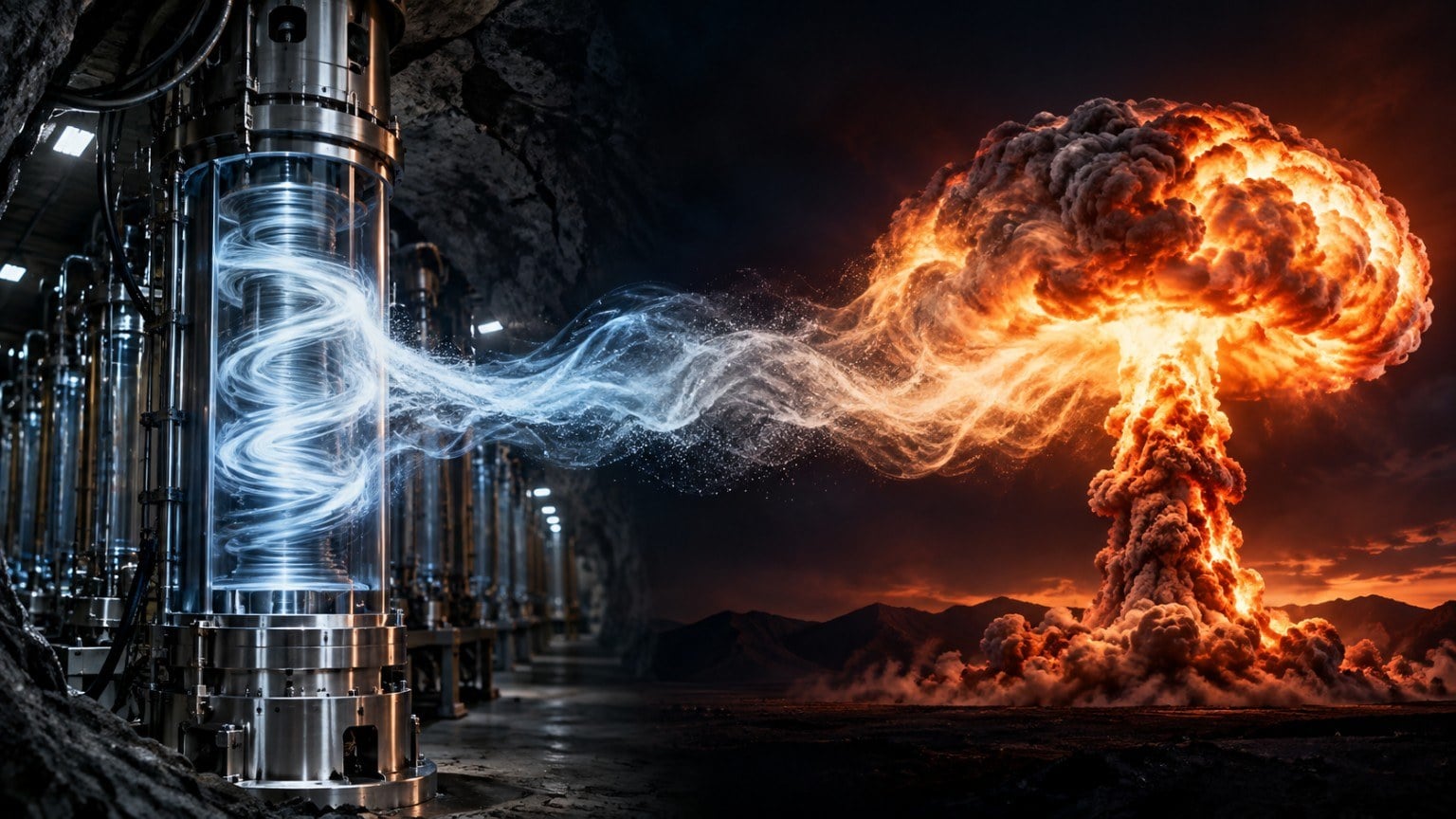
On September 22, speaking to Arab and Muslim leaders on the sidelines of the United Nations General Assembly, Donald Trump returned to a nuclear site that has increasingly occupied American and Israeli attention. “We may have to blow up another one, Pickaxe Mountain,” he said. “We’re not seeing a lot of activity there, but if we do, we’ll blow it up immediately.”
Trump has a reason to be watching the mountain.
In July, The Wall Street Journal reported that Israeli intelligence had concluded that Iran moved thousands of uranium-enrichment centrifuges into Pickaxe Mountain in the fall of 2025, after the twelve-day war. According to US and Israeli officials cited in the report, Israel shared that intelligence with Washington.
Neither Israel nor the United States has published the evidence behind that assessment. But the International Atomic Energy Agency cannot tell us where all of Iran’s centrifuges are either. Its ability to account for them had already deteriorated years earlier. By 2024, France, Germany and the United Kingdom described the problem bluntly: “The IAEA does not know how many centrifuges Iran has and where they are located.”
The sequence of events at Pickaxe is difficult to dismiss as accidental. Iran has spent years building its most protected nuclear complex, and after the destruction of much of its nuclear infrastructure, Israeli intelligence says thousands of centrifuges were moved inside it. Pickaxe is not simply where Iran may be hiding what survived the last war. It appears to be where Iran is preparing for the next stage of its nuclear program.
The history of the mountain helps explain why.
Known in Iran as Kuh-e Kolang Gaz La, the complex lies south of Natanz. Iran began building the underground facility after an explosion seriously damaged an above-ground centrifuge assembly plant at Natanz in 2020. Tehran subsequently announced that the replacement would be built underground. The IAEA has not been allowed to inspect the completed complex.
Pickaxe goes much deeper than Iran’s previous nuclear facilities. Its tunnels were excavated more than 300 feet underground, beneath a mountain composed largely of hard rock.
That geology matters because centrifuges are extraordinarily delicate machines.
Fordow demonstrated the problem. After the American strikes in June 2025, IAEA Director General Rafael Grossi emphasized the “extreme vibration-sensitive nature of centrifuges” when assessing the damage expected underground. Days later, he said Fordow’s centrifuges were no longer operational.
Iran therefore learned something important from Fordow: putting centrifuges underground is not necessarily enough. An operating centrifuge does not have to suffer a direct impact to be damaged. Severe shock and vibration transmitted through the surrounding structure can threaten machines spinning at enormous speed.
Pickaxe may represent Iran’s attempt to solve that problem.
The geology of the mountain could help insulate equipment buried deep inside. That raises an important possibility. Pickaxe may have been designed not simply to put as much rock as possible between an attack and the centrifuges, but to reduce the effects that reach the equipment below.
If that protection is sufficient, Iran gains more than a place to hide centrifuges. It gains a place where they may be able to continue operating even while the mountain itself is under attack.
And Iran is still building.
A September analysis by the Center for Strategic and International Studies examined six years of satellite imagery and found more road activity at Pickaxe during 2026 than at any previous point in the site’s history. Tunnel approaches have been hardened, roads paved, access areas reinforced and excavated material removed. CSIS concluded that the site appears to be shifting from active excavation toward probable internal construction and continued exterior reinforcement.
The imagery cannot confirm the Israeli intelligence report that thousands of centrifuges were moved underground. But neither can it refute it. On July 14, 2026, ISIS assessed that Pickaxe did not yet appear to be operational and remained under construction. The available imagery therefore did not indicate that enrichment was taking place there at that time.
That timing is not necessarily surprising. Iran could have moved the centrifuges underground before the spaces intended to operate them were finished. The construction visible today may be part of that unfinished work.
ISIS has identified several possible purposes for the expanding complex. One is the centrifuge assembly facility originally announced in 2020. Another is an enrichment plant that could further enrich Iran’s existing stockpile. Other nuclear-related activities could eventually be moved underground as well.
Enrichment is therefore one of the possibilities that deserves particular attention.
Iran already knows the value of depth. It also knows the vulnerability of operating centrifuges. Pickaxe could combine both lessons: put the machines farther underground and surround them with enough rock to provide greater protection not only against direct damage but potentially against the shock that could disable them.
Then there is the uranium.
In March, Grossi said that slightly more than 200 kilograms of Iran’s uranium enriched to 60 percent had been stored in the underground complex at Isfahan and that the prevailing assumption was that it remained there. Before the 2025 war, however, the IAEA had estimated Iran’s total stock of 60-percent material at 440.9 kilograms. The agency has since been unable to establish the location and status of the entire inventory.
And Isfahan may not be the whole story. In July, CNN reported, citing a single Israeli source, that Israel assessed that part of Iran’s 60-percent enriched uranium stockpile had been transferred to Pickaxe after the 2025 war. That assessment has not been independently verified.
Trump acknowledged the uncertainty in July. Asked about reports that Iran had moved centrifuges into Pickaxe, he said: “They may have, we don’t have it on record.” He then emphasized the material: “We follow the material, that’s where the action is.”
But the material and the machines may no longer be separate questions.
If Israeli intelligence is correct, thousands of centrifuges are already inside Iran’s deepest nuclear complex. If the separate Israeli assessment about enriched uranium is also correct, at least some of the material may already be there with them. Meanwhile, construction continues inside the mountain.
There is no public evidence that Iran is assembling a nuclear weapon inside Pickaxe today. But unresolved safeguards questions prevent the IAEA from assuring that Iran’s nuclear program is exclusively peaceful.
The IAEA has also described Iran’s accumulation of uranium enriched to 60 percent as a matter of “serious concern” because of its proliferation implications.
The question is not only whether Iran has a nuclear weapon today. It is whether Iran still possesses the essential elements that could eventually allow it to build one.
Three elements now converge in this story: Iran’s stockpile of uranium enriched to 60 percent, the thousands of centrifuges Israeli intelligence says were moved underground, and Pickaxe Mountain itself.
The 60-percent figure is especially important. Iran has already completed a large part of the enrichment process separating natural uranium from material at concentrations associated with nuclear weapons. Moving beyond 60 percent would therefore represent a substantially shorter remaining enrichment step than the process required to reach 60 percent in the first place. That still would not, by itself, give Iran a nuclear weapon.
My conclusion is an inference.
I have written several articles analyzing Pickaxe Mountain, and the sequence is difficult to ignore. Iran built deeper after Natanz was attacked, continued developing Pickaxe after seeing what happened at Fordow, reportedly moved thousands of centrifuges underground, and is still expanding a complex whose geology offers exceptional protection.
I believe Iran intends to turn Pickaxe Mountain into the protected heart of a rebuilt nuclear program, preserving the infrastructure that could bring it closer to a nuclear weapon.
What remains uncertain is how far Iran has already gone in bringing these elements together. We do not know whether enrichment is taking place inside Pickaxe, whether any of the 60-percent uranium is already there, or when the underground complex will be ready for full operation. But the direction of travel is becoming harder to ignore.
Uranium. Centrifuges. Pickaxe Mountain.
Trump has repeatedly said that Iran cannot be allowed to obtain a nuclear weapon. But as long as Iran retains those three elements, the capability to move toward one has not disappeared.
An earlier article on this blog followed Iran’s uranium and reached Isfahan. We can no longer assume that all of the material remained there.
This time, Israel followed the machines.
The centrifuges are in Pickaxe Mountain for a reason.