The Circumcision of Jesus, Cut Off from Its Roots
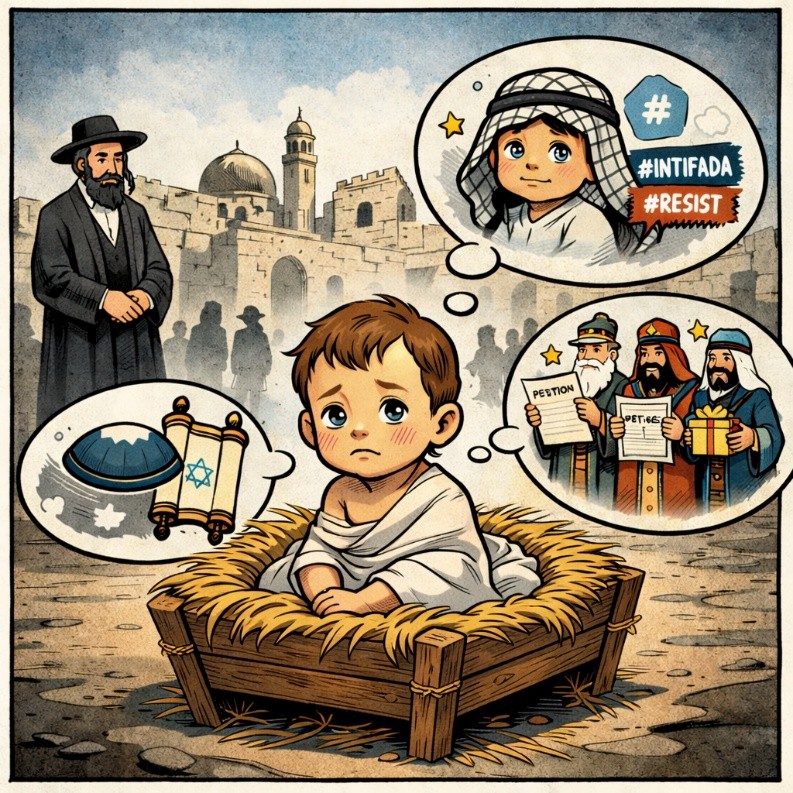
On January 1st, eight days after his birth, Jesus was circumcised—an ancient rite rooted in the Law of Israel.
But the postmodern age intervened, armed with alternative narratives.
“This was not a Jewish ritual,” we are now told. “It was a symbolic, proto-Palestinian gesture, practiced on this land since time immemorial.”
The mohel—the Jewish circumciser—was quietly rebranded a “local health practitioner,” as the sign of the Covenant and the commandment of the Torah faded from view.
The child’s blood was recast as a symbol of the suffering allegedly inflicted by Judean settlers upon the inhabitants of Judea.
Soon, a broader announcement followed: “Jesus has always been Muslim.” His Hebrew name, Yeshua, was replaced by Issa, and with the name came an entirely different destiny.
The Magi themselves were rewritten—now bearers of international resolutions and petitions—arriving not with gold, frankincense, and myrrh, but to adjust a miniature keffiyeh on the infant’s head.
Even the baby’s cries were repurposed. They became evidence of the trauma of the “Occupation,” interpreted as early acts of political resistance and protest against an occupier.
January 1st—long known in Christian calendars as the Feast of the Circumcision, in memory of the Jewish circumcision of Jesus—has thus been handed over to Palestinian reinterpretation and a fashionable Islamization.
And the infant Jesus, no longer shielded from hashtags, is left alone to weep in a Palestinian Bethlehem increasingly emptied of its Christians…