
The Cost of Radicals: How Netanyahu’s Cabinet Is Erasing the Red Lines
For decades, the strategic consensus guiding Israel’s foreign policy rested on an unshakeable premise: regardless of the political winds shifting across Western capitals, foundational support for the Jewish state remained an absolute consensus. Today, that pillar is fractured. As the United States marches toward its upcoming election debates and Europe struggles to contain deep domestic unrest, the vocabulary of mainstream political discourse has undergone a terrifying metamorphosis. Language once confined to the toxic fringes has migrated into the heart of public opinion, directly challenging the “unquestioned” nature of Western support for Israel.
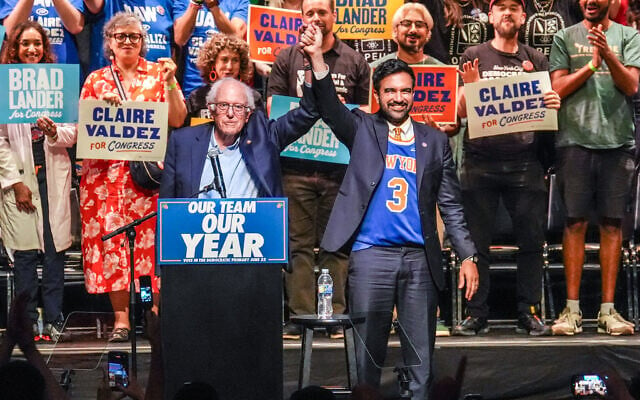
We are no longer dealing with a fringe phenomenon. In the United States, the rhetoric has reached a fever pitch. A poignant example materialized in New York’s recent primary season, where progressive figures like New York City Mayor Zohran Mamdani stood before a crowd alongside Senator Bernie Sanders and explicitly labeled the American Israel Public Affairs Committee (AIPAC) as “monsters” fueled by “dark money.” When mainstream Western politicians feel entirely comfortable deploying classic, conspiratorial tropes of hidden financial cabals to describe a mainstream American Jewish organization, the red lines have not just been crossed; they have been erased. This rhetorical escalation directly shapes the landscape of upcoming American electoral debates, where anti-Israel posturing—frequently bleeding into overt antisemitic tropes regarding dual loyalty—is treated no longer as a liability, but as a potent tool for voter mobilization.
Yet, to treat this alarming shift as an isolated American phenomenon or a simple byproduct of progressive radicalism is a profound diagnostic error. The rot is spreading rapidly across Europe, where the escalation of antisemitic discourse has assumed structural, violent proportions. The newly released Antisemitism Worldwide Report from Tel Aviv University paints a devastating picture of a normalized crisis.
In the United Kingdom, the Community Security Trust (CST) logged 3,700 antisemitic incidents across 2025—the second-highest annual total ever recorded in British history, and more than double the baseline of 2022. This surge included a horrifying milestone: the UK’s first fatal antisemitic terror attack since tracking began in 1984, which claimed the lives of two worshippers on Yom Kippur in Manchester. Furthermore, damage and desecration targeting Jewish property—synagogues, schools, and Holocaust memorials—surged by 38% to a record 217 cases.
Across the English Channel, the pathology manifests with equal venom. While France’s Ministry of the Interior and the SPCJ reported a moderate decline in overall baseline harassment to 1,320 recorded acts, the numbers hide a darker shift: actual physical assaults against French Jews rose significantly, from 106 to 126. Stunningly, while Jews make up less than 1% of the French population, they bore the brunt of 53% of all anti-religious hate crimes in the country. From London to Paris, classic Judeophobic tropes are resurfacing with structural permanence. Synagogues require paramilitary security, and Diaspora Jews are forced into a state of perpetual psychological siege, carrying the burden of a conflict they did not launch.
The painful, self-evident truth that Israel’s current political leadership refuses to acknowledge is that this global mainstreaming of antisemitism is being fueled, in catastrophic measure, by Benjamin Netanyahu’s radical cabinet.
By tying the fate of the nation to messianic zealots and far-right ethno-nationalists, Netanyahu has handed Israel’s detractors the ultimate weapon. It is mathematically impossible to sustain Israel’s international brand as a liberal democracy when senior ministers openly champion annexation, dismiss international law, and conduct a war with a callous disregard for strategic communications and humanitarian optics. The current government’s radical policies have effectively stripped Western allies of the moral vocabulary needed to defend Israel in the court of public opinion.
For an elite audience of strategic thinkers, the calculus is clear: Netanyahu’s cabinet has transformed Israel from a strategic asset into a domestic political liability for Western leaders. When our allies must expend massive political capital just to justify standard defense cooperation, the strategic threshold changes. The rhetoric we saw in New York is the direct domestic consequence of Jerusalem’s current policy choices. By operating with zero regard for the international ecosystem, this government has blurred the line between legitimate criticism of a sovereign state’s executive branch and the ancient, systemic hatred directed at the Jewish people.
The Western public no longer distinguishes between the actions of an extremist coalition in Jerusalem and the Jewish Diaspora at large. Consequently, European and American Jews have been left completely exposed, functioning as the geopolitical lightning rods for a cabinet that views the Diaspora not as a strategic partner to protect, but as an afterthought.
If Israel is to survive as a secure, globally integrated democracy, we must recognize that our greatest strategic threat is no longer just the conventional or asymmetric arsenals of our regional adversaries. The existential danger lies in our growing diplomatic isolation and the systematic dismantling of the taboo against antisemitism in Western political life. We cannot combat the normalization of antisemitic discourse abroad while remaining blind to the radicalism we export from within. To secure Israel’s future and protect the global Jewish community, we must first salvage Israel’s moral center from the radicals currently steering it toward a historic abyss.