
A Midwestern Jewish Politico
The Cost of Staying in Power
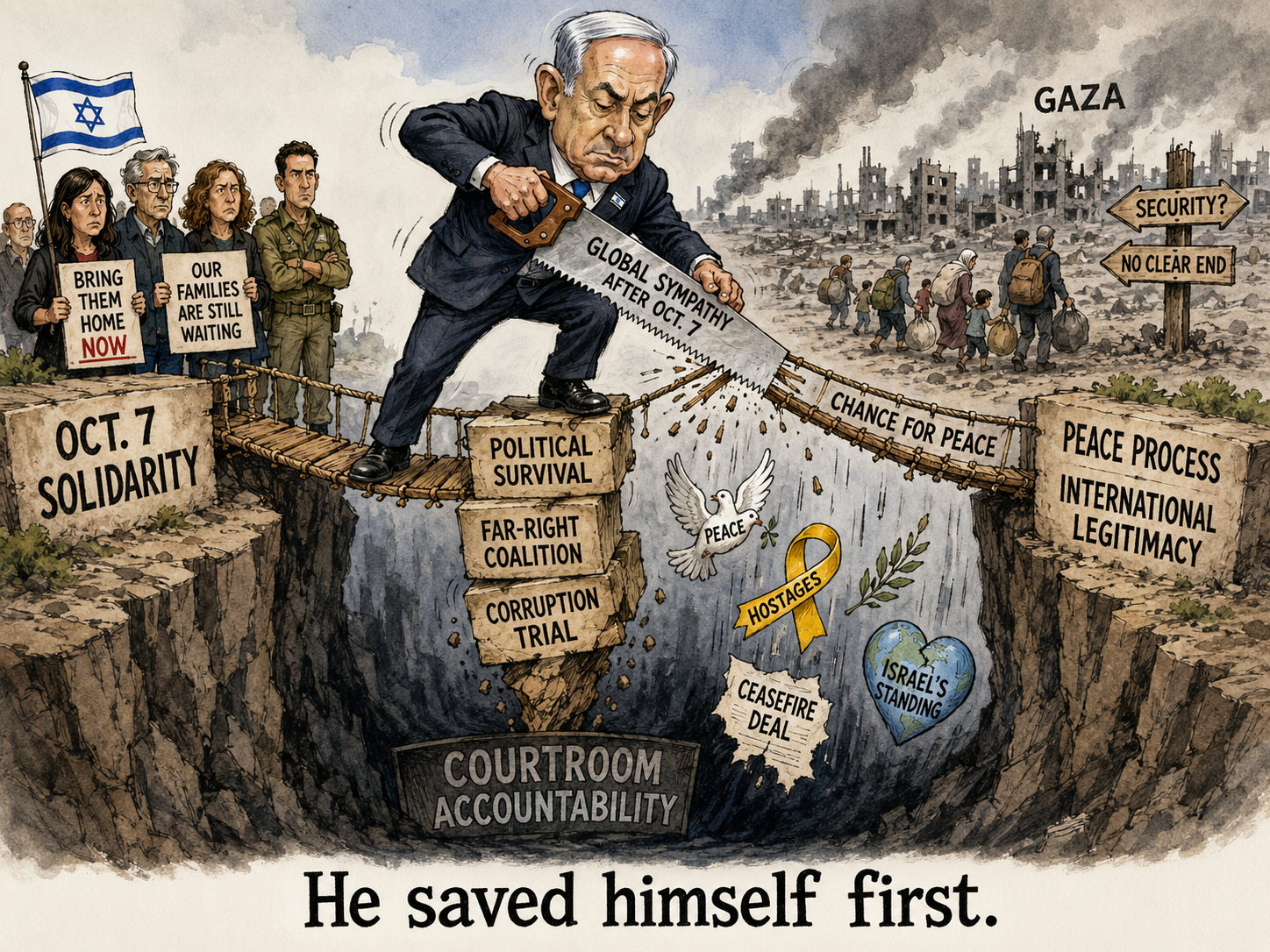
Image: ChatGPT/Author
There is a version of the last two and a half years where Israel emerges from October 7th with something it rarely gets: near-universal global sympathy, a clear moral case, and the credibility to lead on a genuine peace process. That window existed. From a progressive standpoint, it closed because one man chose his own political survival over Israeli security, Palestinian lives, and Israel’s long-term standing in the world, and his name is Benjamin Netanyahu.
The sympathy Israel had, and lost
In the days after October 7th, condemnation of Hamas’s attack was close to unanimous, including from progressives who have spent years criticizing the occupation. That baseline of solidarity mattered. It gave Israel room to respond in a way that isolated Hamas rather than isolating Israel itself.
Instead, the war that followed produced a civilian death toll in Gaza that human rights organizations, UN bodies, and much of the international community consider indefensible by any standard of proportionality. Mass displacement, the deliberate restriction of food and medical aid, the destruction of hospitals and universities, and a West Bank where settler violence has expanded with the tacit blessing of ministers in Netanyahu’s own cabinet: this is not what security looks like. It’s what happens when a government stops distinguishing between defeating an armed group and collectively punishing a population. That’s why the International Court of Justice took genocide allegations seriously enough to issue provisional measures, why the ICC issued an arrest warrant for Netanyahu, and why country after country, including longtime allies, has moved toward recognizing Palestinian statehood. Progressives didn’t invent this shift in world opinion. Netanyahu’s conduct of the war produced it.
A war that never seemed to have an endpoint
What makes this especially damning is that the war never had a coherent theory of victory. Hamas has not been eliminated. Hostage families spent months, some spent years, watching a government that talked about their loved ones as a priority while consistently choosing to escalate military operations instead of closing ceasefire deals that were reportedly on the table. Israeli reservists, retired generals, and hostage families themselves, not just outside critics, have said plainly that the war has served Netanyahu’s political survival more than any military objective.
That’s not a fringe accusation from people who dislike Israel. It comes from inside Israeli society, and it lines up with the facts. Netanyahu has been on trial for corruption since 2020. His coalition survives only because of far-right partners who’ve said outright they’ll bring down the government the moment a permanent ceasefire is signed. A prime minister who loses power risks both prison and the end of his career. Progressives have been right to point out that when a leader’s personal legal jeopardy and a country’s war aims become this entangled, the public deserves deep skepticism about whose interests are actually being served.
Why this matters beyond Netanyahu
The deeper cost isn’t Netanyahu’s approval rating, it’s Israel’s relationship with the rest of the democratic world, and with a rising generation that increasingly views the occupation, not just this war, as the central obstacle to peace. Polling shows young people across the US and Europe, including many young Jews, moving sharply away from unconditional support for Israeli government policy. That shift didn’t happen because progressives ran an effective messaging campaign. It happened because people watched the war unfold in real time and drew their own conclusions about who was responsible.
What a different government might do differently
This is the case progressives have been making for a change in Israeli leadership, and it’s a case grounded in outcomes, not just moral outrage. A center-left or unity government, freed from dependence on annexationist far-right coalition partners, would have far more room to close a hostage deal, commit to a real ceasefire, and reopen a credible path toward Palestinian statehood and an end to occupation, the only framework that has ever offered a durable peace. It could roll back settlement expansion instead of accelerating it. It could rebuild the international coalitions and moral standing that Netanyahu has spent this war burning through. None of that guarantees peace overnight. But it removes the specific political incentive, one man’s need to stay out of a courtroom, that progressives argue has made a just resolution impossible to reach.
The bottom line
Israel had real security needs after October 7th, and no honest accounting of this moment should minimize the trauma of that day. But from a progressive lens, security was never actually served by two years of war without a strategy, mounting civilian death, and a leader whose personal survival depends on the fighting continuing. Whether or not Netanyahu ever faces a courtroom for either the corruption charges or the ICC warrant, the damage to Israel’s standing in the world is already done. The path back starts with new leadership willing to choose peace over political self-preservation.
Related Topics
Related Posts