The court left one way to draft haredi men
The High Court struck down the arrest shield on 3 September. Nine justices found the legislative process defective enough to void the statute, and eight of them went further: a law that lifts criminal enforcement off one group while leaving every man in it legally obliged to report is unconstitutional in what it does, not only in how it was passed. The law never managed to operate, even for a day. Ofer Grosskopf froze it on 15 July, twenty-four hours after the Knesset passed it. And the full panel kept the freeze after a hearing at the end of that month. Sharren Haskel left the government over the debacle.
What is left is the arrangement the numbers already liked.
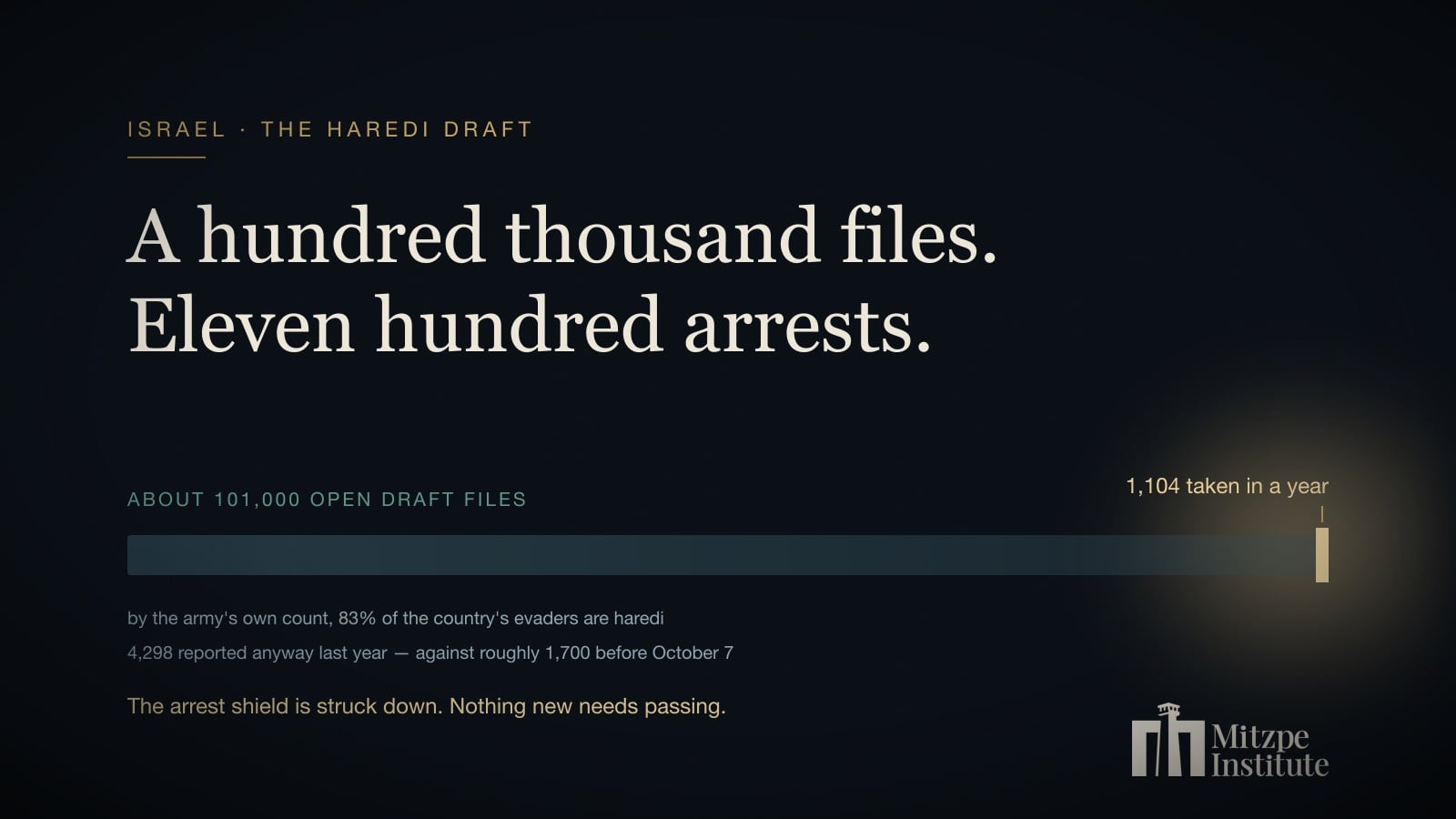
About 101,000 young Israelis liable for conscription have now been declared evaders or handed a Section 12 order (which is what comes after an arrest warrant). The army’s figures to the Attorney-General break that down as 60,217 evaders and roughly 41,000 orders — of which 50,000 and 31,600 respectively are haredi.
By the army’s own count, some 83% of the country’s evaders are part of the haredi community. Israel’s blanket yeshiva exemption is theoretically gone, and no replacement law has passed. Every one of those men can be handed an induction order this morning, with an arrest warrant behind it and nothing at all in between.
That is the combination that has actually moved.
The draft year that closed on 30 June put 4,298 haredi men into uniform, against 2,811 the year before and roughly 1,700 in the year before October 7. It still came in under the army’s own target of 4,800.
The army stopped cutting yeshiva budgets and started sanctioning individual men, and it built places a haredi man can serve without giving up the life he keeps — Netzah Yehuda, the Hasmonean Brigade, the Paratroopers’ haredi company. The Hasmonean Brigade’s Yonatan Battalion has been working in southern Lebanon for more than six months. None of it came out of the coalition. The army built the tracks, and the AG, for all her faults, asked for the arrests.
The arrests, though, are mostly luck. Police stopped a 20-year-old driving a stolen car and discovered he was an evader, and protesters were on Route 443 within an hour or so.
Across the past year the Military Police managed 860 proactive arrests among the general population and collected another 244 deserters and wanted men by accident. Against a hundred thousand files — 1,104 men is what the state managed with everything it had.
Underneath the politics, the community has calculated it can carry the cost. A fund called Prison 1,000 has the blessing of Dov Landau and Moshe Hillel Hirsch (the two senior Lithuanian authorities). Members pay in small amounts on a regular basis, and when one of them is arrested the fund hands him 1,000 shekels for each day he is in military prison. The organisers want an arrest to stop being frightening.
Kol Barama put it to the Shas chairman, Aryeh Deri, on 3 September: would he tell the men who are not learning to go and enlist. “I don’t need to call for that,” he answered. “The army, with all due respect, knows how to bomb Iran. Let it deal with this.” He added that the IDF does not want haredi soldiers anyway. A very large headache, in his phrase, for an army that would rather stay secular and not fill up with men who listen to their rabbis.
Lists closed on 8 September for the Knesset Israel elects on 27 October, and two parties went in making the bill nobody has passed their condition for joining the next government, in opposite directions. Ofer Winter, the retired brigadier running Amcha Yisrael, says his party will not go in until a law ending draft evasion is on the books. “Without that, we will not sit in the government. Full stop.” Yoav Ben Tzur put the opposite condition days later. Shas wants the bill its Council of Torah Sages has been asking for, which exempts anyone who is learning. Neither has said whose government it would join.
The Finance Ministry’s chief economist costed a month of reserve duty at roughly 53,000 shekels a man in late August, and then ran the other half of the sum: move 10,000 of those slots from reservists to conscripts and the figure per man falls to 26,000 a month, which is 2.7 billion shekels a year. Non-haredi Jewish men are 36 percent of the country’s employees and take the overwhelming majority of the working days the country loses to reserve duty.
The men organising the road blocks are betting the country keeps flinching. The Israel Democracy Institute asked in June how the police handle haredim who block roads over conscription, and 47 percent answered too leniently against 25 percent who said too harshly. Blocking the entrance to Jerusalem on a Shabbat does not move that figure toward the people doing the blocking.
Nothing the state needs now requires new legislation. The economic sanctions Baharav-Miara asked to widen are already in the government’s hand. The tracks exist and are full. And the court has taken away the instrument that would have made an arrest unlawful.
What is unsettled is whether anybody in the system will spend a morning of blocked roads on the approach that has produced soldiers or whether the coalition that gets assembled after 27 October means to leave them anything to spend it on.
Four thousand two hundred and ninety-eight men reported last year because the state asked them to, a good many of them walking in past a crowd from their own community chanting that they would die before they enlisted. They are owed an answer about whether it meant it.