
The Crown of Compassion
Why I Created the Royal House of Kanaani — and Why I Believe the Way We Treat Animals Can Bring Redemption Closer
By Ordained Animal Chaplain Mikhail Salita (Rav Papa Kanaani)
Humanity has made remarkable progress in the way we think about animals.
Across the world, organizations devote enormous resources to animal rescue, veterinary medicine, conservation, the prevention of cruelty, animal welfare, and the growing recognition that animals are living beings capable of suffering and deserving of humane treatment.
I support this work wholeheartedly.
But I have increasingly found myself asking another question.
Is it enough for humanity simply to stop being cruel to animals? Or are we ready to learn how to honor them?
For me, this question is not separate from Judaism.
It reaches back to some of the earliest stories of our tradition — and forward to the world for which Jews have prayed for generations.
From Adam to the Messianic Future
The relationship between human beings and animals begins almost immediately in the Torah.
Adam names the animals.
Noah is entrusted with preserving animal life through the Flood.
Jewish tradition remembers Moshe Rabbeinu not only as the man who would lead Israel, but also as a shepherd whose compassion toward a wandering lamb revealed something essential about his capacity to lead.
David, too, was a shepherd before he became a king.
And then there is King Solomon.
The Tanakh describes the extraordinary wisdom granted to Solomon and specifically connects that wisdom with his knowledge of the living world — trees, animals, birds, creeping creatures and fish.
Later Jewish tradition gives us an even more remarkable image.
In the tradition surrounding King Solomon’s magnificent throne, a golden cat appears on the fifth step of the throne itself, facing a golden rooster.
That image has become deeply meaningful to me.
It also became the inspiration behind my literary work The Golden Cat of King Solomon and behind the cultural concept I call the Heirs to King Solomon’s Feline Throne.
I want to be precise here.
I am not claiming that a modern cat can be genetically traced to an animal that lived in Solomon’s Jerusalem. That would require evidence we do not possess.
What I am describing is a symbolic inheritance — an inheritance of place, memory, Jewish tradition and cultural imagination.
And I am deeply proud of that connection.
There is something profoundly moving to me about caring today for cats whose modern story began in Jerusalem and whose symbolic story, in my mind, reaches back toward the golden cat remembered in Jewish tradition on King Solomon’s throne.
That connection does not make one animal more valuable in the eyes of God than another.
But it gives these particular cats a story.
And I believe a story can create responsibility.
The Heirs to King Solomon’s Feline Throne
Nearly three thousand years after Solomon, the modern Kanaani breed emerged in Jerusalem.
For me, that geography matters.
Jerusalem.
The Land of Israel.
King Solomon.
The golden cat.
And, centuries later, an exceptionally rare Israeli cat breed whose appearance still evokes something ancient and wild.
I have therefore come to regard the Kanaani as the Heirs to King Solomon’s Feline Throne.
And within the Kanaani, the particular documented lineage entrusted to my care has become something more specific:
The Royal House of Kanaani.
This is not a human monarchy.
It is not a claim to political authority or aristocratic privilege.
It does not replace pedigrees, genetic documentation, cat registries, or recognized show titles.
It is a modern cultural, spiritual and literary designation — a symbolic royal feline house.
And I believe these cats deserve their titles twice over.
They deserve them because of the cultural inheritance I associate with Jerusalem, King Solomon and the golden cat of Jewish tradition.
And they deserve them because I believe that a crown should represent something greater than status.
A crown should represent responsibility.
Their titles are intended to remind us of ours.
The Royal House of Kanaani
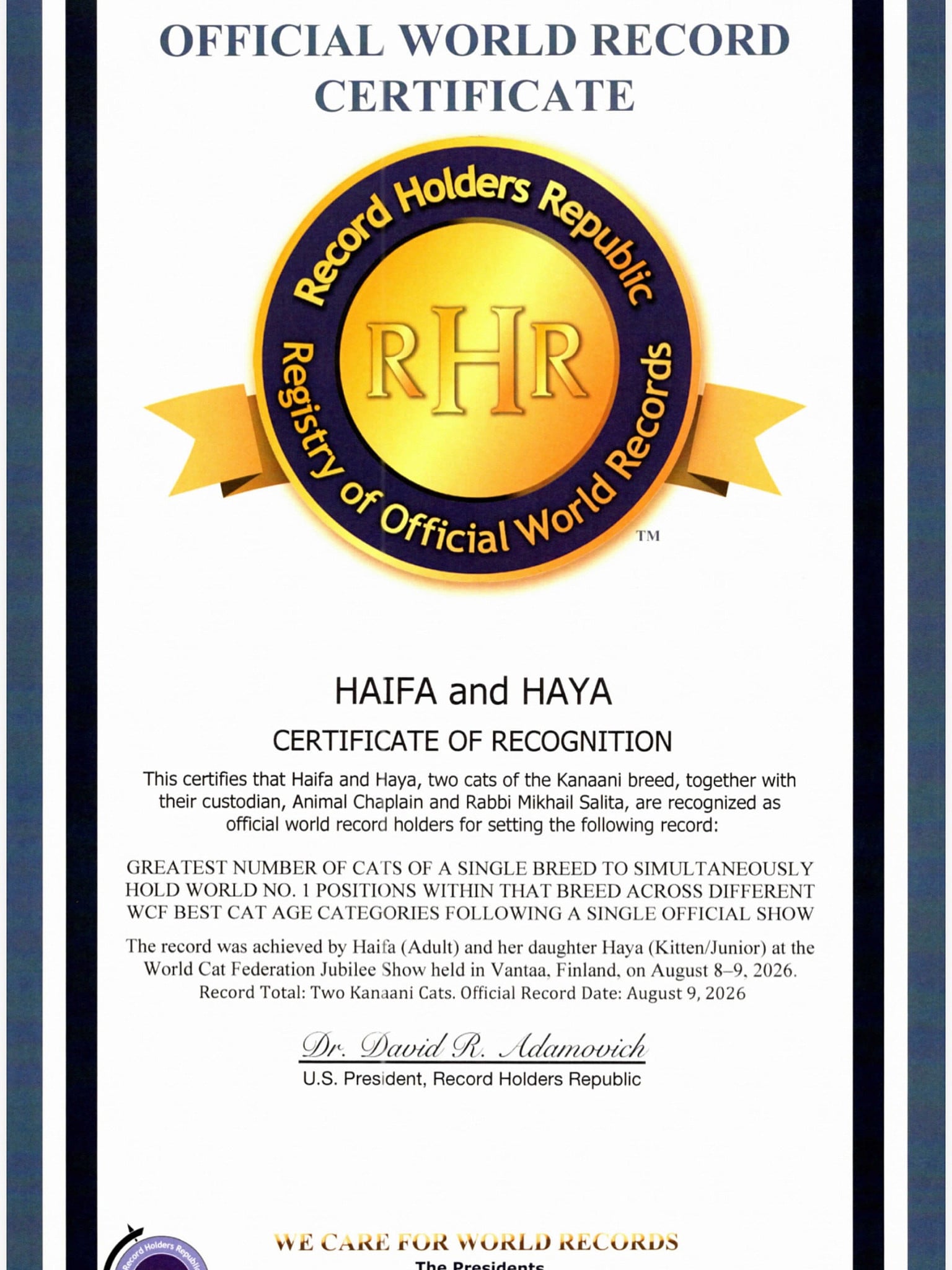
At the head of this feline house stand King Arbuz and Queen Haifa.
The next generation is represented by Crown Prince Sky and Crown Princess Laila Yom Tov, together with Princess Haya, Princess Neshama and Princess Sasha.
These names are not intended to turn animals into human beings.
Quite the opposite.
They ask us to recognize animals as animals — living creatures with their own nature, vulnerability, dignity and place in Creation.
And among these stories, Crown Princess Laila Yom Tov has a particularly tender place in my heart.
Crown Princess Laila Yom Tov
Laila became seriously ill with pyometra, a potentially life-threatening condition.
Her life was in danger.
During that difficult period, my rabbi, Rabbi Zalman Liberov, gave her an additional name:
Yom Tov — “a good day.”
He gave her the name while she was sick, as a blessing and expression of hope for her recovery.
I believed in that blessing.
At the same time, I took Laila to Cornell University in Ithaca, where she received specialized veterinary care.
The doctors there treated her, and her life was saved.
For me, that experience gave her title an even deeper meaning.
She suffered. She was blessed. She was treated. She survived.
That is what her crown means to me.
The People Who Helped
The Royal House of Kanaani was not preserved by one person alone.
There were people who helped at critical moments.
Liudmila Vlasova in Israel played an important role in the continuity of this lineage.
My friend and rabbi, Rabbi Nathan Arister of Brighton Beach — also a physician at Maimonides Medical Center — helped bring Crown Prince Sky and Princess Sasha from Israel to the United States.
When Laila became seriously ill, Rabbi Zalman Liberov helped in a completely different way: with spiritual care, prayer, and the name Yom Tov.
I am particularly grateful for what these experiences taught me.
These rabbis are not cat breeders.
They did not need to devote themselves to my particular vision in order to recognize that I needed help.
But when help was needed, they did not refuse me.
Each helped in his own way.
Both are connected with the Chabad community, and I believe it is right to acknowledge that with gratitude.
I do not present this as an institutional endorsement by Chabad.
I mention it because individual acts of kindness matter.
And perhaps that, too, belongs in the story of the Royal House of Kanaani.
A royal house is not preserved by crowns. It is preserved by acts of care.
Why I Am Rav Papa Kanaani
I did not choose the name Rav Papa Kanaani merely because it sounded memorable.
Over time, I came to understand it as a description of responsibility.
I believe I have two missions concerning these cats.
The first is to help bring the Kanaani back from the edge of disappearance.
The second is to give the lineage entrusted to my care not merely survival, but a cultural inheritance — a story capable of carrying its memory forward.
That is why I established the Royal House of Kanaani.
If I regard these cats as the symbolic Heirs to King Solomon’s Feline Throne, then I believe it is fitting that the lineage I preserve should carry royal feline titles.
Not because the cats need human vanity.
Because perhaps human beings need the reminder.
Can Compassion Toward Animals Bring Redemption Closer?
Here I speak personally, as an Animal Chaplain and as a Jew describing what I believe.
I believe that the way we treat animals matters spiritually.
And I believe that becoming more compassionate toward God’s creatures can help us become the kind of human beings capable of building a world more worthy of redemption.
I do not claim that giving a cat a royal title will bring Mashiach.
Judaism makes no such promise.
My belief comes from a much broader pattern that I see running through Jewish tradition.
Adam encounters the animals.
Noah preserves them.
Moshe shows compassion toward them.
David learns responsibility as a shepherd.
Solomon’s wisdom embraces the living world.
And when the prophet Isaiah gives us one of Judaism’s most beautiful visions of a transformed future, animals appear once again.
The wolf dwells with the lamb.
The leopard lies down with the young goat.
The calf and the young lion are together.
And the lion eats straw like the ox.
The prophetic imagination does not picture peace as something belonging only to human beings.
Creation itself participates in it.
That matters to me enormously.
I believe that every genuine movement away from cruelty and toward compassion, away from exploitation and toward stewardship, away from indifference and toward dignity, helps us become more worthy of that future.
Perhaps such acts help bring that future closer.
That is my faith.
What Does a Crown Mean?
For thousands of years, human beings have placed crowns upon themselves.
Kings wore them as symbols of sovereignty, inheritance and power.
Perhaps one small sign of a more compassionate civilization is that we can finally place a crown symbolically upon an animal — not to make the animal human, but to remind ourselves to become more humane.
That is also why I believe the Royal House of Kanaani can be especially meaningful for children.
A child may first encounter Queen Haifa, King Arbuz, Crown Prince Sky or Crown Princess Laila Yom Tov because the titles sound magical.
Then the child asks:
Why is this cat a queen?
And suddenly we have an opportunity to talk about Jerusalem.
About King Solomon.
About Jewish tradition.
About rare animals.
About veterinary medicine.
About compassion.
About responsibility.
And about why a living creature should never be treated as disposable.
Perhaps giving a cat a crown will not change the world.
But if that crown changes the way one child sees an animal, then something in the world has already changed.
The Royal House of Kanaani does not ask whether a cat understands a crown.
It asks whether we understand what the crown requires of us.
Their crowns do not give them power over humanity.
Their crowns remind humanity of its responsibility toward them.
I am proud — very proud — that the story of these cats can be connected with Jerusalem, the Land of Israel, Jewish tradition and the golden cat upon King Solomon’s throne.
That connection means a great deal to me.
And because I consider them the Heirs to King Solomon’s Feline Throne, I believe the lineage entrusted to my care deserves its royal feline titles twice over:
as an inheritance of memory,
and as a living symbol of responsibility.
May their crowns make us kinder.
May their survival teach us responsibility.
May the children who encounter their story learn that greatness is measured not only by the power we possess, but by the tenderness with which we treat those placed in our care.
And may every genuine act of compassion toward God’s creatures bring our world one small step closer to redemption.
Amen.
P.S. A Thought for Shemini Atzeret
There is a beautiful coincidence in the timing of this article.
This Shemini Atzeret, the Haftarah takes us directly to King Solomon. We read from I Kings of Solomon completing his prayer, blessing the people of Israel, and marking the dedication of the Temple.
For me, that makes this an especially meaningful week to write about the Royal House of Kanaani.
King Solomon is not merely a distant name in this story. His throne — and the golden cat preserved upon it in later Jewish tradition — is the spiritual and cultural point from which my idea of the Heirs to King Solomon’s Feline Throne grows.
So in a week when Jewish communities once again hear Solomon’s words and remember the dedication of the Temple, I find myself thinking about another kind of dedication: the dedication required to preserve life, memory, and a rare lineage entrusted to our care.
Perhaps there could be no more fitting week for me to place this idea into the world.
From Solomon’s Jerusalem to the Kanaani of today, the thread is not power. It is responsibility.
Chag Sameach.