
The Curse Promised to Abraham: Understanding the Nature of Antisemitism
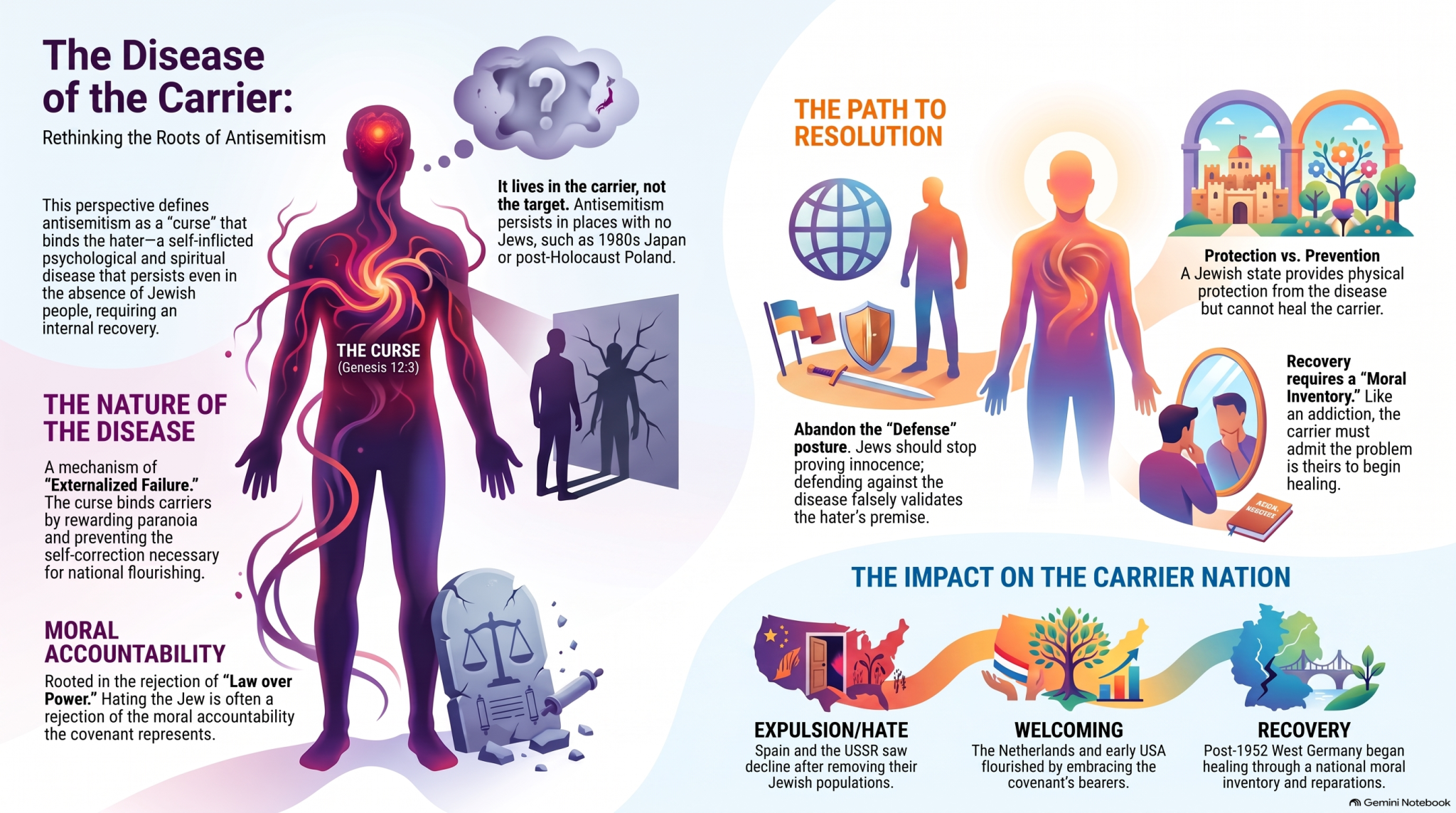
For three thousand years and more, Jews have asked why they are hated for trying to live as they believe God asks. The answer has been in front of us since Genesis. Antisemitism is the curse God described to Abraham when He offered the covenant: whoever treats the bearers of that covenant with contempt will be bound by that contempt. The curse is not a punishment added to antisemitism. It is antisemitism itself, a disease carried by those who hate, and it harms the carrier as surely as it endangers the Jew.
Once this is understood, several things follow. Jew-hatred should be demystified; it is neither an unanswerable riddle nor evidence of Jewish fault. It is a condition of the carrier, contracted through active contempt rather than indifference, and it does not require the presence of Jews. Jews cannot argue it away, and the endless effort to do so should stop. Herzl was wrong that a Jewish state would end it, but right that such a state could protect Jews from it. And the Jewish task is to understand the disease clearly, to engage those willing to exchange ideas, and to withdraw when conversation becomes a trial. What we are living through is what God told Abraham that following Him would bring.
A disease that needs no Jews
The strongest evidence that antisemitism lives in the carrier is that it survives without Jews. Spain expelled its Jews in 1492, then spent centuries enforcing purity-of-blood statutes against the descendants of converts. The hatred outlived its object by generations.
Poland lost nearly its entire Jewish population in the Holocaust. Yet in 1946 a pogrom in Kielce killed survivors who had come home, and in 1968 the state drove out most of the few thousand Jews who remained. Surveys still find antisemitic attitudes widespread in a country with almost no Jews.
Japan never had a meaningful Jewish community. In the 1980s, books claiming that Jews secretly controlled the world economy became bestsellers there. None of this required a Jewish neighbor, a Jewish rival, or a Jewish act. A hatred that persists without its supposed cause is not a reaction to that cause. It is a condition of the one who holds it.
Where it begins
The covenant with Abraham was not God’s first approach to humanity. The first eleven chapters of Genesis record humanity left to find its own way. That experiment ended in violence that brought the Flood, and in the arrogance of Babel. After those failures, the method changed. Instead of guiding all humanity at once, God chose one man and his descendants as the vehicle of guidance.
The purpose is stated in Genesis 18:19: Abraham was chosen to teach his household “the way of the LORD, doing righteousness and justice.” The promise that accompanies it, in Genesis 12:3, has two halves. God will bless those who bless Abraham and curse the one who curses him. And through Abraham, “all the families of the earth shall be blessed.” The covenant was never meant to be private. Others could learn from it. Many would refuse.
The Hebrew of 12:3 is precise. The one who “curses” Abraham is described with a verb meaning to make light of, to treat with contempt. God’s response uses a heavier word, one some scholars connect with binding or placing under a ban. The one who belittles is bound by the belittling. And in Genesis 15:13–14, when the covenant is formally made, God tells Abraham plainly that his descendants will be strangers, oppressed in a land not theirs, and that the nation that oppresses them will be judged.
The verse is also notable for what it leaves out. It names those who bless Abraham and the one who curses him. It says nothing about those who simply ignore him. There are three possible stances toward the covenant’s people, and God addresses only two. The blessers are many, the curser is one, and the indifferent, who are most of humanity most of the time, are not mentioned at all. The disease is not a universal human condition. It is contracted by a specific act: treating the bearers of the covenant as of no account.
That line needs care. Not thinking about Jews is neutral. Actively belittling them, treating their lives and claims as though they do not count, is the contempt the verse describes. Nor does the verse’s silence make indifference morally innocent. The Torah elsewhere forbids standing idly by a neighbor’s blood (Leviticus 19:16), and the bystanders of the Holocaust stand judged by that command. Indifference in the face of harm is a moral failure. It is simply not the disease described in Genesis 12:3.
The rabbis understood where the hatred came from. The Talmud (Shabbat 89a) asks why the mountain of revelation is called Sinai, and answers with a play on words: at Sinai, sin’ah, hatred, descended to the nations. The hatred is born with the covenant. Balaam saw “a people that dwells alone.” Haman complained that “their laws are different from every people.” Both were describing the covenant, not a Jewish offense.
How the curse works
Demystifying antisemitism does not mean removing God from the story. The prophecy names the pattern; the mechanism can be understood. The covenant set a people apart under a law above power, a law that judges kings and calls its own nation to account. The Jew is therefore a standing reminder that power is answerable. For any person or society that wants power to be ultimate, that reminder is intolerable.
The covenant’s way is built around self-correction: prophets who indict their own people, and repentance as a permanent institution. Antisemitism is its opposite. It offers a ready explanation for every failure, and the explanation always points outward. A society that can say “the Jews did this” never has to ask what it did itself.
That is how the curse binds. A carrier who blames the Jew gradually loses the capacity to see his own errors. Conspiracy replaces analysis, and paranoia is rewarded over competence. Often the carrier expels or destroys the people who were among its most productive builders and critics. Spain after the expulsion, Germany after it drove out the scientists who helped build the weapons that defeated it, and the Soviet Union in its decline all show the pattern. The blessing works the same way in reverse. Societies that welcomed Jews, from the Netherlands to the Ottoman Empire after 1492 to the United States, often flourished.
This is a tendency, not a ledger. Nations rise and fall for many reasons, and some have hated Jews while prospering for a time. The claim is not that antisemitism alone causes decline. It is that antisemitism reliably damages the faculty a nation needs to correct itself.
Herzl’s diagnosis and Israel’s defense
Theodor Herzl believed antisemitism was a product of Jewish homelessness. In The Jewish State, he argued that once Jews had a nation like other nations, the “Jewish question” would be resolved. The normal would no longer provoke.
The diagnosis was wrong, and history has proved it. The Jews gained a state, and the hatred moved to the state. Anti-Zionism became the respectable form of the old disease, holding the Jewish nation to standards applied to no other. If antisemitism had been a response to Jewish statelessness, statehood would have cured it. Instead it confirmed that the disease was never about what Jews lacked.
Yet Herzl’s project succeeded at something he did not fully intend. Israel did not end antisemitism. It changed what antisemitism can do to Jews. For the first time since antiquity, Jews have a state that can defend them against those who act on the disease. Israel cannot heal the carriers. It can refuse to be their victim.
Exchange, not defense
If antisemitism is a condition of the carrier, then Jews cannot argue the carrier out of it. Generations of Jewish effort have gone into explaining, correcting, apologizing, and proving innocence. None of it has cured the disease, because the disease was never based on evidence.
The defensive posture also carries a hidden cost. A Jew who defends himself against the charge accepts the premise that there is a case to answer. Each round of rebuttal confirms that the Jew is on trial, and the carrier is the judge.
This does not mean Jews should stop talking. The verse itself identifies the right audience: the indifferent, the unmentioned majority who neither bless nor curse. They are curious, uncertain, or simply uninformed, and genuine exchange with them is worth having. The line is recognizable. When a conversation involves the exchange of ideas, stay. When it turns into a demand that Jews justify their existence, their state, or their faith, withdraw. Leaving that conversation is not defeat. It is refusing to take part in a trial the other side has already decided.
The verse also releases Jews from a burden they were never given. Much of the flailing comes from seeking universal affection, as though anyone not actively supportive must be won over or feared. Genesis promises no such thing and requires no such thing. Jews do not need to turn the indifferent into blessers. And treating the indifferent as carriers is its own mistake, one that can push neutral people toward hostility.
A therapy for the carrier
If there is a therapy, it looks less like debate and more like a twelve-step program. The first step in recovery from addiction is admitting that the problem is one’s own. No one can take that step on the addict’s behalf. That is exactly why Jewish argument fails: the recognition has to come from inside the carrier.
Genesis supports this. The curse falls on the one who curses, which is an act, not a failure to embrace. If the condition is entered by choice, it can only be left by choice. The way in and the way out both run through the carrier’s own will.
The model fits in other ways. Recovery requires a moral inventory, an honest accounting of what one has done. It requires making amends. And it calls on a power greater than oneself, which returns the problem to where Genesis placed it, in the relationship between people and God’s way.
There is a historical example. After the Holocaust, West Germany undertook something close to a national moral inventory. In 1952 it signed a reparations agreement with Israel, and it built a culture of confronting its past in schools, law, and public memory. The recovery was real. It was also partial, and the recent rise of antisemitism in Germany shows that relapse is possible, as it is in any addiction. Recovery is never finished, but it can begin, and it begins only when the carrier chooses it.
What Jews can do
Jews cannot cure the disease in others, but that is not the same as having nothing to do. Jews can understand the disease once and for all and stop spending themselves on efforts that were never going to work. They can refuse the guilt the carrier assigns. They can maintain a state strong enough to protect them. They can welcome real exchange and walk away from trials. And they can remain faithful to the covenant that provokes the hatred in the first place. The goal is not to be loved by the nations. It is to understand those who curse, welcome those who bless, and leave the indifferent in peace.
None of this makes Jewish suffering necessary or deserved. The persistence of the hatred is the cost of the covenant, not its purpose. God told Abraham that the path would be hard and that those who despised it would be bound by their contempt. For thousands of years, both halves of that promise have been kept.
The question “why do they hate us?” has an answer, and it is not in anything Jews have done. It was given to Abraham before there was a Jewish people. Antisemitism is the curse that falls on the carrier who rejects the way through which his own blessing was meant to come. Our task is not to cure it. Our task is to understand it, to protect ourselves from it, and to keep walking the way we were given.