
The Danger of “Clear, Hold, Flatten”
For two decades, Western military doctrine was summarized in a simple phrase: clear, hold, build.
You remove militants.
You secure the territory.
You rebuild civil life so the conflict does not return.
It was imperfect. Often naïve. But it rested on a core assumption: that stability requires some form of habitable order—people living, working, governing, even if imperfectly.
What is emerging now is something different.
A new sequence is taking shape:
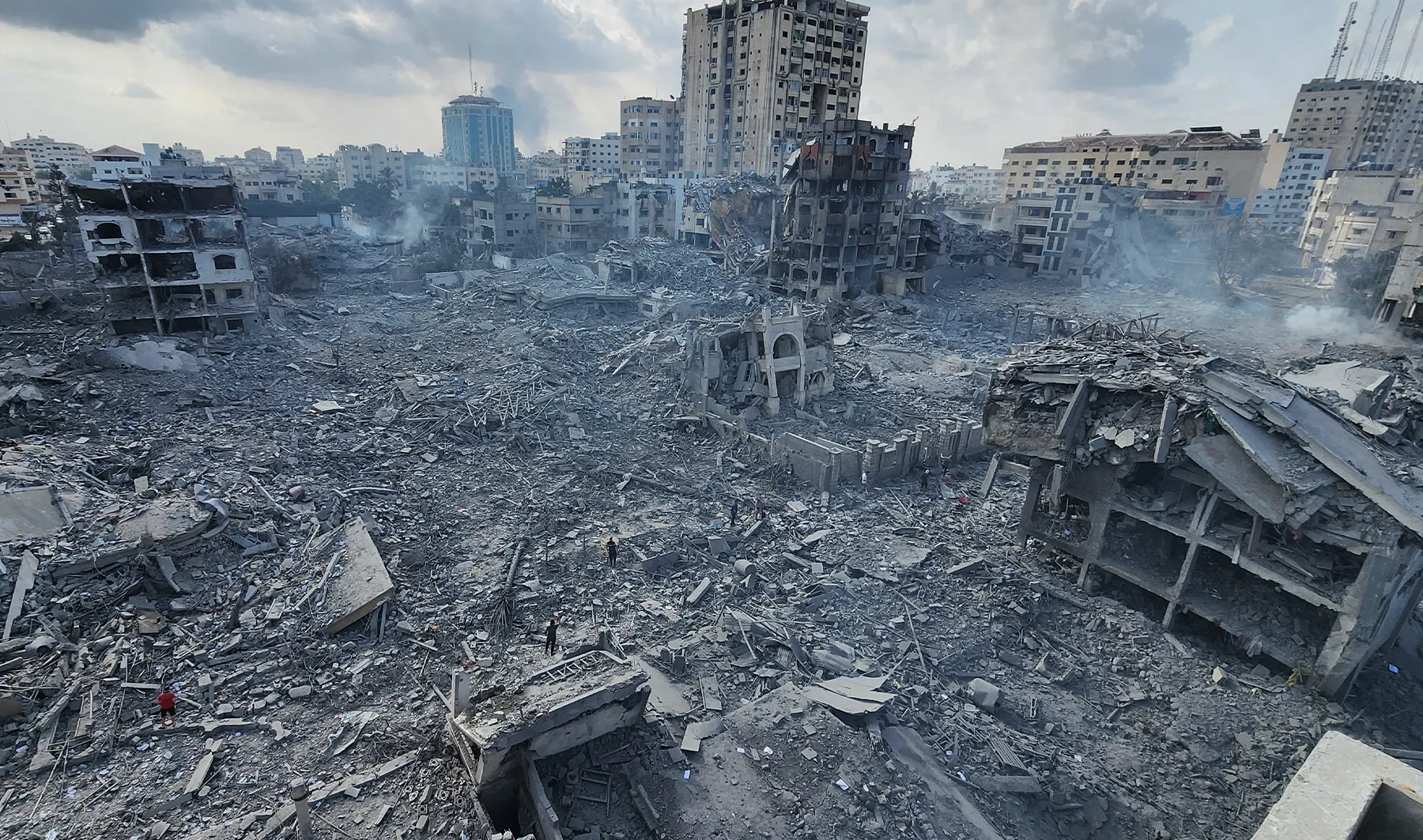
Clear → Hold → Flatten
And the consequences of this shift are not being fully reckoned with.
From Governance to Denial
The logic of clear, hold, flatten is deceptively straightforward.
- Clear the fighters and infrastructure
- Hold the space through surveillance, strikes, and limited presence
- Flatten the environment so it cannot regenerate threat
The third step is the break.
“Build” assumed that people would return, institutions would reform, and legitimacy could be constructed over time.
“Flatten” assumes the opposite:
That the safest environment is one that cannot support normal life at all.
Urban density becomes a liability.
Civilian return becomes a risk.
Complexity itself becomes the enemy.
Security is no longer achieved through governance.
It is achieved through emptiness and visibility.
The Missing Variable: Where Does the Pressure Go?
There is a fundamental problem embedded in this model:
It treats space as if pressure disappears when it is cleared.
It does not.
It moves.
When a border region is flattened—homes destroyed, return prevented, economic life erased—the human, economic, and political pressure does not vanish. It is displaced.
Into cities.
Into neighboring regions.
Into already fragile states.
Lebanon is the clearest example of what this looks like in practice.
It is already carrying:
- Palestinian refugees
- Syrian refugees
- A fragmented political system
- A weakened fiscal base
Now imagine adding:
- A depopulated southern belt
- Large-scale internal displacement
- Loss of economic activity and tax revenue
- A further erosion of sovereignty in the south
The result is not stability.
It is compression.
Compression Is Not Containment
There is a recurring assumption in this model:
That instability can be geographically contained.
But compression behaves differently.
When populations are pushed into smaller spaces:
- Housing shortages intensify
- Prices rise
- Infrastructure strains
- Political factions radicalize
- Armed groups gain new recruitment pools
What looks like “security” on one side of the border becomes systemic stress on the other.
And that stress does not remain local.
It spills:
- into politics
- into migration
- into renewed conflict
The Blame Cycle
There is a second-order effect that is just as dangerous.
When the receiving system begins to fracture, the narrative often becomes:
“They failed to govern themselves.”
Lebanon becomes “a failed state.”
Gaza becomes “ungovernable.”
But this framing erases the causal chain.
It ignores:
- the displacement that preceded the crisis
- the territorial disruption
- the removal of economic capacity
- the external constraints placed on sovereignty
The system is first destabilized.
Then it is blamed for being unstable.
Gaza as a Preview
We are already seeing the dynamics of compression in Gaza.
As habitable space shrinks:
- populations concentrate
- humanitarian pressure intensifies
- governance becomes nearly impossible
The outcome is predictable:
Pressure builds.
And when it releases—through unrest, violence, or humanitarian collapse—it is treated as a new crisis, rather than the continuation of the same one.
A Model Without an End State
The most striking feature of clear, hold, flatten is that it has no natural conclusion.
- It does not aim to rebuild
- It does not aim to transfer governance
- It does not aim to normalize life
It aims to maintain denial conditions indefinitely.
Which means:
- The zone must be continuously monitored
- Re-entry must be continuously prevented
- Enforcement must be continuous
This is not resolution.
It is permanent management.
The Strategic Paradox
In the short term, the model is coherent.
It reduces immediate threats.
It simplifies the battlefield.
It leverages modern surveillance and strike capabilities.
But over time, it creates a paradox:
The more you flatten one space, the more instability you generate elsewhere.
And eventually:
The instability you displace returns in new forms.
Not as tunnels under a border.
But as:
- regional collapse
- mass migration
- political radicalization
- new fronts of conflict
The Return of the Problem
What makes this model especially dangerous is its illusion of finality.
Flattening feels decisive.
It looks like the problem has been removed.
But the problem has not been removed.
It has been repositioned.
And when it reappears—whether in Lebanon, Gaza, or beyond—it will be treated as:
a separate failure, rather than the downstream effect of the same strategy.
Conclusion
“Clear, hold, build” failed in many places because it overestimated our ability to construct order.
“Clear, hold, flatten” risks failing for the opposite reason:
It abandons the idea of order altogether.
Security cannot be sustained indefinitely by emptiness.
Because people do not disappear.
They move.
And wherever they are pushed, the pressure follows.
The question is not whether that pressure will return.
It is where—and in what form.