
The Dangerous Implications of “Free Palestine” for World Jewry
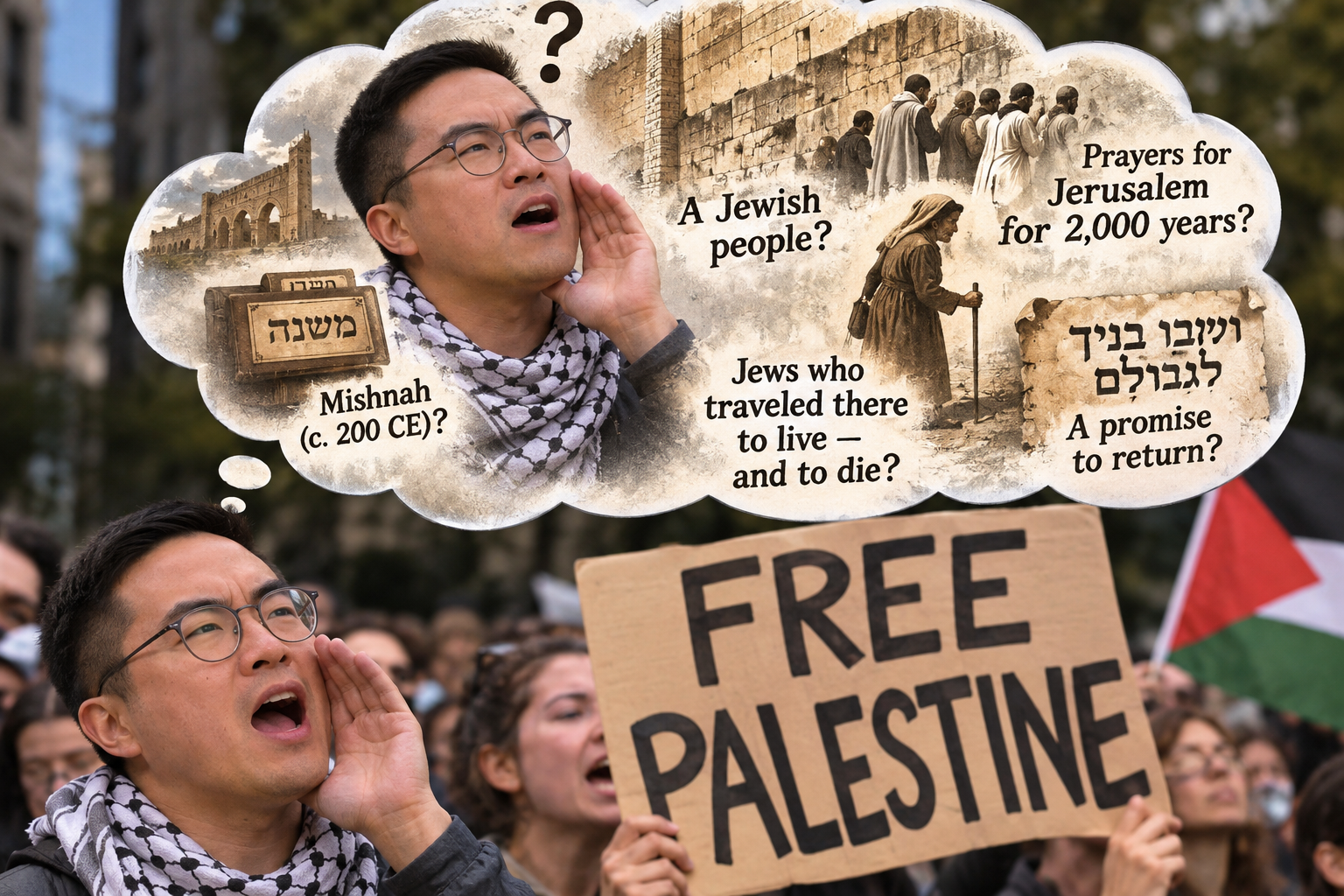
On November 20, former Saturday Night Live comedian Bowen Yang apologized for referring to Jewish singer Regina Spektor as a “Zio,” a derogatory term for Zionists popularized by white supremacist David Duke. Shortly after issuing his apology, Yang posted on Instagram, “At the same time, Free Palestine.”
So what do Yang and others mean by this chant that we have been hearing incessantly since October 7, 2023? The meaning of the chant itself is seldom elaborated upon. What exactly is Palestine to be freed from? And why is so much of a movement ostensibly dedicated to Palestinian freedom preoccupied with boycotting Israel? Why is there so little talk about building a prosperous Palestinian society, establishing accountable Palestinian leadership or promoting peaceful coexistence between Palestinians and Israelis? And how much do those chanting “Free Palestine” understand about the Jewish people, our history and our religion?
What Zion means to Jews
We are called Jews because we come from Judea. The very name of our people reflects our connection to the land.
The first thing God does in establishing the line of descendants who would become the Jewish people is to instruct Abraham to go to the land that He would give to his descendants (Genesis 12:1–7). That promise is reiterated to Isaac (Genesis 26:3–4) and Jacob (Genesis 28:13–15), whose name is changed to Israel and whose descendants become the people of Israel.
Throughout the Hebrew Bible, the connection between the Jewish people and the land of Israel is central, as is the promise that, following our exile, we will be restored to our land.
In Deuteronomy (30:4–5), we are promised:
“Even if you are scattered to the ends of the heavens, from there the Lord your God will gather you and take you. And the Lord your God will bring you to the land that your ancestors possessed.”
Isaiah (11:12) speaks of gathering the dispersed of Israel and the scattered of Judah from the four corners of the earth.
In one of the most poignant passages of the Hebrew Bible, Jeremiah (31:17) offers consolation to Rachel, who weeps for her children:
“There is hope for your future, declares the Lord, and your children shall return to their own borders.”
Ezekiel (36:24) reiterates the promise:
“I will take you from among the nations, gather you from all the countries and bring you to your own land.”
And in Amos (9:15), we are promised that we will be planted upon our land and never again uprooted from it.
In Psalm 137, composed in the context of the Babylonian exile some 2,500 years ago, we read:
“If I forget you, Jerusalem, may my right hand forget its skill.”
These are not obscure biblical passages. Their language and sentiments are woven into the prayers, rituals and traditions that have sustained the Jewish people throughout centuries of exile.
Three times a day, in our traditional weekday prayers, observant Jews pray for the ingathering of the exiles and the rebuilding of Jerusalem. Indeed, the language of Isaiah is echoed in our daily prayers when we ask God to gather us from the four corners of the earth.
In our grace after meals, we give thanks for the land of Israel and pray for the rebuilding of Jerusalem. We conclude our Passover Seders and our Yom Kippur services with the words “Next year in Jerusalem.” On Tisha B’Av, we mourn the destruction of our Temples. At Jewish weddings, even at one of the happiest moments in our lives, we traditionally break a glass in remembrance of the destruction of Jerusalem.
The land of Israel permeates our religion, our history, our calendar and our traditions.
Moreover, archaeological discoveries, ancient inscriptions, coins and historical accounts attest to the existence of Jewish civilization and Jewish sovereignty in the land long before the emergence of modern political Zionism. Even modern genetic studies provide evidence of shared Middle Eastern ancestry among many geographically dispersed Jewish communities. Our connection to the land is not merely a matter of religious belief.
Two thousand years of longing and sacrifice
The Jewish people’s attachment to their ancestral homeland was expressed not merely in prayer. Despite the loss of Jewish sovereignty, Jewish life in the land persisted.
Indeed, some of the most foundational works of rabbinic Judaism were produced in the land of Israel during the centuries that followed the destruction of the Second Temple.
Following the destruction of the Temple in 70 CE, Yavne emerged as an important center of rabbinic Judaism. The Mishnah was compiled by Rabbi Judah HaNasi around 200 CE, and the Jerusalem Talmud was compiled some two centuries later, primarily in the Galilee. The remains of numerous ancient synagogues attest to the vitality of Jewish communities during this period.
In the tenth century, Jewish scholars in Tiberias were refining the system of Hebrew vocalization and biblical textual transmission that we use to this day.
Throughout the subsequent centuries, Jews made extraordinary efforts to reestablish and sustain Jewish communities in their ancestral homeland, often under exceptionally difficult circumstances.
Under successive rulers, Jewish inhabitants of the land experienced varying degrees of persecution, discrimination and expulsion, although there were also periods of relative tolerance. Notably, it was the Muslim ruler Saladin who, after wresting Jerusalem from the Crusaders in 1187, permitted Jews to resettle there.
In 1267, the renowned Jewish scholar Nachmanides, already in his seventies, arrived in Jerusalem and helped revive its depleted Jewish community. In the sixteenth century, Sephardic Jews helped transform Safed into a major center of Jewish religious scholarship. In the eighteenth and early nineteenth centuries, groups of Hasidic Jews and disciples of the Vilna Gaon made the arduous journey to settle in the Holy Land.
My mother told me that my grandfather’s grandmother undertook the journey to the Holy Land because she wished to die there. In researching this essay, I discovered that she was far from alone. Historical research documents how elderly Jews, including many widows, made their way to the Holy Land to spend their remaining years there and be buried in its soil.
And how were these often impoverished Jewish communities sustained? Through a centuries-old institution known as the Halukkah, whereby Jewish communities throughout the diaspora collected funds to support the Jewish inhabitants of the Holy Land. Jews who themselves lived under conditions of poverty and persecution contributed to the support of their often even more impoverished brethren in Jerusalem, Hebron, Safed and Tiberias.
For centuries, Jews not only prayed to return to their ancestral homeland but also devoted their limited resources to sustaining Jewish life there. Some went there to study, some went there to build communities, and some went there simply to die and be buried in the soil of their ancestors.
The modern Zionist movement did not invent the Jewish people’s connection to Israel. Rather, given the precariousness of Jewish life in the diaspora and the emergence of national movements around the world, its leaders recognized that the time had come for Jews to pursue national self-determination in the land they had always regarded as their ancestral birthright.
Yet today, Zionism is portrayed in some circles as an ideology so reprehensible that people who identify as Zionists are deemed unworthy of friendship, professional association or even inclusion in progressive movements.
From historical erasure to moral condemnation
As alarming as the denial of Jewish history is, its convergence with the accusation of genocide against Israel is even more alarming.
In a recent interview with Aaron MacLean on his School of War podcast, former Israeli minister Ron Dermer argued that the relentless repetition of the genocide accusation serves to malign Jews and incite violence against them.
Moreover, the genocide accusation has been vigorously challenged by military and legal experts. John Spencer, an expert in urban warfare who has chaired urban warfare studies at West Point’s Modern War Institute, has argued that Israel has gone to extraordinary lengths to minimize civilian casualties while fighting an enemy that deliberately embedded its military infrastructure within densely populated civilian areas. He points to Israel’s use of advance warnings, telephone calls, evacuation corridors and humanitarian measures, some of which come at a cost to its own military effectiveness. Such measures deserve consideration when assessing allegations that Israel intended to destroy the Palestinian population.
International law scholar Malcolm Shaw, representing Israel before the International Court of Justice, has also challenged the allegation that Israel’s military campaign demonstrates the specific intent to destroy the Palestinian people required under the Genocide Convention.
The suffering of Palestinian civilians and the devastation of Gaza are undeniable. There are serious allegations concerning Israel’s conduct of the war that warrant examination. But the devastation of urban warfare and the loss of civilian life, however tragic, do not in themselves establish genocidal intent. The International Court of Justice, which has issued provisional measures in the case brought by South Africa, has not yet rendered a judgment on the merits of the genocide allegation.
When support for Israel’s very existence is equated with support for genocide, millions of Jews throughout the world become targets of moral condemnation. For antisemites, this conflation can provide a pretext for harassing and abusing Jews under the guise of defending human rights.
What are the implications for our synagogues, which pray for the welfare of Israel? For our Jewish schools, which teach our children about their ancestral homeland? For our Jewish communal institutions, which celebrate Israel’s independence? For the countless Jewish families whose children and grandchildren live in Israel?
From moral condemnation to violence
The use of the chant “Free Palestine” in acts of violence against Jews is well documented.
In May 2025, two young Israeli Embassy employees, Yaron Lischinsky and Sarah Lynn Milgrim, were murdered in Washington, D.C. In June of the same year, a group of people peacefully gathering in Boulder, Colorado, to draw attention to the plight of Israeli hostages was subjected to a horrific attack in which an elderly woman ultimately lost her life.
According to the US Department of Justice, the alleged perpetrators in both Washington, D.C. and Boulder invoked the slogan “Free Palestine.”
Nor were these isolated incidents. In July 2021, three Brooklyn men were indicted on hate crime charges in connection with incidents that included the alleged assault of a Jewish man who refused their demand that he say “Free Palestine.” In August 2024, a Jewish yeshiva student in Brooklyn was stabbed by a man who shouted “Free Palestine” and subsequently pleaded guilty to attempted murder. Similar incidents have been reported in Europe.
In Britain alone, the Community Security Trust documented at least 289 antisemitic incidents in 2025 involving the slogan “Free Palestine,” including 148 occasions on which it was shouted at randomly targeted Jews in public. The organization makes a distinction between the expression of support for Palestinians and the use of the slogan to harass people because they are Jewish.
It would be wrong to assume that everyone who chants “Free Palestine” endorses violence or harbors animosity toward Jews. Nevertheless, these incidents should compel us to examine the political and social environment in which Jews who support Israel, or who are simply identifiable as Jews, come to be regarded as legitimate targets.
They underscore the danger of rhetoric that assigns collective moral guilt to people on the basis of their connection to Israel.
The institutionalization of hostility toward Israel
What is particularly disturbing to me is the extent to which this hostility toward Israel has made its way into local government in the United States.
In Massachusetts, where I lived for decades, I have watched municipal leaders devote their time and resources to initiatives aimed at boycotting or divesting from Israel. Cambridge and Somerville are among the communities that have recently adopted divestment measures, although their provisions differ.
I have written to municipal leaders asking them to consider what these measures actually accomplish for Palestinians and what their consequences might be for their own Jewish residents.
Palestinian advocate Ahmed Fouad Alkhatib, who once supported BDS as a means of influencing Israeli policy, has himself criticized the movement for its increasing preoccupation with delegitimizing Israel and for discouraging relationships between Palestinians and Israelis that could benefit Palestinians. Surely his perspective deserves the attention of those who purport to be acting on behalf of the Palestinian people.
How many Palestinians will have better access to education, employment, housing or medical care because an American municipality boycotts Israel? How will such a boycott advance the establishment of a Palestinian society in which its citizens can live in freedom, prosperity and security?
And what message is being sent to the Jewish residents of these municipalities when the one country to which their people have an extraordinary historical, religious and cultural connection is singled out for economic isolation?
Municipal leaders may believe that they are taking a stand for human rights. But they should also consider whether their actions contribute to an environment in which the legitimacy of their own Jewish residents’ connection to Israel is increasingly called into question.
There is another way
Palestinian advocate Ahmed Fouad Alkhatib, British Muslim author and scholar Ed Husain and the Muslim-led Unbreakable Bond Coalition offer examples of a very different approach to the Israeli-Palestinian conflict.
The Unbreakable Bond Coalition, formed by Muslim groups in New York City, argues that boycotts of Israel can be detrimental to the livelihoods of the very Palestinians whom the boycotts purport to help. Instead, the coalition seeks to promote economic cooperation, dialogue and peaceful coexistence.
Their advocacy demonstrates that one need not deny Jewish national aspirations to support Palestinian welfare.
The United Arab Emirates offers another example of a possible way forward.
During the Gaza war, even as many Western airlines suspended their flights to Israel, the Emirati airlines Flydubai and Etihad continued to provide vital air connections between Israel and the rest of the world. The UAE maintained diplomatic relations with Israel while criticizing its conduct in Gaza and providing substantial humanitarian assistance to Palestinians.
Is it not remarkable that some American municipalities, thousands of miles from the Middle East, seek to sever economic ties with Israel while a Muslim-majority Arab country in the region recognizes the value of maintaining them?
What do those chanting “Free Palestine” know about the Jewish people?
And so I return to Bowen Yang and the countless others who chant “Free Palestine.”
How much do they know about the history of the Jewish people? Do they know that for thousands of years, the Jewish people have prayed for their restoration to the land of Israel? Do they know that throughout the centuries of exile, Jews repeatedly undertook arduous journeys to reestablish communities in their ancestral homeland, and that impoverished Jews throughout the diaspora contributed their limited resources to sustain those communities?
Do they know that generations of elderly Jews, including my own ancestor, made their way to the Holy Land simply to spend their remaining days there and be buried in its soil?
Do they understand that the Jewish people’s attachment to the land of Israel has been an integral part of Jewish identity for millennia?
And have they considered the implications for Jews throughout the world when this fundamental aspect of our identity is portrayed as morally reprehensible?
The Palestinian people have a history, an identity and an attachment to the land that deserve recognition and respect.
I would welcome a movement dedicated to improving the lives of Palestinians, promoting their freedom and prosperity, and enabling them and the Israelis to live alongside one another in peace and security.
But when the cry of “Free Palestine” is accompanied by the vilification of Zionism, the denial of Jewish history and the portrayal of Jews who support Israel as accomplices to genocide, its implications extend far beyond the borders of Israel.
Perhaps before condemning Zionists, Bowen Yang and others should take the time to understand what Zion means to the Jewish people.
Surely, the freedom of one people need not require the historical erasure, moral condemnation or endangerment of another.