
The Dangerous Rise of “Rising Antisemitism”
Antisemitism is rising. The claim has become so ubiquitous, so automatic, that it rarely registers a closer look. But rising from what? Toward what? And if antisemitism is always on the rise, does it ever fall?
We don’t tend to describe other forms of bigotry this way. We call anti-black sentiment racist, a gay slur homophobic, and prejudice against women sexist. Whether these labels are always applied fairly is another question. Sometimes they are wielded as political weapons. But we don’t need to establish that racism is on the rise to condemn a racist act. The conduct itself warrants our attention, regardless of how widespread it may be.
But when it comes to antisemitism, how often do we reflexively reach for a language of escalation? We speak of rising antisemitism as though its significance lies in the fact that there is more of it than before. This framing pulls us back into a panoramic view, transforming individual acts of Jew hatred into evidence of a larger social trend. We move from the specific to the general, from accountability to observation. And within that is the danger of normalization: the more familiar the warning becomes, the more accustomed we become to the hatred it describes.
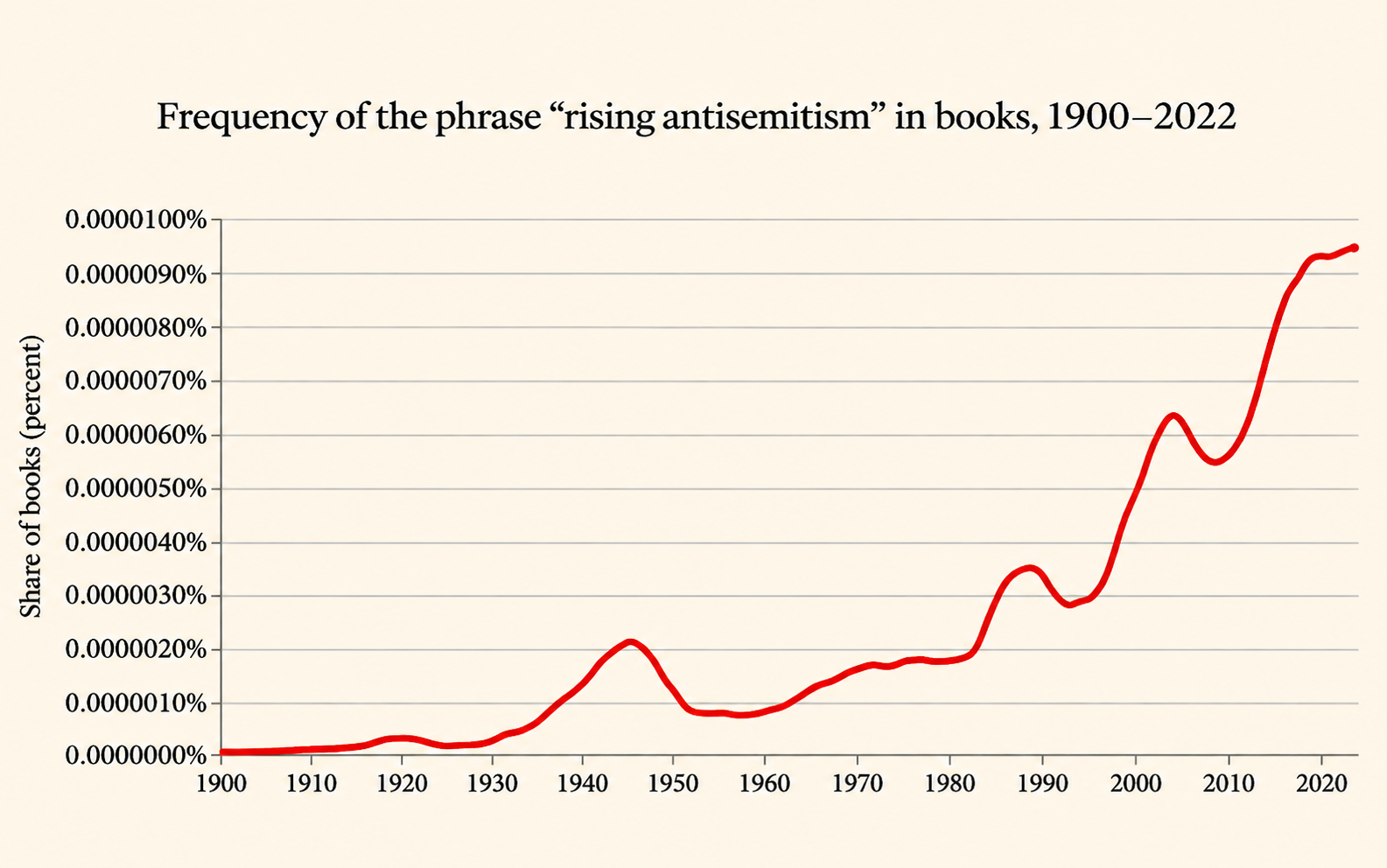
A search of historical language usage on Google Books Ngram Viewer reveals that the expression rising antisemitism has appeared in published books for generations, but its frequency has increased dramatically in recent decades. And the data ends in 2022, before the October 7 Hamas massacre and the subsequent global outpouring of Jew hatred. In other words, the language of rising antisemitism is itself on the rise. But whether Jew hatred is actually increasing or the social restraints that once kept it beneath the surface are eroding is a distinction rarely explored in our habitual warnings.
There is also a sense of perpetual surprise, as though centuries of social and moral progress should have rendered antisemitism obsolete. Yet it has survived the Enlightenment, Jewish emancipation, liberal democracy, socialism, the defeat of Nazism, and the modern human rights movement. Its intensity has varied enormously, but Jew hatred has proved adaptable. Over time, Jews have been condemned for their religion and their race, accused of being both capitalist exploiters and communist revolutionaries, rootless cosmopolitans and dangerous nationalists. Today, some of the oldest antisemitic tropes have been repackaged in the language of social justice, anti-imperialism, and liberation. The vocabulary changes and the political affiliations shift, but familiar patterns of demonization persist. In treating antisemitism as an unexpected deviation, we avoid examining the cultural and ideological conditions that continue to sustain it.
The myth of rising antisemitism lies in its habitual characterization as an emerging crisis, as though the problem were always just beginning to become intolerable. The word rising suggests movement toward some threshold, a point at which the problem becomes serious enough to demand intervention. It carries the paradoxically comforting implication that what goes up must eventually come down. Or, more ominously, that the pressure will build until some breaking point forces us to act. Either way, we are invited to wait.
And in that waiting lies a kind of acquiescence. Imagine speaking of rising racism decade after decade, without demanding more than another round of warnings and condemnations. We would rightly question not only the persistence of the prejudice but the failure to confront it. Yet rising antisemitism has become a nearly permanent feature of public discourse, as though its continued ascent were an unfortunate but inevitable fact of life. At what point does repeatedly acknowledging a problem become a way of accommodating it?
Even the word rising subtly removes responsibility. We speak of antisemitism as though it were a natural phenomenon, like temperatures, inflation, or sea levels. But antisemitism does not rise on its own. It is taught, cultivated, propagated, rationalized, and excused. Political movements exploit it. Institutions tolerate it. Consider the difference between announcing that antisemitism is rising on college campuses and identifying administrators who have failed to respond to documented harassment of Jewish students. One describes a climate; the other identifies conduct and accountability.
This also raises uncomfortable questions about the institutions dedicated to combating antisemitism. Jewish advocacy organizations perform important work documenting incidents, educating the public, and supporting victims. But a culture organized around measuring and publicizing antisemitism risks confusing documentation with progress. Each year brings new reports, statistics, conferences, and statements of alarm. Headlines announce another disturbing increase, another escalation. Meanwhile, how often do we apply the same scrutiny to the effectiveness of our responses? Which interventions have actually changed attitudes or institutional practices? Where have perpetrators faced meaningful consequences? Have we merely become bean counters of bad behavior?
There is also a psychological cost to the Jewish community. When we are repeatedly told that antisemitism is rising, fear can become a defining feature of Jewish life. We learn to anticipate the next outrage and prepare for the next betrayal. Whatever the intention, the constant sounding of the alarm risks reinforcing the very sense of vulnerability that Jew hatred seeks to produce. Security and vigilance may be necessary, but something is lost when Jewish identity becomes disproportionately defined by the rising hatred directed against us. Shouldn’t we be devoting at least as much energy to nurturing Jewish identity, pride, and confidence as we do to documenting Jewish victimhood? Living proudly as Jews may be one of the most powerful antidotes to the fear that these perpetual warnings instill.
October 7, 2023, and its aftermath make this question especially urgent. The Hamas atrocities and subsequent war in Gaza exposed and intensified prejudices that many Jews had believed were confined to the margins. For so many of us living in ostensibly liberal and pluralistic societies, the experience was one of profound disillusionment and betrayal. Some of the people and institutions we had trusted appeared willing to justify or accommodate expressions of antisemitism as moral virtue. The shock came not only from the prevalence of Jew hatred but from discovering how much hostility could emerge once the social restraints against expressing it weakened. That experience cannot be adequately described by an upward-pointing arrow on a statistical chart.
Reducing such profound ruptures to yet another instance of rising antisemitism risks obscuring their significance. The challenge is to move beyond documenting the hatred directed at Jews toward confronting the people, institutions, and ideologies that perpetuate it, without allowing that hatred to become the organizing principle of Jewish identity. The answer to Jew hatred is Jewish pride and power.