
The Day After Plan- Gaza Urban Redevelopment
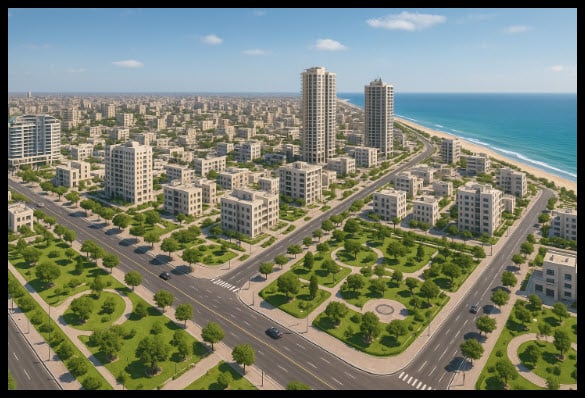
The time has come for Israel to do something historic—not just defensively, but constructively. After decades of war and unending humanitarian crises, we should ask a different question: What if Gaza became the most ambitious urban redevelopment project in the world?
This is not idealism—it’s strategic pragmatism, aligned with Israeli interests and the doctrine that shaped the Trump administration’s foreign policy: strength, clarity, regional alignment, and economic leverage.
Rather than waiting for the next round of destruction, Israel should propose to lead an international initiative to transform Gaza from a failed terror statelet into a functioning urban society—demilitarized, governed by neutral civilian oversight, and rebuilt through partnerships with Arab states, U.S. leadership, and European participation.
This plan proposes a four-phase, ten-year timeline for transformation, combining hard-nosed security enforcement with high-impact civilian development.
PHASE 1: Securing the Ground (0–18 months)
Objective: Elimination, Stabilization and Demilitarization
- Israel establishes and maintains strict security perimeter to prevent any resurgence of weapons stockpiling, tunneling, or terrorist infrastructure.
- The U.S. (through a Special Presidential Envoy) convenes a Gaza Redevelopment Compact involving Egypt, Jordan, the UAE, Saudi Arabia, and Qatar.
- A Neutral Redevelopment Authority (NRA) is established to govern civilian zones.
- Initial investments begin in debris removal, emergency shelters, sanitation, and water purification.
- Employment of 10,000+ local Gazans in cleanup and preparatory work begins.
- Hamas and all militant factions are disarmed under verifiable, enforceable conditions as a prerequisite to further phases.
Deliverable: Gaza transitions from active war zone to a secured, de-escalated territory with functioning civilian administration under international oversight.
PHASE 2: Laying Foundations (18–48 months)
Objective: Begin civilian life and light infrastructure
- Construct five Urban Renewal Districts, each with housing, schools, clinics, and roads.
- Arab nations finance infrastructure, with the U.S. coordinating transparency, governance, and sequencing.
- Israeli firms may assist in solar power, water desalinization, and construction technology.
- European partners contribute technical design, vocational training curricula, and health systems.
- 100,000 Gazans employed in housing, logistics, trades, and skilled training programs.
- A local police force is trained, demilitarized, and accountable to the NRA, not factions.
- No-go zones and secure corridors ensure Hamas cannot reassert control.
Deliverable: Daily civilian life resumes in designated districts; basic services are stable; a new generation is being trained to work, not fight.
PHASE 3: Economic Engines (Years 4–7)
Objective: Employment, industry, and long-term stability
- Launch economic opportunity zones: tech parks, logistics hubs, agricultural greenhouses, and fisheries, with oversight by Arab sovereign wealth funds and private sector partners.
- Build ports and commercial corridors, monitored for weapons interdiction by a multinational task force.
- Establish academic institutions and trade schools, possibly with campuses sponsored by Gulf and European universities.
- Young Gazans begin earning and saving, not emigrating or radicalizing.
- Israeli and Palestinian entrepreneurs collaborate in controlled digital and service sectors.
Deliverable: Gaza begins generating its own economic momentum, becoming self-sustaining in essential goods and labor, with outside aid slowly tapering off.
PHASE 4: Normalization and Growth (Years 7–10)
Objective: Transition from redevelopment to self-governance and regional integration
- Civil administration transitions to local Gazan leadership, vetted and trained over prior years, still supported by international monitors.
- Host an International Expo in Gaza celebrating peace-based renewal.
- Open secure border trade with Israel and Egypt, with monitored crossings and regulated movement.
- Gaza becomes eligible for international development grants, tourism partnerships, and inclusion in regional economic forums.
- Palestinian youth now grow up not knowing war as a norm, but with ambitions to build and belong.
Deliverable: Gaza becomes a model of post-conflict renewal in the Middle East—imperfect, but functioning, demilitarized, and governed by a generation that chose productivity over provocation.
Strategic Roles
Israel: Vision and Security Backbone
- Guarantees national security through buffer zones and oversight
- Leads diplomatically by proposing the initiative and cooperating in construction and technology
- Sends a global message: we lead not just by force, but by building
United States: Anchor and Diplomatic Engine
- Appoints a Special Envoy for Gaza Reconstruction
- Leverages Trump-era Gulf relationships (Abraham Accords) to secure capital and cooperation
- Oversees transparency, deconfliction, and conditional funding benchmarks
- Provides strategic cover for Israel while realigning regional architecture
Arab States: Investors and Influencers
- Contribute billions in redevelopment funding via sovereign funds
- Use on-the-ground expertise in construction, energy, and urban planning
- Validate the civilian nature of the project through religious and cultural legitimacy
Europe: Technical Partners
- Offer urban design, educational partnerships, and health infrastructure
- Contribute personnel to oversight missions and post-project audits
- Avoid political overreach, remain focused on humanitarian delivery
Why Now?
Because failure to act ensures the next war.
Because every destroyed building is a future wound.
Because the region is shifting toward practical cooperation and mutual interests.
The Trump administration’s foreign policy redefined what was possible in the Middle East. Israel, the U.S., and Arab partners can now finish what the Abraham Accords began—not just with normalized embassies, but with rebuilt neighborhoods, functional economies, and hopeful populations.
Let Gaza rise—not just for the sake of its people, but for the stability of the region and the credibility of those who claim to lead it.
This is not a dream. It’s a ten-year plan, with measurable outcomes and enforceable milestones.
Let the world see that Israel is not afraid to lead—even in the hardest places.
Bring the naysayers, critics and anti-Zionists to be part of the solution instead of remaining the problem.
Let Gaza rise—not as a threat, but as proof of what can happen when the region chooses to build rather than break.
What it needs now is courage. Vision. Leadership.
Let’s build it.