
Articles Crafted for Action
The Day After the Iranian Regime
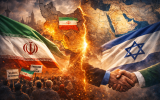
For forty-five years the Middle East has been organized around one assumption: the Islamic Republic of Iran is permanent.
But what if it isn’t?
If the regime in Tehran were to fall tomorrow, the entire strategic architecture of the region would change overnight.
And one of the most dramatic consequences may be something few people are even discussing:
The collapse of the Middle East’s longest war against Israel.
For decades the Iranian regime built an entire foreign policy around Israel’s destruction. Tehran financed, armed, and directed proxy militias such as Hamas and Hezbollah as the front lines of that strategy.
Those groups were never merely local actors.
They were pillars of a regional project.
Remove the project, and the pillars begin to crack.
Without Iranian money, Iranian weapons, and Iranian coordination, both Hamas and Hezbollah would face a radically different reality.
Missiles require funding.
Militias require logistics.
Ideological wars require sponsors.
And the Islamic Republic has been the primary sponsor of the anti-Israel war for nearly half a century.
But the implications go even further.
Because the hostility between Israel and Iran was never historically inevitable.
Before the 1979 revolution, the two countries were quiet strategic partners. Israeli engineers worked in Iran. Iranian oil flowed to Israel. Intelligence cooperation was routine.
The hatred that defines the relationship today was not born from the peoples themselves.
It was imposed by a revolutionary regime.
Which raises a question that once sounded impossible but now feels increasingly relevant:
What would a Middle East look like without that regime?
Inside Iran today, a younger generation has shown growing frustration with a government that spends billions funding foreign militias while ordinary Iranians struggle under economic pressure and repression.
One protest slogan captured the sentiment clearly:
“Neither Gaza nor Lebanon. My life for Iran.”
It was not a pro-Israel slogan.
But it was something almost as significant.
A rejection of endless ideological war.
None of this means a post-regime Iran would instantly become friendly toward Israel. Transitions after authoritarian rule are rarely simple. Instability and internal power struggles could follow.
But even uncertainty would mark the end of something enormous.
The revolutionary project that exported militancy across the region.
For decades the Middle East has been shaped by the ambitions of one revolutionary regime in Tehran.
But history has a way of surprising even the most entrenched systems.
If the day comes when the Islamic Republic no longer defines the region’s politics, the Middle East will not simply face the end of a regime.
It will face the beginning of an entirely new strategic landscape.
And the most remarkable realization of all may be this: Israel’s longest war was never truly with the Iranian people.
It was with the regime that ruled them.
Related Topics
Related Posts