
The Day America Betrayed the Jewish Homeland
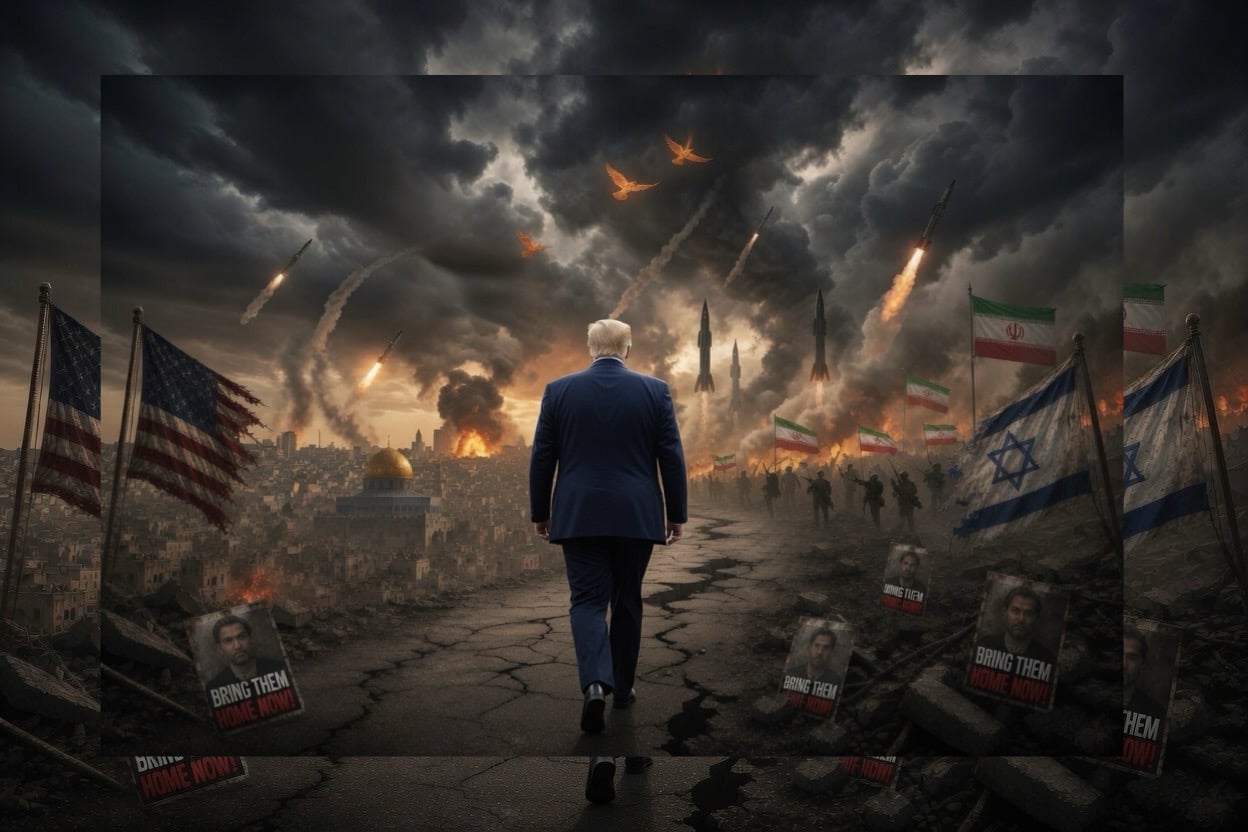
Something has happened over the past two days that I never thought I would witness.
Not after October 7. Not after the hostages. Not after two and a half years of war. Not after watching Israel fight on multiple fronts against enemies openly dedicated to its destruction.
Yet here we are.
Over the past forty-eight hours, the terms of the memorandum have emerged. At the same time, President Trump has publicly argued that Iran should be permitted ballistic missiles because other countries in the region possess them. We have watched public criticism directed at Israel and Prime Minister Netanyahu while the regime responsible for funding and arming much of the terror that has engulfed the region is treated as a problem to be managed rather than a threat to be defeated.
I have read the reporting. I have listened to the statements. I have looked at the totality of what is unfolding. Ultimately I am left with a conclusion I can no longer avoid:
I believe I am witnessing the day America betrayed the Jewish homeland.
Those are not words I write lightly. I have spent years trying not to write them.
I did not vote for Donald Trump. I voted for Hillary Clinton because I did not believe he possessed the character, temperament, or judgment necessary to be President. Much of what I saw in his first term reinforced those concerns. When the American people elected him to a second term in 2024, my personal feelings ceased to matter. I had an obligation to judge him by his actions as President, not my prior vote. When he was right about Israel, I said so. When he helped, I acknowledged it. I tried to call balls and strikes.
That is precisely why this is so painful. This is not the conclusion I wanted to reach.
I know many will disagree. They will point to a particular clause or diplomatic concession and insist I am overreacting. Perhaps any one of those things, viewed in isolation, could be explained away. But I am no longer looking at isolated pieces. I am looking at the entire picture through the prism of the last two and a half years.
I believed October 7 would teach the world one lesson: that:
Never Again is Now
I fear, tragically, the world learned the opposite lesson.
October 7 was the largest massacre of Jews since the Holocaust. It happened in the Jewish homeland. Nearly two and a half years later, Hamas still survives, Hezbollah has joined the war, and the rockets have never stopped. Yet the conversation has steadily shifted from the perpetrators to demands that Israel show restraint, accept ceasefires, and normalize threats no other nation would tolerate.
The massacre became a statistic.
The hostages became background noise.
The trauma became familiar.
The outrage faded.
The impossible became ordinary.
Through all of it, one concession followed another. Iran built the network of proxies that set the region ablaze. It armed Hamas and Hezbollah. It spent decades calling for Israel’s destruction. Yet today, we discuss sanctions relief, reconstruction funds, and security assurances that would have been unthinkable months ago, while President Trump suggests Iran’s ballistic missiles are negotiable simply because others possess them.
What I see is surrender masquerading as diplomacy.
I see normalization masquerading as pragmatism.
I see accommodation masquerading as strategy.
That is not the lesson I took from October 7.
Just two days ago I listened to former IDF officer Itai Medina on the IDSF podcast. What stayed with me was not his politics but the deadly seriousness with which he approached Jewish survival.
Something far more fundamental than diplomatic formulas or public relations. His words echoed as the memorandum details emerged, as Trump’s comments landed, as Israel once again became the target of criticism while its chief enabler was granted legitimacy.
The question that haunts me now is simple:
What lesson did we actually learn from October 7?
For two and a half years I have said that “Never Again” is not a slogan. It is a responsibility. On October 7 it happened again—in our lifetime, in our homeland. And ever since, the world has asked Israel to normalize the abnormal, one compromise at a time.
I watched the crack form. October 7 struck like a sledgehammer, but the stone held.
I still believed the world would understand. I still believed the scale of the horror would force a moral reckoning. Then came the excuses, the rationalizations, the demands for restraint while the butchers received context. The UN, the media, the governments, the activists, the academics—all explaining to Jews why the massacre of Jews required more scrutiny of the victims than the perpetrators.
Each one another strike.
Another fracture.
A death by a thousand cuts.
Still I held on.
I believed certain lines would never be crossed. Through all of it, I still believed America understood. That was the pillar that remained.
The United Nations had failed.
The media had failed.
The activists had failed.
The academics had failed.
Much of the international community had failed.
But I still believed America understood what October 7 meant. That was the assumption that survived.
That is why the last forty-eight hours hit me so damn hard.
Then came the memorandum.
The concessions.
The ballistic missile comments.
The public criticism of Israel and Netanyahu.
The accommodation of the regime that made October 7 possible.
The final blow landed. The crack reached the other side of the stone. This is not because Trump created the fracture. He didn’t. But, what unfolded in these two days delivered the final coup de grâce to a belief that had already been under relentless assault for two and a half years.
What angers me most is the language we now accept. We speak of “the destruction of Israel” as though it were an ordinary geopolitical dispute over borders. It is not.
Iran is a regime that has spent decades promising the murder of seven million Jews—the largest Jewish community on earth—in the Jewish homeland. So after October 7, no one gets to pretend they don’t understand what those words mean.
We saw what happens when people who openly seek the murder of Jews are given the opportunity. I refuse to normalize that.
I no longer trust the United Nations.
I no longer trust the media.
I no longer trust the governments of the world.
And after the last forty-eight hours, I no longer trust the United States to do what is necessary when Jewish survival is on the line.
But I still trust Israel and I still trust the Jewish people. And I still believe that whoever sits in the Prime Minister’s Office will act before the Jewish people are once again forced to depend upon the courage of others for their survival.
Because if the last two and a half years have taught me anything, it is that nobody will ever care more about Jewish survival than Jews themselves.
As Itai Medina said:
“This is our Auschwitz.”