The Day The Marathon Man Stole A Chick
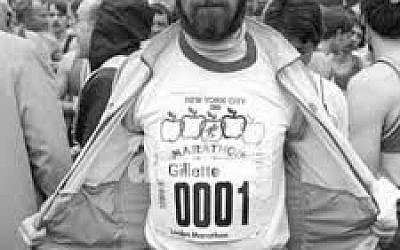
In 1992, Fred Lebow told me a story he had never before told in public. It had to do with a chick.
The founder of the New York City Marathon and president of the New York Road Runners Club told me the chick story in an interview for a book in his office. Photos of him with Pope John Paul III and Presidents Ronald Reagan and George H.W. Bush were framed on his desk and the wall behind him.
Lebow recounted learning in February, 1990 that he had a rare cancer of the brain, and that family and friends had visited him at Mount Sinai Medical Center in upper Manhattan, and how that night, alone in his hospital room, he had cried for the first time in 50 years.
Fischel Leibowitz was born in Western Rumania, in an Orthodox Jewish family. When the Nazis occupied his small Transylvanian town of Arad, his father was sent to a work camp, where he was ordered to wear a yellow star stigmatizing him as a Jew. Later the boy would learn that the Nazis had murdered his grandparents, uncles, aunts and cousins. He fled his homeland to Bulgaria, then migrated to Czechoslovakia, Holland, England and Dublin before arriving in the United States in 1951, reincarnated as Fred Lebow.
His weeping in the hospital had nothing to do with either Nazis or the disease that now threatened to kill him, as his doctor predicted, within three months, maybe six. It had to do with an incident he had long since forgotten about, only to realize that he had carried its memory with him for half a century.
“When you’re in the hospital, you have lots of time to think,” he told me. “It was the first time I had had this. I was able to think about myself in depth.”
Lying in bed, he said, Lebow suspected he must have committed a wrong grievous enough to taint his soul and spur a tumor to grow in his skull. He now wanted to recall his mistakes and come clean.
“Why me?” he told me he asked himself about his cancer. “Why now?” I wanted to find out. I needed to know. Maybe, I thought, it was something I had done. Maybe God was punishing me for misbehaving. Suddenly I wanted to confess my sins.”
And now, in the flickering cinema of recollection, aching with guilt and remorse, he vividly remembered why he was crying.
“I remembered being only six years old, in Rumania, before World War II,” Lebow told me. “I was walking on a road with my friends. I was going from my house to the main section of town, only two blocks. It was a city street, but it had a country atmosphere.”
“A farmer went by in the road,” Lebow went on, “and he was followed by a mother hen with a dozen chicks behind her. The chicks toddled along in a line, all small and yellow and fuzzy. I’d always loved those little chickies and wanted one as my pet. So I scooped up the last chick in my palm and ran down the block, back to my house. I decided that my pet goat would have a companion and I would keep the chick in the backyard.”
Lebow spoke softly, in a raspy voice. Telephones trilled in the background. A fan whirred overhead. He nibbled on some rugelach I had brought him from a kosher bakery.
“I remembered that I sat that night on a stool in front of my house,” he said. “It was dark. And from inside I heard the neighbor who owned the chickens tell my father I had stolen the chick. I had left my cap on the street early that day, and he found out it was mine and told my father. My parents knew and gave back the chick and never punished me, and I never found out what happened to the chick.”
“I felt so ashamed that I cried,” he explained. “And that was what had bothered me for 50 years. It was the only bad deed I could remember. And after my diagnosis, I cried for the first time since the incident. Then, I thought, So this is what I’ve worried about all these years – that I stole a chick.”
Lebow seldom indulged in introspection, almost never dwelling on mistakes or second-guessing himself. That was how he had established an empire and the biggest marathon in the world But this was different from anything else he had ever confronted. This was cancer of the brain.
“I went through so much that first night in the hospital,” Lebow told me. “It lasted only about two hours, all this remembering, but it felt like the longest night of my life. I realized I had nothing to be sorry about anymore. I had never insulted or hit anyone. I had treated women well.
I was actually a pretty good guy. I had never known this. I forgave myself.”
“My last thought before I fell asleep was about the chick,” he said. “I woke at seven the next morning, and I felt great, ready to fight my cancer.”
Fred Lebow, informed he might live another three to six months, lived four-a-half more years. A life-sized bronze statue of him in his trademark running suit stands today in Central Park. He was a pioneer who helped bring running as sport and recreation into the global mainstream, His legacy promises to be impossible to equal.
Better still, his revelation about the chick before he died, originally a source of anguish, ultimately brought him peace.
Related Topics