
Where history exposes power and moral failure
The Dead Made Easier: The Narrative Laundering of the Holocaust
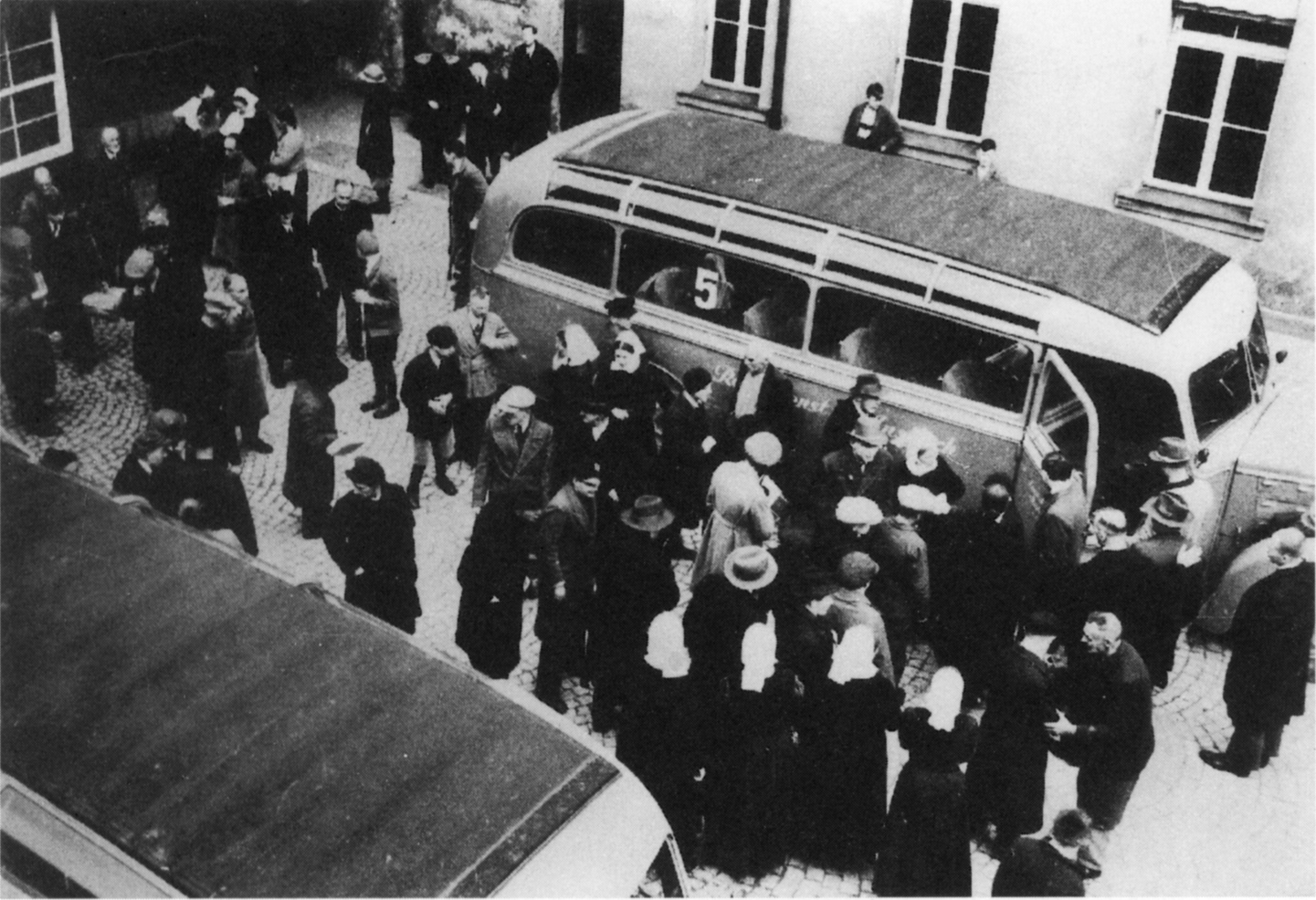
Transfer of Disabled institutionalized people during Aktion T4, the Nazi state murder program targeting Disabled people, from the Bruckberg care institution in Bavaria, c. 1940–1941. Public-domain archival image via Wikimedia Commons.
People do strange things to the dead when the dead become politically inconvenient.
They soften them. They resize them. They strip away the details that create friction with the moral self-image of the living. The revolutionary, the partisan, the armed resistance fighter becomes respectable. The refugee becomes lawful, grateful, and safely assimilated. The homosexual becomes tragic rather than targeted. The Disabled murdered become unfortunate patients rather than processed victims of state killing. The Roma and Sinti dead become background casualties of war rather than victims of deliberate racial extermination.
The process is not always overt falsification. In fact, it is often more effective when it is not.
Narrative laundering usually operates through reduction. The politically specific becomes morally generic.
One of the more revealing examples is Pierre Seel, the French Holocaust survivor arrested because he was homosexual and sent to Schirmeck-Vorbrück in occupied Alsace. Seel’s homosexuality was not incidental biography. It was the reason for his arrest. Yet for decades after the war, queer Holocaust victims occupied an uneasy position within public memory. Their suffering could be acknowledged abstractly while the sexuality that produced the persecution remained socially embarrassing, criminalized, or morally suspect across much of Europe.
The result was a peculiar form of postwar distortion. The homosexual victim could be mourned only after being rhetorically detached from homosexuality itself.
This was not merely omission. It was continuity. The camps were liberated. The shame systems were not.
Postwar Europe did not suddenly become comfortable with homosexual life because Nazi Germany had fallen. In West Germany, Paragraph 175, the law criminalizing homosexual acts between men, remained in force for decades after the Third Reich. Many queer survivors therefore moved from one persecutory order into another, carrying memories that public culture was still not prepared to dignify without first disinfecting them.
The dead, of course, are easier to assimilate than the living.
A dead homosexual prisoner can eventually be folded into universal victimhood. A living homosexual demanding social legitimacy remains much harder for respectable society to metabolize.
The same laundering mechanism appears in public memory surrounding Aktion T4, the Nazi program that systematically murdered Disabled institutionalized people beginning in 1939. Disabled victims are still too often remembered through euphemistic or depoliticized language that obscures the structure of the crime. The killings become tragic medical abuse, pseudo-scientific excess, or horrifying ethical failure within psychiatry.
But Aktion T4 was not administrative confusion. It was not uncontrolled sadism. It was organized state killing.
Disabled people were identified, categorized, photographed, evaluated, transported, gassed, cremated, and falsified through bureaucratic systems operating with procedural calm. Doctors signed transfer papers. Clerks processed records. Families received fraudulent death certificates. Institutions became channels through which people first classified as burdens were converted into administrative problems and then removed.
Even the language around the program performs its own laundering. “Euthanasia” softens. “Mercy killing” softens. “Medical tragedy” softens.
Each term creates distance from the more destabilizing reality: Disabled people were murdered because the state classified their continued existence as socially, biologically, and economically burdensome.
That is precisely why Aktion T4 remains so uncomfortable.
It does not merely expose Nazi violence. It exposes how quickly modern bureaucratic systems can recode dependence itself as evidence against a person’s right to remain alive.
The Roma and Sinti dead have endured a different but equally revealing form of laundering. For decades after the war, Roma and Sinti victims of Nazism were submerged into broad discussions of wartime suffering or concentration-camp imprisonment, despite the fact that Nazi persecution of Roma communities was explicitly racialized, systematic, and genocidal.
Roma and Sinti people were registered, segregated, deported, sterilized, exploited for forced labor, subjected to medical experimentation, starved, shot, and exterminated under racial policy. Yet postwar Europe remained profoundly reluctant to confront this genocide because anti-Roma prejudice itself survived the collapse of the Third Reich with remarkable durability.
Recognition came slowly because recognition required implication.
To fully acknowledge the genocide of Roma and Sinti people would have required postwar European states to admit that the prejudices underpinning Nazi persecution had not disappeared in 1945. They had merely become less theatrical, less uniformed, and more administratively polite.
This is why euphemistic flattening proved so useful.
“Camp victims” is easier than racial enemies. “Wartime suffering” is easier than genocide.
“Other victims” is easier than admitting that the hatred which helped make their extermination possible remained socially functional after liberation. Administrative vagueness protects societies from examining the continuity between historical persecution and present-day prejudice.
This argument begins from the historical fact that Jews were the central targets of Nazi extermination policy and that antisemitism was the ideological core around which the Holocaust was organized. Refusing to flatten other persecuted groups does not dilute that fact; it prevents Holocaust memory from becoming so abstract that even Jewish victims are stripped of the actual conditions that made their persecution possible.
The same pattern repeats constantly across Holocaust memory.
The same pattern repeats constantly across Holocaust memory. This does not diminish the centrality of Jewish persecution to the Holocaust, nor does it blur the specific antisemitic purpose of the Nazi genocide. It insists, instead, that honest Holocaust memory cannot require Jewish victims or any other targeted group to be made simpler than they were.
Jewish refugees sometimes become immigrants who “came legally,” detached from statelessness, exclusion quotas, detention systems, ship turnaways, and international indifference toward Jewish displacement.
Communist resistance fighters become generic opponents of tyranny, their actual political commitments softened once anti-Communism became foundational to postwar Western identity.
Militant anti-fascists become beloved grandfathers whose radicalism quietly disappears beneath family nostalgia.
Women whose persecution involved sexual violence, coercion, forced sterilization, or prostitution are often remembered through cleaner narratives of generalized suffering that leave gendered bodily violation at the margins. Even bureaucratic language itself performs laundering work.
The Nazi state understood the political usefulness of euphemism perfectly well. Deportation became “resettlement.” Murder became “special treatment.” The administrative file transformed annihilation into procedure. A clerk processing transport schedules in Berlin could understand himself as handling logistics rather than facilitating mass death.
Postwar memory often inherits this same instinct toward sanitization, albeit for different reasons.
The problem is not always denial. The problem is frequently aesthetic and moral management.
Societies prefer victims who can be commemorated without producing obligation.
The refugee must not complicate immigration politics. The queer victim must not complicate sexual politics. The Disabled dead must not complicate contemporary attitudes toward dependency, institutionalization, or bodily worth. The Roma victim must not complicate modern Europe’s treatment of Roma communities. The Communist anti-fascist must not complicate Cold War moral narratives. The politically difficult victim is gradually transformed into a universally consumable one.
Families perform the same operation on a smaller scale.
Within families, narrative laundering often emerges not through malice but through the pressure to stabilize identity across generations. Contradictions become expensive inside kinship systems. The politically inconvenient ancestor is softened into someone emotionally manageable.
A refugee becomes proof of patriotic assimilation. A radical becomes proof of hard work. A concentration-camp survivor becomes evidence of family resilience detached from the politics that produced the imprisonment in the first place.
None of this displaces the central Jewish catastrophe of the Holocaust. On the contrary, it shows how the machinery of Nazi persecution also produced survivor histories that later families and nations have repeatedly tried to simplify.
In my own extended family, archival records concerning a concentration-camp survivor later resettled in the United States preserve a far more politically specific figure than the later family mythology allowed: a man identified in refugee-processing records as Communist before the outbreak of the Second World War, arrested by German authorities for assisting anti-fascist partisan activity through transport work, imprisoned in Dachau and Neuengamme, evacuated through Red Cross refugee systems, and later resettled through displaced-person infrastructure.
Over time, however, the story became cleaner. According to those who survived him, the refugee became an immigrant. The anti-fascist became a kindly grandfather who had suffered during the war. The political commitments which had led to his persecution under Nazism faded. The statelessness faded.
The phrase eventually offered, with hand-writing helplessness, was that he had simply been “in the wrong place at the wrong time.” But concentration camps were not inconvenient meteorological events. People were processed through them for reasons. Those reasons included Jewishness, ethno-religious identity, disability, homosexuality, and political enmity against the Nazi regime.
The wrong place at the wrong time.
That sentence, common in family memory, performs an enormous amount of ideological labor. It removes politics from persecution. It removes agency from resistance. It converts historically specific anti-fascist imprisonment into unfortunate accident. The dead become easier to inherit once they no longer threaten the worldview of their descendants. This is why archival specificity remains so destabilizing.
A refugee file restores statelessness. A police interrogation restores political identity. A camp registration restores the reason for imprisonment. A transport manifest restores displacement. The record interrupts the softened version of the dead that later generations preferred to keep.
And often the reactionary and political anger this produces is revealing. Cognitive dissonance regarding this inconvenience is seen on large and small scales when narrative laundering about Holocaust victims is not tolerated. The conflict is rarely about whether the victim suffered. The conflict emerges over why they suffered, who they were before they suffered, and whether the living are willing to inherit the full historical implications of the dead rather than merely their moral symbolism.
Because a Holocaust victim or survivor is not a decorative object for descendants or nations, and the dead do not become more truthful simply because later generations have made them easier to love.
Selected Sources
- Pierre Seel, I, Pierre Seel, Deported Homosexual
- Raul Hilberg, The Destruction of the European Jews
- Henry Friedlander, The Origins of Nazi Genocide: From Euthanasia to the Final Solution
- Michael Burleigh, Death and Deliverance: “Euthanasia” in Germany c. 1900–1945
- Guenter Lewy, The Nazi Persecution of the Gypsies
- Ian Hancock, The Pariah Syndrome: An Account of Gypsy Slavery and Persecution
- United States Holocaust Memorial Museum, Holocaust Encyclopedia
- Documentation Centre of Austrian Resistance
- Arolsen Archives
- Swedish National Archives refugee-processing records
- Neuengamme Concentration Camp Memorial Archives
- Dachau Concentration Camp Memorial Site Archives
- United States Holocaust Memorial Museum, “Antisemitism and the Holocaust.”
- United States Holocaust Memorial Museum, “What Groups of People did the Nazis Target?”
Related Topics
Related Posts