A Moroccan Journalist
The deafening silence: Israel’s inexcusable absence from the Es-Smara chorus
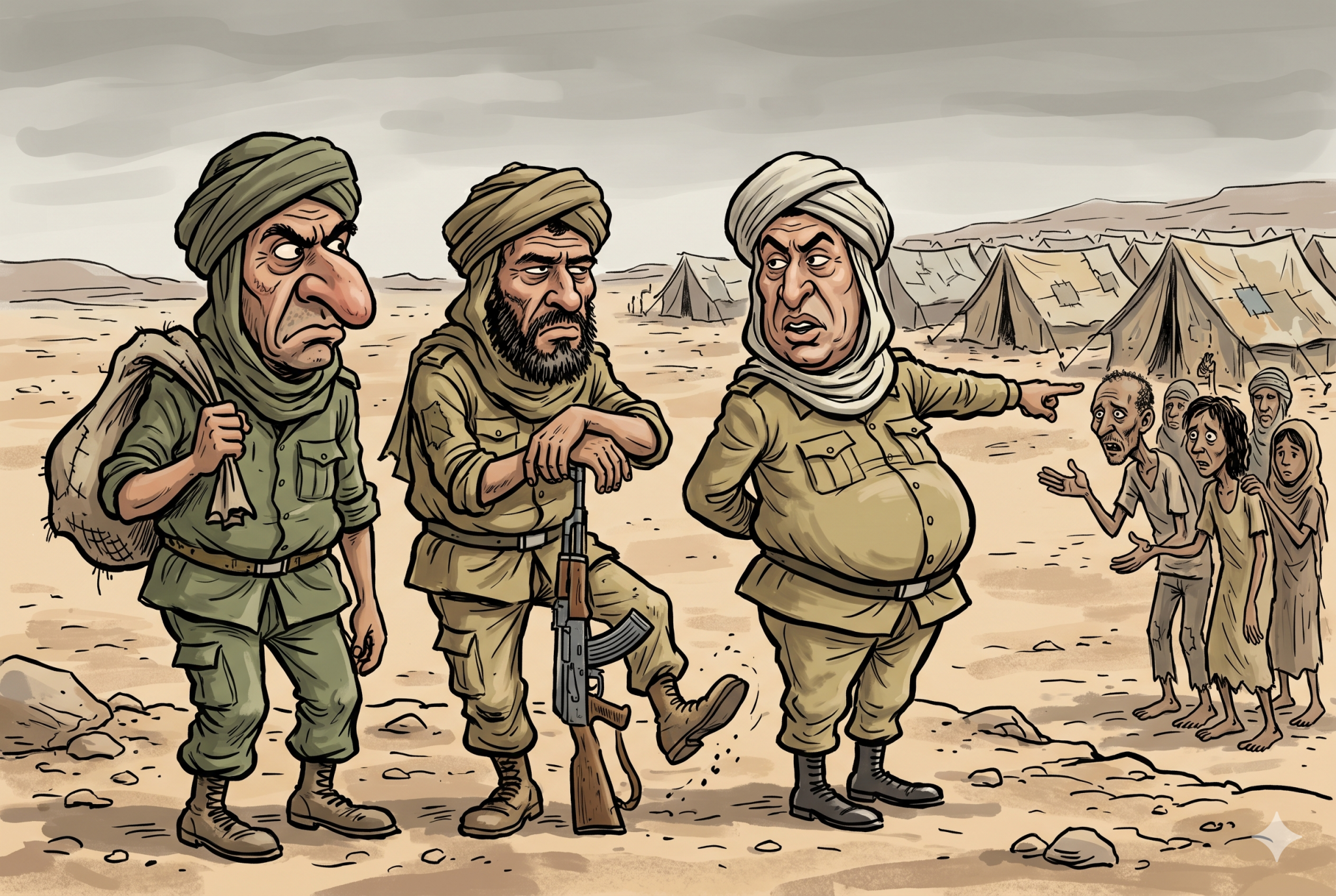
The Polisario fires rockets to liberate a land it has never governed, while the people rotting in Tindouf’s camps remain its most neglected hostages.
When projectiles tore through the air above Es-Smara on the evening of May 5 – landing near a civilian prison, behind a cemetery, and wounding a woman whose only crime was existing in the vicinity of a conflict she never chose – the world, for once, spoke with something approaching a unified throat.
The United States condemned the attack in language so muscular it rattled the windows of the Algerian junta. France followed with characteristic diplomatic precision. The European Union, the United Kingdom, Belgium, the Czech Republic, Spain, Bahrain, Saudi Arabia, Qatar, the UAE, and Liberia all issued denunciations ranging from the sternly worded to the unequivocally incendiary.
The UAE and even Qatar, in an unprecedented rhetorical escalation, branded the Polisario’s assault a “terrorist act” – terminology that, until this month, had been almost surgically absent from official Arab discourse on the Front.
I followed every statement. I tracked every embassy communiqué, every diplomatic tweet, every carefully calibrated expression of solidarity and outrage. As a journalist covering this dossier for years, I have learned that in international relations, what is said matters – but what is not said can be catastrophic.
Israel said nothing.
Not a syllable. Not a perfunctory statement of concern. Not even the hollow, bureaucratic boilerplate that foreign ministries produce the way factories produce widgets. From the state that formally recognized Moroccan sovereignty over the Sahara in July 2023 – in a letter from Prime Minister Netanyahu to King Mohammed VI himself – there came only the vast, embarrassing hum of diplomatic nothingness.
Let me be precise about what this silence is, and what it is not. It is not a mystery. It is not an oversight. It is a calculated omission, and it is indefensible.
I am not in the business of dictating foreign policy to sovereign nations. Every state navigates its own constellation of interests, pressures, and strategic imperatives, and I hold no pretension of interfering in those calculi. As Thucydides wrote, “The strong do what they can, and the weak suffer what they must.” But there are moments when the refusal to speak becomes indistinguishable from complicity – when silence ceases to be neutrality and becomes, instead, a form of betrayal.
This is one such moment.
Israel’s recognition of Moroccan sovereignty over the Sahara was not a casual diplomatic courtesy. It was a foundational pillar of the Abraham Accords architecture – a strategic compact that bound Rabat and Jerusalem in a web of military cooperation, intelligence sharing, and geopolitical alignment that has only deepened since.
In January 2026, the two nations signed a joint military work plan at their Third Joint Military Committee in Tel Aviv. Israeli soldiers train alongside Morocco’s Royal Armed Forces (FAR) in the African Lion exercises. Israeli drones, air defense systems, and reconnaissance satellites now form the vertebrae of Morocco’s security spine. The relationship is not transactional; it is structural, intimate, and – if Israel’s own rhetoric is to be believed – existential for regional stability.
And yet, when a militia operating from Algerian soil fires rockets at a Moroccan civilian city – the very territory over which Israel has staked its sovereign recognition – Jerusalem cannot muster a single sentence of condemnation?
The irony is not merely academic. It is architecturally atrocious. The Polisario Front and Hamas are ideological twins separated at birth – non-state armed groups that cloak territorial maximalism in the language of liberation, that target civilians while claiming to strike military installations, and that operate as proxies for larger powers invested in perpetual instability. If Israel expects the world to treat rocket fire into Sderot as terrorism, then it cannot look the other way when projectiles slam into Es-Smara. Moral consistency is not a luxury; it is the price of credibility.
There is, of course, the Palestinian dimension – an irony so layered it verges on the absurd. Palestinian leftist factions, principally the PFLP, have for decades been among the Polisario’s most vocal ideological allies. George Habash himself visited the Tindouf camps in the 1970s and declared fraternal solidarity with the Sahrawi separatist cause. The very movements that seek the dissolution of Israel’s territorial integrity champion the dissolution of Morocco’s. One would think that this shared adversary – this common grammar of separatism and subversion – would make Israel’s solidarity with Rabat not merely easy but instinctive.
And in fairness, behind the curtain, Israel does help. The defense contracts, the satellite deals, the tunnel warfare simulations in the Moroccan desert – none of this is fiction. But diplomacy conducted exclusively in the shadows is diplomacy half-done. Israel has offered Morocco the hardware of alliance while withholding the firmware of public solidarity – selling the sword but refusing to raise the voice.
Israeli statesman Abba Eban once skewered the Arab world with an observation that has since calcified into geopolitical scripture: “The Arabs never miss an opportunity to miss an opportunity.” The bitter irony of Es-Smara is that Israel has now appropriated the very affliction its greatest diplomat diagnosed in others. Here was an opportunity – crystalline, cost-free – to stand beside a partner whose sovereignty Israel itself endorsed before the United Nations, and Jerusalem let it pass like sand through an unclenched fist.
It was also Eban who remarked that “if Algeria introduced a resolution declaring that the earth was flat and that Israel had flattened it, it would pass by a vote of 164 to 13 with 26 abstentions.” He understood that Algeria’s diplomatic machinery operates on the engine of obstruction – the same Algeria that today bankrolls, arms, and shelters the Polisario while feigning ignorance when rockets arc toward Moroccan cities. That Israel would decline to confront Algeria’s proxy at the very moment the entire international community was doing precisely that is a strategic absurdity.
Every sovereign state is free to calibrate its own positions. I do not dispute this. But freedom of action does not exempt a nation from the consequences of inaction. Israel missed an opportunity – not merely to stand with a partner, but to demonstrate that its recognition of Moroccan sovereignty is more than parchment, more than a quid pro quo for normalization, more than a geopolitical transaction stripped of moral content.
The Polisario wants Morocco’s territory back but refuses to negotiate, refuses the autonomy framework, refuses to abandon violence – it wants, to borrow Eban’s immortal formulation, “resolution by immaculate conception.” Israel knows this pathology intimately. It has lived it, bled from it. And yet, when the same pathology manifested in Es-Smara – rockets at civilians by a militia that answers diplomacy with detonation – Israel chose the unforgivable luxury of silence.
The chorus of condemnation after Es-Smara was remarkable for its breadth and its ferocity. It may well prove to be the Polisario’s political obituary. But in that chorus, one voice was conspicuously, inexplicably, and scandalously absent. And in the cathedral of international relations, a missing note is never just silence.
It is a verdict.
Related Topics