CEO of Time to Stand Up for Israel
The Decline of the World Is Visible on X
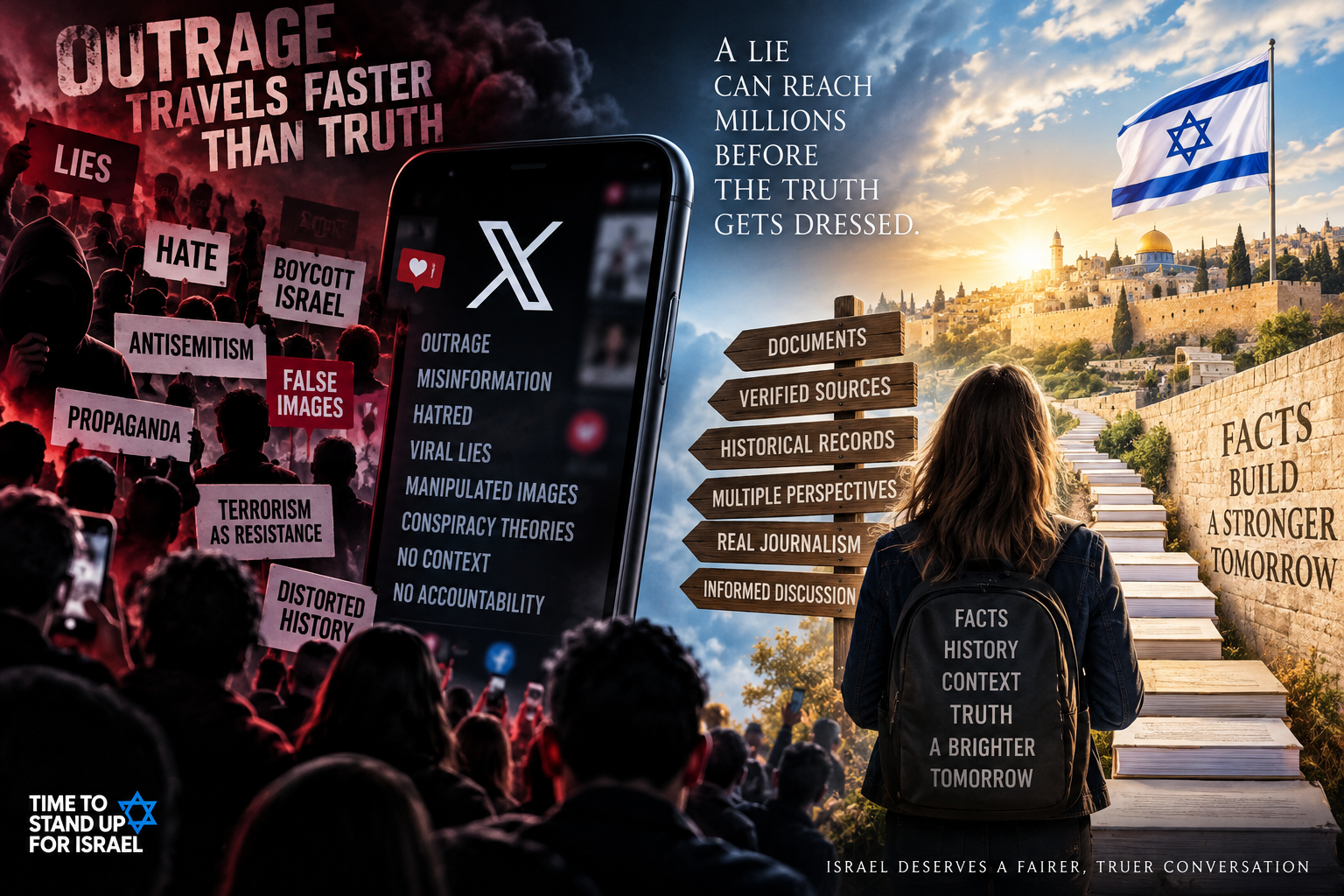
Photo Credits: Sabine Sterk (AI)
There was a time when Twitter seemed almost revolutionary in the best possible sense of the word. Created in 2006 by Jack Dorsey, Noah Glass, Biz Stone and Evan Williams, it began with a remarkably simple idea: allow people to tell the world what they were doing in 140 characters.
Nobody could have imagined what that little messaging platform would eventually become.
Twitter grew from “What are you doing?” into “What is happening?” and suddenly ordinary people could witness history while it unfolded. During demonstrations in Iran and later the Arab Spring, social media showed its enormous political power. Journalists discovered that breaking news could appear on Twitter before it reached a newsroom, politicians discovered that they could speak directly to millions of people, and activists discovered that information could cross borders faster than governments could control it.
But somewhere along the road, something changed.
Twitter became X after Elon Musk purchased the company for approximately $44 billion in 2022 and renamed it in 2023. Musk presented himself as a defender of freedom of expression, and there is something genuinely valuable about challenging the enormous power that social media companies possess over political discussion. No private company should casually decide which political opinions humanity is permitted to hear.
I know something about that personally.
For a long time, I refused to join Twitter. When I eventually created an account and began sharing material from my foundation, Time To Stand Up For Israel, I was permanently suspended. When Twitter became X, I decided to return and start again, this time completely under the name of my foundation. I purchased a Premium subscription because the platform offered something extremely valuable to a writer and Israel advocate: the possibility of publishing longer articles and reaching people without waiting for traditional media to decide whether my voice deserved space.
That part of X remains valuable.
Unfortunately, there is another X.
And that X tells us something deeply uncomfortable about the world we have created.
Spend enough time advocating for Israel on the platform and you encounter an astonishing amount of antisemitism, hatred of Israel, historical ignorance, conspiracy theories and propaganda. Facts that require years of history to understand are dismissed by people who watched a thirty second video. Complicated military events become slogans. Terrorism becomes “resistance.” Jewish history is rewritten. The atrocities of October 7 are questioned, minimized, rationalized or sometimes grotesquely celebrated.
October 7 demonstrated exactly why the digital battlefield matters.
As Hamas terrorists crossed into Israel, murdering civilians and abducting people into Gaza, information was already circulating around the world. Some horrific footage originated with the perpetrators themselves. Israelis desperately searched online for relatives who had disappeared, while journalists, governments and ordinary citizens attempted to understand what was happening.
Within hours, another war had begun.
The war over reality.
Every Israeli military operation now produces two battles simultaneously. One takes place physically, where Israelis must protect their citizens from Hamas, Hezbollah, Iran and other threats. The other takes place on millions of smartphones, where photographs, casualty claims, edited videos and emotional accusations can reach millions before anyone has established whether they are accurate.
The lie has one enormous advantage over the truth.
It does not have to wait for verification.
And X rewards speed, outrage, engagement and emotional reaction. A sensational accusation can circle the planet while researchers are still determining whether the photograph accompanying it was taken yesterday, ten years ago or in another country altogether.
This is particularly destructive for Israel because Israel is expected to defend itself not merely militarily but rhetorically, instantaneously and perfectly. Before the smoke has cleared, people thousands of kilometres away are already announcing their verdict.
But my concerns about X go beyond Israel.
Open the wrong corner of the platform and you can encounter endless unsolicited sexual solicitation, accounts advertising explicit services, spam, scams and people apparently trying to monetize sexuality and desperation. My own inbox has repeatedly received messages of this nature. I cannot determine who is genuinely behind those accounts, and I certainly cannot establish their ages merely from profiles, but the sheer volume itself says something disturbing about the environment social media has helped create.
I am not religious, nor do I believe adults need my permission to make private choices about their bodies. If consenting adults voluntarily choose sex work, that is their responsibility and their decision.
That is not the point.
The question is what kind of public environment enormous technology platforms choose to build.
Freedom does not require the abandonment of standards. Freedom of expression does not mean that every digital public square must become a marketplace for pornography, prostitution advertising, hatred, bots, manipulation and political propaganda. A civilized society can believe passionately in freedom while still understanding that children, teenagers and ordinary users should not have to navigate an environment in which increasingly extreme material competes for their attention.
Perhaps X does not represent the decline of civilization.
Perhaps it merely reflects it.
And that possibility may be even more disturbing.
We created an information revolution and somehow transformed attention into the most valuable currency. Once attention becomes money, anger becomes profitable, sexuality becomes profitable, extremism becomes profitable and misinformation becomes profitable because truth is frequently boring while outrage generates clicks.
Israel has experienced the consequences more severely than almost any other democracy.
A democratic country defending its citizens can spend hours establishing facts while someone with a smartphone, an ideological agenda and absolutely no knowledge of Middle Eastern history can produce a viral accusation in thirty seconds.
This is why I increasingly wonder whether Israel needs something different.
Imagine a platform dedicated exclusively to Israel where popularity does not determine truth, where historical claims require sources, where photographs require context, where casualty claims are clearly distinguished between verified information and claims made by interested parties, where terrorism is not romanticized because somebody discovered an emotionally attractive slogan, and where Jewish and Israeli history is presented through archives, documents, maps, testimonies and evidence.
No propaganda.
No popularity contest.
No endless screaming.
Facts only.
Perhaps such a platform sounds unrealistic, but consider what X itself has demonstrated. A single social media platform can influence elections, wars, journalism, diplomacy and public opinion across continents. Technology has already proven that it can change how humanity understands the world.
The question is whether we are willing to use that technology responsibly.
For Israel advocates, there is another lesson.
We cannot simply leave.
Because silence leaves the information battlefield to somebody else.
When lies about Israel are repeated thousands of times, facts must be repeated thousands and one times. When Jewish history is rewritten, somebody must open the history books. When terrorism is presented as heroism, somebody must remember the victims. When hostages become yesterday’s news, somebody must say their names again.
That is why I remain there, despite everything that frustrates me about X.
Because truth does not automatically win.
Truth needs evidence. Truth needs persistence. Truth needs people willing to stand behind it when the algorithm rewards something easier, angrier and more fashionable.
Maybe the next revolution in social media should not be another platform promising unlimited expression.
Maybe it should be a platform promising something considerably more radical.
Accuracy.
Facts.
Context.
Truth.
And when it comes to Israel, perhaps it really is time to build it.
––
NB: A screenshot of a few the hundreds of messages offering sex

Related Topics
Related Posts