The Desert of Edmond Jabès
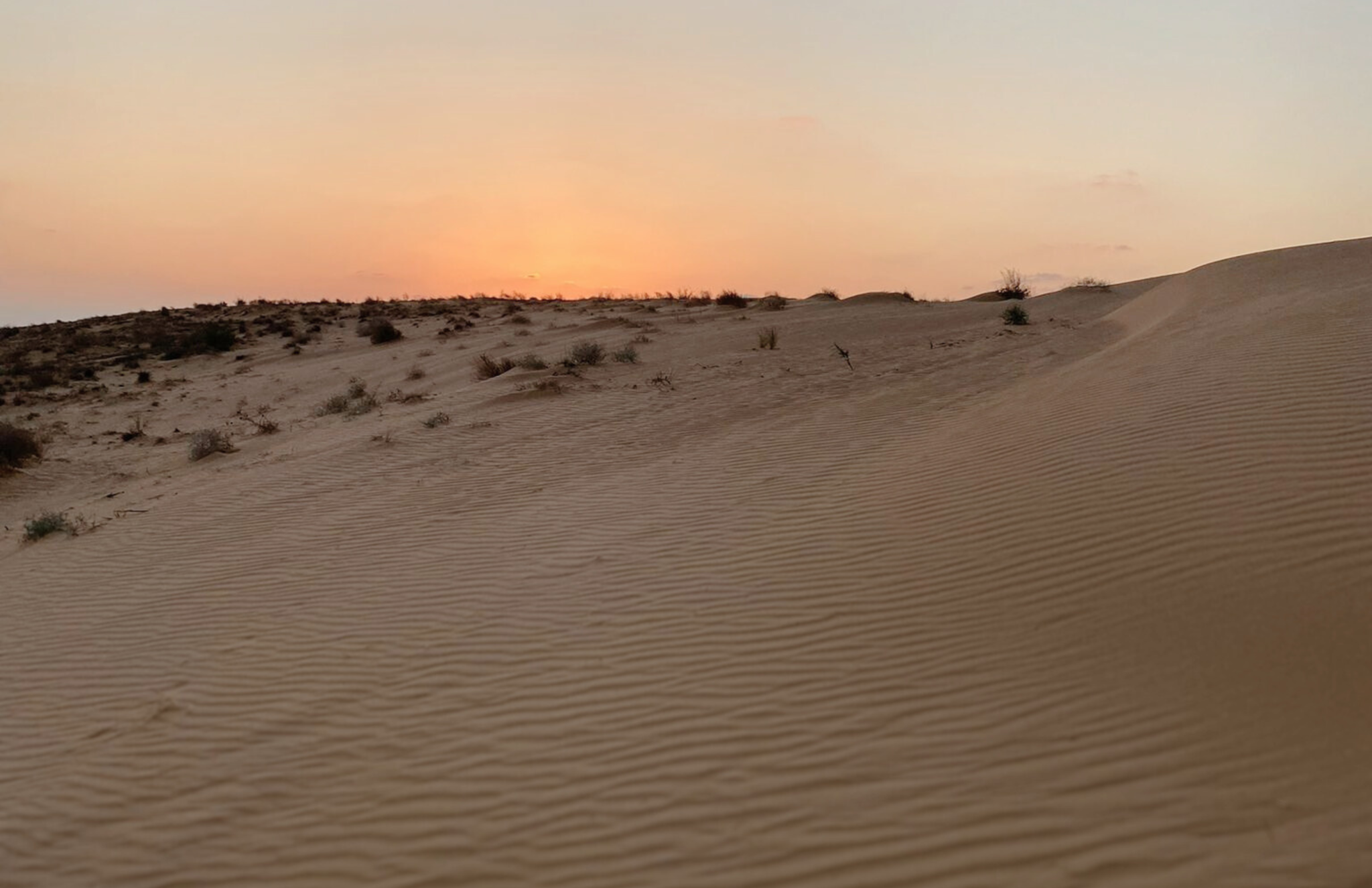
Poets and philosophers have always loved the desert.
When Edmond Jabès lived in Cairo, he often traveled alone to the desert, but he limited each trip to three or four days at a time. “I could have stayed longer, but sometimes I couldn’t stand it anymore,” he reflected in an interview. “The desert is listening pushed to the extreme. And to which you can’t even respond with words. You’re obliged to submit.”
Jabès was obsessed with the desert, both as metaphor and muse. At age 45, he fled Egypt for France during the Suez Crisis. There, he returned again and again to the desert — not only as a poet, but also as a Jew. “The Jew chooses to set out for the desert, to go toward a renewed word,” he wrote in his Book of Resemblances (Volume 2).
Since I discovered his work, I have admired Jabès as a writer of modern literary works. But he was also, in his own right, an author of midrash: exegesis, commentary, dialogue with the texts of our heritage. He attached weight to the search for God, the Book, and the Word; he wrote on each topic with the seriousness of the parshanim we read to demystify our holy books. It is no coincidence that one of the few items he managed to bring with him from Egypt was a Talmud set that belonged to his father.
***
The book of Bamidbar is set, fittingly, in the midbar — the desert — where the Jewish people camp according to God’s directions following the exodus from Egypt. Authors of the Septuagint called this book the Book of Numbers in reference to the censuses that take place within. The different names speak to the two impulses of the wanderer — to be swallowed by the desolation, or to count and create order in the wilderness.
Scholars link the word midbar (desert) and medaber (speak). In the words of Rabbi Lord Jonathan Sacks, “it is in the wilderness that the Israelites hear revelation, the word or speaking of God.”
There is a reason that the desert is the home to revelation. “Anyone who does not render himself like a wilderness, accessible to all, is unable to acquire wisdom and the Torah,” Bamidbar Rabbah explains. The people of Israel must embody the desert in order to receive revelation. The medaber and the midbar are intertwined. God speaks only when we are like deserts: open, humble, unending, ownerless.
For Jabès, the desert was a prerequisite. About the desert, he writes as a privileged witness to a secret Talmudic debate, scattering fictional rabbis in conversation across the pages of his books:
“If God spoke in the desert it was to deprive His word of roots, so that the creature should be His privileged bond. We shall make our souls into a hidden oasis,” said Reb Abravanel.
“And of His written word?” asked his disciple, “what shall we make of that?”
“Of his fiery vocables we shall make a book of inconsumable fire,” replied Reb Abravanel.
But Reb Hassoud, whose bold statements and commentaries were most often badly received by the interpreters, spoke up: “A wandering word is the word of God. It has for echo the word of a wandering people. No oasis for it, no shadow, no peace. Only the immense, thirsty desert, only the book of this thirst, the devastating fire of this fire reducing all books to ashes at the threshold of the obsessive, illegible Book bequeathed us.
Here, Jabès imagines a dialogue, unmoored from time, that captures the paradox of divine speech in exile. Its characters are there in response to Bamidbar Rabbah — and to centuries of Jewish suffering and exile. He links them all, a midrash on the midrash. The dialectic of Reb Abravanel and Reb Hassoud captures two vastly different understandings of what it means to be spoken to in the desert. Perhaps God spoke in the desolate wilderness so that His revelation was tied only to the Jewish people. Or perhaps the desert is a reflection of never finding a home — a place in which the Jews sought God’s revelation, unmoored and desolate. Jabès, the desert-wanderer and the refugee, would understand this enigma firsthand.
***
Can poets really be theologians?
Jabès answered that question without ever addressing it directly. And if he was not a theologian, perhaps he was a prophet — a man who wrote against the void, from the wilderness, bringing himself to the edge of his own limits.
“When you are between sky and sand,” he explained, “you are truly in infinity.”
If there was ever a place that felt infinite, it would be the wilderness unencumbered by human structures. There, amidst the desolate emptiness, it might be plausible that a people could find an expanded God. The God of the desert is not the contracted God of cities, engaged in tzimtzum to make space for human beings. This desert God is closer to the Ein Sof, the neverending.
Jabès went to the desert to discover the truth of himself, but what he found was the truth of his people.
And God’s revelation is nothing, if not infinity.