
The Dirty Bomb Threat in West Asia: Pathways, Risks, and Prevention
The continued survival of the Islamic Republic in Iran is not only an existential threat to the Iranian nation but also to regional and global stability. As the Islamic regime in Iran faces the Lion-and-Sun Revolution led by Crown Prince Reza Pahlavi—responding to the peaceful, pro-democracy protests of the Iranian people with an unprecedented massacre of its own citizens in complicity with its proxies—it has increasingly turned toward a desperate ‘scorched earth’ policy. By transforming its regional proxy groups into instruments of war and leveraging its vast stockpiles of radioactive waste, the Islamic Republic might be laying the groundwork for the deployment of Radiological Dispersal Devices (RDDs)—commonly known as ‘dirty bombs’—operated by militias from sites within Iranian territory. This possibility is deeply concerning, as it suggests the regime may seek to use proxies and radiological materials to enable RDD attacks against Israeli targets.
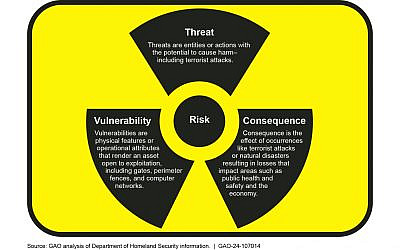
Figure 1: Components of radiological risk. The diagram shows that overall risk (center) is determined by three interacting factors: Threat—the presence of actors or actions with the potential to cause harm (including terrorism); Vulnerability—weaknesses in physical or operational defenses that can be exploited (e.g., gates, perimeter fencing, computer networks); and Consequence—the severity of impacts if an incident occurs, including losses affecting public health and safety and the economy. Image source: US GAO analysis of Department of Homeland Security information, | GAO-24-107014, and the report.
Their recent efforts to produce fourth-generation fissionless nuclear weapons, the commissioning of the secret ‘Pickaxe Mountain‘ facilities, the movement of UF6 in a frozen state, and the concealment of 441 kg prior to the 2025 U.S.-Israeli strikes, alongside the rapid restoration of targeted nuclear centers and the regime’s military drive to acquire any form of weapon of mass destruction for its own survival, demonstrate a chilling reality. To safeguard humanity, a swift, internationally-backed transition from the Islamic Republic is the only viable solution to secure these hazardous sites and prevent a catastrophic legacy of radioactive contamination affecting the environment and human health across West Asia and the world.
The Ideological Roots of Terrorism in the DNA of the Islamic Republic of Iran
The political DNA of the Islamic Republic is a synthesis of mid-20th-century extremist ideologies, heavily influenced by the Muslim Brotherhood’s focus on dismantling the established order under the guise of anti-imperialism and anti-Zionism in West Asia. This radical framework was originally deployed in 1979 to subvert the rule of law during the Pahlavi monarchy. In what proved to be a catastrophic strategic miscalculation by the Jimmy Carter administration—intended to create a ‘Religious Belt’ to contain Soviet communism—the regime instead became an agent of those very anti-Western ideals, cloaked in ‘Islamic Liberation Theology’ and guided by the theories of Sayyid Qutb. Qutb’s discourse on Takfir (excommunication) provided the pseudo-religious justification for using bloody violence to delegitimize regional states.
For decades, the Islamic Revolutionary Guard Corps (IRGC), acting as the clandestine military wing and student of the Muslim Brotherhood’s violent school of thought, has used the Iranian social and political landscape as a laboratory for state-sponsored cultivatingof global terrorism. Their most recent ‘achievements’—prior to the horrific January 2026 massacre of thousands of Iranians—include the catastrophic attacks of October 7, 2023. According to reports and predictive algorithms, the January 2026 atrocities saw over 36,500 casualties in just two days, with estimates reaching up to 110,000 between January 8th and 14th. This evolution has now reached a critical threshold, shifting from conventional militancy to the brink of unconventional ecological warfare. Within this ideological system, the survival of the regime—as declared by Ruhollah Khomeini’s fatwa that ‘preserving the system is the supreme obligation’ (Ojab-e Vajebat)—takes precedence over the survival of the land and the lives of the people. This doctrine implies that any form of slaughter, domestic or foreign, is sanctioned if it serves to sustain the Islamic Republic’s ideology.
The Islamic Republic’s Recent Strides Toward Nuclear Weaponization
A critical component of the regime’s nuclear ambitions is its persistence in the plutonium pathway, centered around the IR-40 heavy water reactor in Arak. This facility is specifically designed to produce weapons-grade plutonium, which poses a unique threat compared to uranium enrichment; plutonium allows for the construction of smaller, more advanced nuclear warheads that can be easily integrated into the regime’s existing ballistic missile arsenal.
In the months leading up to the ’12-Day War,’ Israeli military intelligence uncovered alarming evidence that the Islamic Republic was developing an entirely new class of nuclear weaponry. Unlike conventional nuclear weapons that rely on atomic fission, the regime was working on a nuclear fusion process that does not require a fission primary stage—effectively bypassing the traditional ‘trigger’ used in atomic or hydrogen bombs. The strategic foresight of President Trump and Prime Minister Netanyahu, along with their timely military intervention, neutralized and dismantled this lethal clandestine project.
However, the regime’s current activities within the secret ‘Kolang Gaz La‘ underground facilities—deeply embedded in the Alborz mountain range and potentially linked via tunnels to the southern sectors of the Natanz site—demonstrate the mullahs’ lethal resolve. The Islamic regime’s twenty-year effort to equip the first Shiite ideological state with nuclear weapons for the explicit purpose of destroying Israel serves as a dire warning to the world. Immediate international action is required to confront this existential threat to humanity.
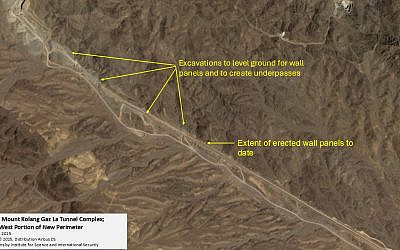 Figure 2. The southwest segment of the perimeter shows wall panels being installed and underpasses under construction. Image credit: David Albright, Sarah Burkhard, and the Good ISIS Team.
The Proxy Threat and the Scorched Earth Strategy
Following the bloody suppression of the initial stages of the Iranian people’s peaceful and pro-freedom uprising in January 2026 against the Islamic Republic, media evidence has confirmed the deployment of foreign proxies—including Hashd al-Shaabi and Kata’ib Hezbollah from Iraq, the Fatemiyoun from Afghanistan, and Lebanese Hezbollah—within Iranian borders to bolster the machinery of repression and the massacre of anti-regime protesters. This constitutes ‘Plan A.’ In ‘Plan B,’ the regime likely utilizes these non-Iranian paramilitary forces to maintain control over sensitive military, administrative, and security hubs in the event of defections within the national armed forces, or to neutralize potential coups. Estimated calculations based on current killing algorithms suggest the death toll could rise to 100,000. The Islamic regime in Iran made this decision in anticipation of potential military strikes by the U.S. or Israel; by severing all domestic telephone, satellite, and internet links to the outside world, they intend to blame the high number of casualties on foreign intervention—a tactic reminiscent of their liesregarding the downing of flight PS752.
The fundamental question for human rights organizations, members of the UN Security Council, and global public opinion is this: how dangerous can a theocratic regime be to the world and its ideological opponents when it unleashes such lethal, criminal fire upon its own defenseless people? As the regime loses its regional grip over Syria, Iraq, and Lebanon, it views the geography of Iran as its final battlefield and ultimate victim. Unlike complex nuclear fission, a ‘dirty bomb’ is easily constructed by combining conventional explosives like C-4 with radioactive isotopes. These materials include Strontium-90 and Cesium-137 (extracted from spent fuel at the Bushehr plant, with a half-life of several decades), as well as high-potency gamma sources such as Iridium-192 and Cobalt-60 (found in medical and industrial sites). The dispersal of these particles into the atmosphere is designed not for physical destruction, but to create ‘exclusion zones’ and impose irreparable human and environmental costs on humanity. If this pulverized fuel is dispersed via explosion, it creates a highly complex and hazardous environmental contamination.

Figure 3. Schematic of a purported “dirty bomb” reportedly uncovered by British intelligence in Afghanistan in 2003. It was believed that al-Qaeda had constructed a small radiological dispersal device, but the device was never recovered. Image credit: Radiologykey.
Has the time not come for the Islamic Republic—which began by threatening to export its revolution to Arab nations, remains a potential threat to the sovereignty of Persian Gulf states, has conducted numerous attacks on U.S. bases, launched missiles at Iraqi Kurdistan, and openly calls for the annihilation of Israel—to be recognized as an ‘actual threat’ and permanently neutralized? Such a mission is a fundamental act of ‘Humanitarian Protection’ aimed at preventing an irreversible catastrophe—a catastrophe that will respect no international borders.
Conclusion
The Islamic Republic in Iran has proven its cold-blooded readiness to massacre its own citizens to maintain its grip on power. A regime that treats its own people with such bloody cruelty will not hesitate to poison the very soil of any nation to ensure its survival. Therefore, the international community must act decisively in support of Iran’s pro-democracy Lion-and-Sun Revolution. The case of Kosovo established a precedent for the use of force in the face of a humanitarian catastrophe without a direct UN Security Council mandate, as seen with NATO’s intervention in March 1999. In Iran, however, we are faced with a disarmed, freedom-seeking population whose plight is far more significant and sensitive, demanding urgent military and diplomatic protection. The global community bears a dual responsibility: first, to defend millions of defenseless Iranians against a regime and its regional militias whose atrocities—such as the January 2026 massacres—echo the horrific slaughter of Ukrainian Jews in September 1941 by Nazi forces; and second, to protect the lives of millions of civilians in Israel who face the constant threat of systematic terror from the Islamic Republic and its proxies. Supporting the Iranian people is not a political choice; it is a fundamental act to safeguard human rights and civilization.