The Documents Lithuania Demanded Twice
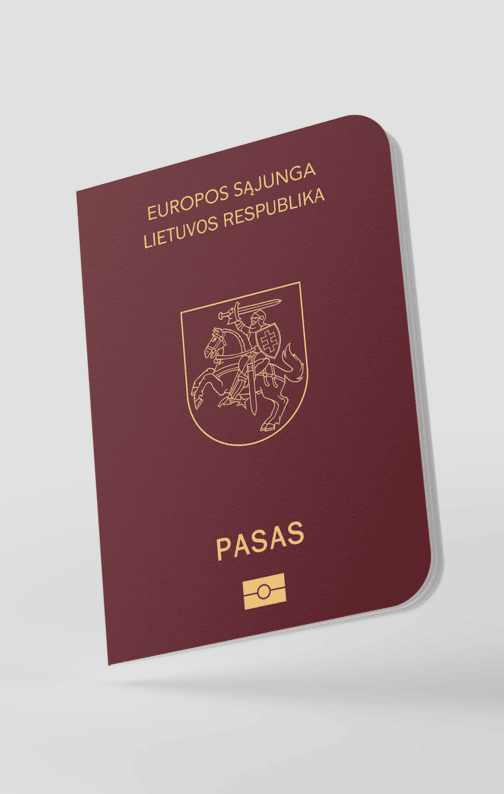
In Samuel Gochin Existed, I set down the documentary spine of my paternal grandfather’s life in Lithuania. Birth in Papilė on 15 February 1902. Conscription in 1924. The 5th Grand Duke Kęstutis Infantry Regiment. The Jonas Basanavičius War Hospital. Internal passports stamped Žydas. Lithuania knew Samuel when it could use him. In 2008, when his grandson asked the same Lithuania to honor those records, the state suddenly found uncertainty.
This piece is the first crack in a larger record now published in long form. The Lithuanian state used the same evidentiary method against my family in 1922 that it used against me in 2008. The first time, eight of my direct relatives died. The second time, I had relatives in South Africa, an archive of survivors’ records, and the patience for litigation, and the method failed. Lithuania did not reform. The family had survived enough to fight back.
On 26 December 1921, my great-great-grandfather Faive Gochin filed an application with the Lithuanian authorities asking that his son Avram, Avram’s wife Chaie, and their children be permitted to return to Papilė from Russian Imperial deportation in Melitopol. The application is preserved in the Lithuanian Central State Archive at Fund 412, Inventory 13, File 6, Page 857. The Council of Papilė, on 28 February 1922, confirmed there were no reasons to bar the family’s return. The Jewish community of Papilė testified.
On 28 March 1922, the Lithuanian Department of Citizen’s Security overturned the District. The family, the Department wrote, “lacked the documents to prove they were Lithuanian.”
Lithuania’s own Migration Department now describes the implementing rules of the 9 January 1919 Provisional Law on Citizenship as “very liberal,” with statements of two witnesses sufficient to prove a person came from Lithuania. That standard accommodated displaced Jews. The 28 March 1922 denial did not.
Avram died of starvation in March 1922. Three of his and Chaie’s children, Leya, Tsipa, and Edel, died in 1922. Tsipa’s husband died. One of Tsipa’s children died. Both of Leya’s two children died. At least eight family members died during the application period, the denial period, and its immediate aftermath. They died while Lithuania delayed and then denied the family’s re-entry on documentary grounds.
On 27 September 1922, six months after the denial that killed Avram, Chaie Gochin walked her surviving children and grandchildren to the Obeliai border crossing. She completed paperwork. She proved her Lithuanian citizenship. She was permitted to re-enter. The same family. The same documents. A different official.
That is the dispositive evidence on what the March 1922 denial was. It was discretionary. It was not a legal outcome. It was a Department brief against a specific Jewish family, written in the standard language of bureaucratic refusal, with lethal effect.
Eighty-six years later, in 2008, a different Lithuanian agency wrote a different brief in the same language.
The Migration Department denied my application for citizenship by descent on the ground that Samuel Gochin’s extensive Lithuanian state record, the military file, the hospital file, the internal passports stamped Žydas, the photographs in regimental uniform, the witness statements including one from a Litvak born in Raguva, was insufficient to prove that the documented Samuel was the same Samuel who fathered my father, Harold, in South Africa. The state’s evidentiary theory required that within a Papilė Jewish community of approximately one thousand in 1926, two Samuel Gochins must have been born around February 1902, both connected to the same village, both bearing identifying records in the Lithuanian state system. The state produced no second Samuel. It posited none. It asked the court to entertain the abstract possibility.
The reason this method persisted into 2008 is not bureaucratic inertia. It is statutory architecture.
Lithuanian restitution law, from 1991 forward, required citizenship. The 1991 Restitution Law required current citizenship and permanent residence. The 1997 Restitution Law dropped the residence requirement and kept the citizenship requirement. Article 10 of the 1997 Law set the application deadline at 31 December 2001 and required the citizenship document to be submitted with the application.
Lithuania’s own Migration Department puts the lock in plain language. “A person had to acquire citizenship of the Republic of Lithuania and also to become a suitable subject until 31 December 2001.”
During the same decade, 1991 to 2001, the Migration Department’s caseflow on Jewish citizenship applications operated as it operated against me. Documentary requirements that exceeded what was applied to non-Jewish applicants. Witness testimony discounted. Surviving state records treated as insufficient. Cases disposed of through delay, repeated additional document requests, and sustained denials. Deny the citizenship; the restitution claim cannot be filed. Let the deadline lapse; the claim is permanently barred.
The two regimes operated together with mathematical precision.
The timing of the corrections confirms the architecture. The Constitutional Court ruled on 13 November 2006 that denial of Lithuanian citizenship on the ground of “repatriation to ethnic homeland” was unconstitutional. Five years too late. The 2010 Citizenship Law took effect in April 2011. Nine and a half years too late, and as the World Jewish Restitution Organization records, it “did nothing to assist those previously ineligible persons from being able to file a restitution claim, because the claims filing deadline under the 1997 Restitution Law closed on 31 December 2001.” The June 2016 Litvak amendment came fifteen years after the deadline.
Lithuania liberalized citizenship for Jewish descendants only after the restitution claims window had closed. The state did not need to coordinate this. The statutes did the coordinating.
The Lithuanian Migration Department’s own published commentary on the 2016 amendment is the cleanest available state-language admission of what its prior practice had done. The Department records that the amendments were stimulated by the practice it had itself formed, under which Litvaks who left Lithuania before 1940 had been required to prove they had left because of threat, persecution, or political reasons, and that such documents were “extremely difficult to provide,” resulting in the inability of many Litvaks to reinstate their citizenship. The Department names the affected communities: Israel, South Africa, and elsewhere. That is the Lithuanian state apparatus, in writing, conceding that its practice had functionally barred Litvak citizenship restoration until 2016, with the obvious property-claim consequence.
On 20 December 2022, twenty-one years after the deadline closed, the Seimas amended Law No. XI-1470 to extend a one-time symbolic compensation to Lithuanian Jews and their heirs whose property had not been returned under the original procedure. The amendment excluded land. The application window opened in 2023 and closed on 31 December 2023. The total fund was €5–10 million. The per-property symbolic payment was approximately €20,000, regardless of actual value. On 14 July 2025 the Good Will Foundation completed distribution: €7.5 million among hundreds of approved applicants.
Twenty thousand euros per property, twenty-one years late, drawn from a finite pool, on a one-year window, on immovable property only, with land excluded. This is not restitution. It is the closing entry on an account the Lithuanian state has decided will not be reopened.
I have filed approximately thirty legal actions against Lithuanian institutions since 2015. Every one has been refused. The five lawsuits that produced the 2011 Lithuanian Supreme Administrative Court reversal in my own citizenship case are not part of that record, and preceded the record of Holocaust truth litigation. The 2011 reversal corrected the 2008 outcome. It did not correct the institutional pattern that produced it. The Migration Department’s own commentary, the WJRO’s 2016 overview, the LRT’s 2026 reporting on LGGRTC, the silence of every Lithuanian oversight body I have tested, and the operating doctrine that a Jew cannot be a Lithuanian, which a Lithuanian Honorary Consul stated to my face in 1989, all sit on the same record.
The 1922 Department of Citizen’s Security denial killed eight members of one family. The 1991–2001 citizenship–restitution architecture extracted, by foreclosure, the inheritance of thousands of Litvak families that had survived. The 2008 Migration Department denial in my case was the same method applied to a claim that was not for property but for recognition. The state declined recognition with the same instinct, and the same evidentiary technique, with which it had declined property.
The methods were different. The principle was identical. Deny the Jew the legal status that would unlock the legal right. Let the law’s clock run. Call the result administrative.
The full documentary record — the Lithuanian Central State Archive fund references, the five Lithuanian case numbers, the Migration Department’s own commentary, the WJRO 2016 overview, the Constitutional Court rulings, the 2010, 2016, and 2022 amendments, and the cross-century analytical apparatus, is set out in The Documents Lithuania Demanded Twice, published this week on Substack and also available as a PDF. Sixty-five footnotes. Twenty pages. Future researchers will have what they need to make the determination Lithuania has not yet made about itself.
When Jewish evidence proves a Jewish claim against Lithuania, Lithuania’s first answer is not recognition. It is resistance.
That refusal should remain visible.