The Drawing on the Blackboard
On the day Niels Bohr died, 18 November 1962, someone photographed the blackboard in his study at the Carlsberg mansion in Copenhagen. On it was a drawing. It depicted a box of light, the thought experiment that Albert Einstein had devised at the 1930 Solvay Conference to prove that quantum mechanics was incomplete. Bohr had spent 32 years answering that drawing. He never stopped because the drawing was never really the problem. The problem was the question behind it. Is light a wave or a particle? Bohr had resolved this as early as 1927 with his principle of complementarity. It is both. The two descriptions are not contradictory. They are necessary halves of the same whole. When the Danish king awarded Bohr the Order of the Elephant in 1947, the physicist designed his own coat of arms. In its centre he placed the yin yang symbol. Beneath it he inscribed four words in Latin. Contraria sunt complementa. Opposites are complementary.
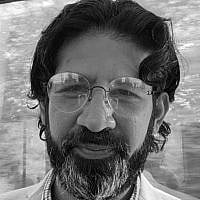
Nearly a century later, a different man sat in a different studio and offered the same insight in a different vocabulary. Quantinuum’s chief executive Rajeeb Hazra, speaking to Bloomberg’s Lizzy Burden, delivered a line whose simplicity concealed its force. “We don’t see AI competing with quantum,” he said. The framing that has dominated the technology press for three years was gently dismissed in a single sentence. Artificial intelligence and quantum computing are not wave and particle fighting for the right to describe reality. They are wave and particle together, and the power lies in accepting both.
The man delivering this verdict has spent a career learning that computing paradigms do not compete so much as they accumulate. Hazra studied computer science at Jadavpur University in Kolkata, an institution born from the Swadeshi movement’s resistance to British partition of Bengal in 1906 and home to India’s first indigenous transistor computer, built with the Indian Statistical Institute in 1966. From there he crossed an ocean, earning a doctorate at the College of William and Mary in Virginia, then joining Lockheed at NASA’s Langley Research Center, where aerospace met computation. In 1995 he moved to Intel. Over twenty five years he rose through supercomputer architecture, technical computing and enterprise systems, accumulating sixteen patents along the way. He moved to Micron. Then, in 2023, he took the helm of the world’s largest integrated quantum computing company. His career is the biography of complementarity itself. Classical, accelerated and quantum computing did not replace one another in his working life. Each layer made the next one thinkable.
That layered architecture now has a thermodynamic argument behind it, and it is the argument that matters most. Global computation for artificial intelligence is projected to require at least seventy terawatt hours of electricity in 2026, roughly the annual consumption of Austria. In the United States, data centres could exceed nine per cent of national electricity demand by 2030, up from approximately three and a half per cent today. The grid was not engineered for this. Quantum computing is the complement that AI’s energy physics demands. Quantinuum’s Helios machine, the most accurate commercial quantum computer in the world, consumes roughly 60 kilowatts. The leading supercomputers of the kind Hazra spent his Intel years advancing draw between sixteen and 39 megawatts. That is not an incremental gain. It is a category difference, and when Quantinuum announced a multi year partnership with Oracle in August to deploy Helios inside an Oracle Cloud Infrastructure data centre, it turned the category difference into a commercial product. Quantum hardware physically co located with classical and AI infrastructure, accessible as a managed cloud service. The company that raised 1.68 billion dollars in an upsized Nasdaq listing in June, reporting second quarter revenue growth of 279 per cent, is now selling convergence as architecture.
And the architecture has a Jerusalem address. Einstein, who debated Bohr until neither man was alive to continue, was a co founder of the Hebrew University of Jerusalem. He delivered the first lecture on Mount Scopus in 1923, and the original manuscript of general relativity sits in its archives to this day. The intellectual tradition within which quantum computing now operates was shaped on that hillside. Israel’s quantum ecosystem inherits both sides of the debate. The Israel National Quantum Initiative has channelled approximately 1.25 billion shekels of public funding into quantum science since 2018. The Israeli Quantum Computing Centre at Tel Aviv University, operated by Quantum Machines, integrates multiple qubit technologies under a single Israeli built control architecture. In August 2026, the National AI Directorate and the Ministry of Finance announced Project Nexus, a tender for a domestically built national quantum computer framed explicitly as technological sovereignty. A nation that built Unit 8200 into one of the world’s most formidable signals intelligence operations has concluded, as Bohr concluded, that the question is never which description of reality prevails. The question is who accepts complementarity first and builds accordingly.
The coat of arms still hangs in Frederiksborg Castle. The yin yang symbol has faded only slightly. The four Latin words have not faded at all.
Bohr’s study at the Carlsberg mansion is empty now. The blackboard has been photographed, catalogued, preserved. The drawing of the photon box is still visible in the image. Einstein’s challenge. Bohr’s lifetime reply. Neither man won because neither man was supposed to. The wave and the particle were never rivals. They were the same light, seen from different positions. The room is empty. The principle is not.