London based entrepreneur, cybersecurity analyst doing a PhD in AI
The Echo Chamber Is the Enemy of Wisdom
The greatest threat to a democracy is not disagreement. It is the moment disagreement becomes impossible.
History has shown that nations rarely collapse because every citizen held a different opinion. More often, they falter when a single narrative becomes so dominant that questioning it is treated as betrayal rather than civic responsibility.
The Hebrew Bible repeatedly warns against confusing certainty with wisdom.
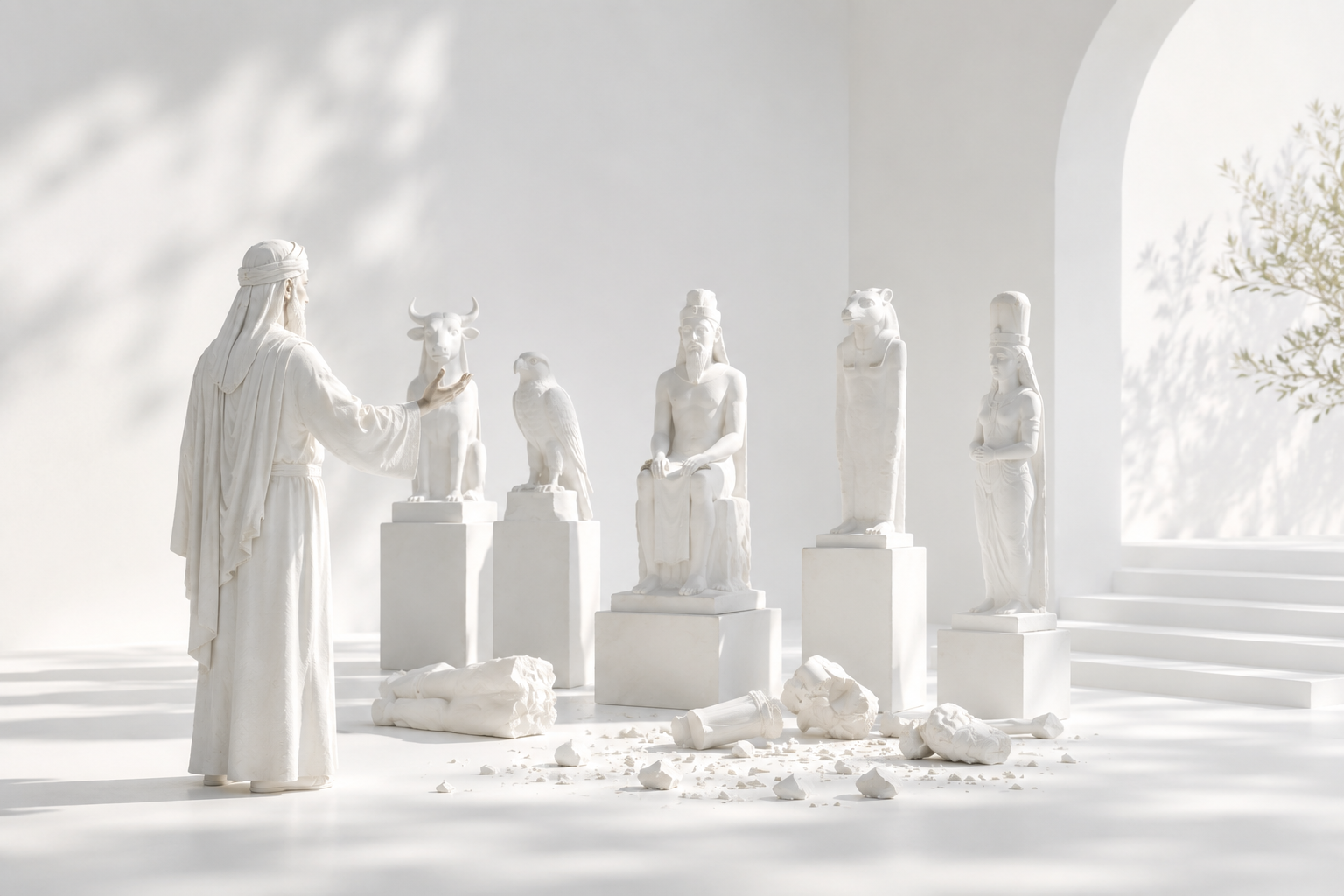
One of its most foundational figures is Abraham (a.s) . Before he was the father of nations, he was a man who refused to mistake inheritance for truth. In a world saturated with idols and unquestioned assumptions, Abraham (a.s.) does something radical: he asks questions.
According to Jewish tradition, he looked at the world around him and refused to accept inherited explanations simply because they had been inherited. He challenged the gods of his time not through force, but through reason.
The Qur’an captures this same spirit in a single question Abraham (a.s.) poses to his people:
“What are these statues to which you are devoted?” (Qur’an 21:52)
It is one of the simplest questions ever asked.
The essence of the story is exactly the same in the Midrash (Bereshit Rabbah 38:13).
It is also one of the most dangerous.
Abraham (a.s.) is not merely asking about carved idols. He is asking why people surrender their reason to inherited certainty. Why do we devote ourselves to ideas simply because everyone around us does? Why do we mistake tradition, popularity or power for truth?
And science is based on exactly this endeavour. To question the assumptions and methods and conclusions of those who came before us. We expand on them if sound, or reject and revise if unsound.
Every generation has its statues.
Some are carved from stone.
Others are carved from ideology, political tribes, party loyalty, nationalism, media narratives or the comforting reassurance that everyone around us already agrees.
Social media and social proof has become the scourge of today. Pop idols’ opinions have more policy weight than experts in their fields. Not that experts can’t be wrong, they can. But there is a way of challenging assumptions – based on evidence and sound logical reasoning. That does not hold true much of the time.
Politicians behave as if they know more economics than those who studied Smith, Hayek and Keynes. They sound so confident that most people suspend their reason to “well if he is so confident, he must be right”.
Abraham’s (a.s.) greatness lies not simply in rejecting idols, but in refusing to worship societal held certainty itself. He reminds us that truth must be robust enough to survive scrutiny. Beliefs that cannot withstand honest questioning are rarely foundations upon which free societies should stand. Karl Popper’s legacy of deductive falsification is in the lineage of Abraham. This is the legacy we must follow.
Question any statement made, and ask why or why not is it true.
This is the first great biblical lesson in intellectual independence: reality does not fear examination. One person can be right when a billion are wrong. Societies can hallucinate more than AI models – and it takes a few to hold the truth to society.
The second comes through Solomon (a.s.).
One of the Hebrew Bible’s most enduring accounts of wisdom is the judgement of King Solomon (a.s.). Two women stood before him, each claiming to be the mother of the same child. Solomon (a.s.) did not rush to judgement. He did not reward the loudest voice, the most persuasive argument or the claim that appeared most convincing.
Instead, he searched for what lay beneath appearances.
His (a.s.) proposal to divide the living child was never intended as punishment. It was a test. Solomon understood that genuine truth often reveals itself indirectly. The true mother would rather surrender her claim than surrender the life of her child. By creating the conditions in which character revealed itself, Solomon discovered what argument alone could not. [Reference(s) Tanakh, 1 Kings 3:16–28. & Ṣaḥīḥ al-Bukhārī 3426, Ṣaḥīḥ Muslim 1720, Muttafaqun Alayhi (authenticity agreed upon).]
His (a.s.) wisdom was not certainty.
It was discernment.
This story is about far more than legal arbitration. It teaches that justice begins by resisting the temptation to decide too quickly. The wise judge seeks reality before reaching a verdict.
Modern democracies often reverse this order. We reward speed over reflection, certainty over curiosity and outrage over understanding. Social media has made it easier than ever to surround ourselves with people who think as we do, consume the same information and reinforce the same assumptions. Agreement becomes a substitute for truth.
An echo chamber is comforting because it removes friction.
But friction is what sharpens understanding.
Without challenge, assumptions become ossified dogma. They clog the arteries of democracies and societies till they one day collapse without much warning. Without dissent, mistakes go uncorrected. Without competing perspectives, confidence quietly replaces wisdom.
Democracies rarely implode because disagreement exists.
They weaken when disagreement disappears. They are the antibodies keeping the pathogens of hubris away from a functioning society.
They weaken when questioning becomes suspect, when curiosity is mistaken for disloyalty and when inherited narratives become immune from examination.
Abraham (a.s.) challenges us to ask uncomfortable questions.
Solomon (a.s.) challenges us to resist comfortable answers.
Together they offer a timeless model for every free society.
Abraham (a.s.) teaches that no idea should be beyond examination.
Solomon (a.s.) teaches that no judgement should precede the search for truth.
The two lessons belong together.
Question first.
Judge carefully.
Only then does wisdom emerge.
The opposite of an echo chamber is not perpetual disagreement.
It is a society confident enough to question itself and course correct like science does when better evidence is presented. Evidence is sought, not systematically suppressed if it is an opposing view.
If democracies are to endure, they will need more of Abraham’s (a.s.) courage to ask, “What are these statues to which you are devoted?” and more of Solomon’s (a.s.) patience to seek the hidden truth before passing judgement.
That has always been the beginning of wisdom when darkness prevails.
And every democracy today must ask the same question – do we want to be the Athenian court that poisoned Socrates or the rule of Nimrod who tried to set Abraham (a.s.) on fire, or the society that cherished them as they lived, and judges like King Solomon (a.s.), just like we cherish their examples today.
Religion and piety first lives in the hearts of people, and external monuments are an extension of that, not the inverse. While no human being or society is perfect, striving for it, should be the moral goal, not completely abandoning reason and suspending questioning to systems that depend on the people who use them.
That is the essence of democracy.
Related Topics
Related Posts