A Moroccan Journalist
The Eighth ‘-Stan’ the Arab World Won’t See
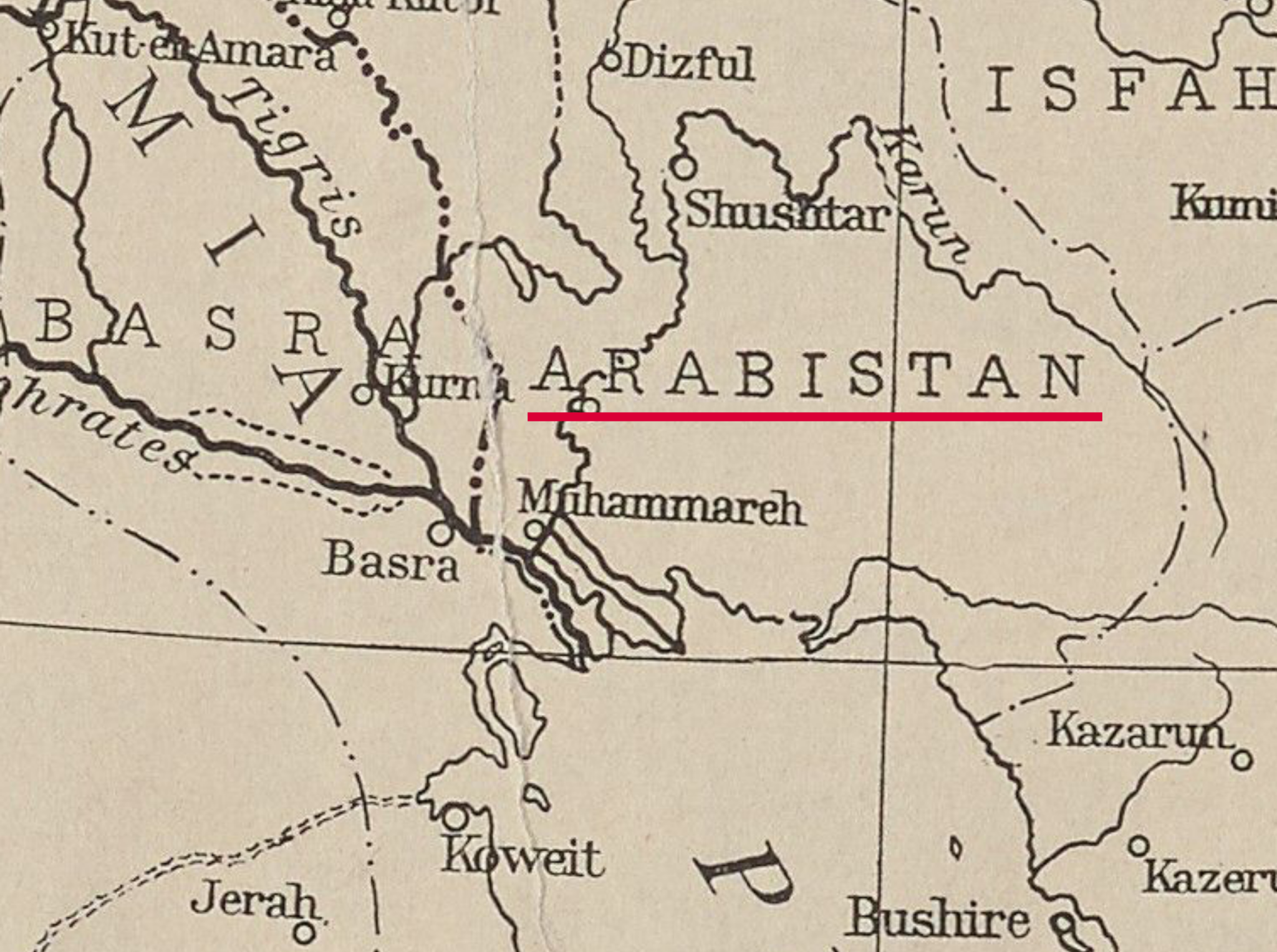
A cropped part of a larger map of western Asia, depicting Arabistan region, before 1920.
Kazakh-stan, Afghan-stan, Uzbek-stan, Tajik-stan, Kyrgyz-stan, Pakistan, Turkmen-istan – seven familiar suffixes on our maps, each meaning, simply, “land.” There is, however, an eighth that has been deliberately erased from the cartographic conscience: Arabistan – the Arab land east of the Shatt al-Arab, known today, in bureaucratic euphemism, as Khuzestan.
If the Arabic-speaking world truly believes its own slogan about “occupied Arab land,” it should begin not with the tired theater of anti-Zionist pageantry, but with the century-long subjugation of Al-Ahwaz by Tehran.
History is inconvenient here, which is why it is rarely told. For centuries an Arab emirate – Arabistan – functioned as a semi-autonomous polity under Arab rulers, culminating in the reign of Sheikh Khazal al-Kaabi. It had flag, army, currency, and relations. Then came the modern alchemy of oil and raison d’état.
In 1908, the first gushers at Masjid-i-Suleiman transformed a frontier into a prize. By April 1925, Reza Khan (soon Reza Shah Pahlavi), with British acquiescence, abducted Sheikh Khazal, dissolved the emirate, and annexed its territory.
What followed is a textbook of internal colonialism: toponymic erasure (Mohammerah became Khorramshahr; Al-Ahwaz became “Ahvaz” within “Khuzestan”), the Persianization of education and administration, the suppression of Arabic in schools, and demographic engineering through land seizures and resettlement schemes.
The numbers, too, are stubborn things. Between 8 and 12 million Ahwazi Arabs live atop the resource core of the Iranian state. The region produces on the order of 80% of Iran’s oil, a majority share of its gas, and supplies a substantial portion of its surface water through the Karun, Karkheh, and Jarrahi river systems.
Yet the Ahwazis – Sunni and Shia, alongside a historic Mandaean community – are structurally impoverished: locked out of the best jobs, under-represented, and relentlessly surveilled. When dams like Gotvand salted the Karun and desiccated farms, the environmental despoliation was not an accident; it was policy as hydrology – divert, degrade, depopulate.
We have the human ledger as well. In 1988, as the Iran-Iraq war closed, mass executions consumed political prisoners across Iran; eyewitnesses and UN rapporteurs documented the worst in Khuzestan’s cities. In 2005, leaked plans to “rebalance” Khuzestan’s demography triggered protests brutally suppressed.
In 2021, amid water protests, the pattern repeated; Amnesty International chronicled live fire, arbitrary arrests, and the ever-elastic charge of moharebeh (“enmity against God”) – a theological solvent poured over dissent to dissolve due process. That same year, three Ahwazi men – Jasem Heidary, Ali Khasraji, and Hossein Silawi – were executed after torture-tainted confessions.
A decade earlier, the teachers and cultural organizers Hashem Shabani and Hadi Rashedi were hanged for founding an Arabic education institute. Shabani’s prison poem – “Saturday, because you are an Arab… Friday: you’re a man, isn’t that reason enough to die?” – is the literature of a people told their mother tongue is contraband.
If this dossier described any Israeli district, the global commentariat would convulse. NGOs would emergency-convene panels. Western chancelleries would summon ambassadors by night. Hashtags would bloom. But because the perpetrator is Iran and the victims are Arabs inside Iran, the outrage is rationed, the vocabulary softened, the timelines blurred.
The Orientalist inversion is complete: Israel, a small, imperfect, litigated democracy, is cast as metaphysical occupier; the Islamic Republic, an ethnocratic security state, is rationalized as a misunderstood post-colonial sovereign.
This selective morality is not accidental; it is geopolitics laundering itself as ethics. “Palestine” functions in much Arab political discourse as a moral deodorant – perfuming the failings of regimes that invoke it; Ahwaz is the mirror they will not face.
From Cairo to Rabat, televised indignation at Israel’s every zoning dispute coexists with near-radio silence when Ahwazi teenagers are shot at checkpoints, when Arabic names are refused at registries, when entire neighborhoods are displaced under “development.”
Those who insist Israel must end “occupation” cannot bring themselves to utter that Tehran’s rule over Arabistan began in 1925 with an abduction and has been consolidated by confiscation, renaming, and repression.
Nor is this a parochial Arab-Persian quarrel. It exposes the conceptual bad faith at the heart of much anti-Zionist rhetoric. If “self-determination for indigenous peoples” is a universal good, it cannot be a bespoke cudgel for one case and a gag order for another.
If “anti-colonialism” is a virtue, it must apply to internal colonies – to Ahwaz, to Kurdistan, to Baluchistan – not only to convenient external villains.
If “apartheid” is the slur-du-jour, it belongs, if anywhere, to systems that forbid one’s language in school, police one’s dress, bar one from livelihoods in one’s own oilfields, and dissolve one’s toponyms into someone else’s lexicon.
The usual rejoinder arrives on schedule: Israel is “settler-colonial,” Iran is a sovereign state. But the sovereignty fetish cuts both ways. The Firman of 1903, recognizing Sheikh Khazal’s perpetual property and autonomy, was not rescinded by divine right; it was trampled by force.
The Anglo-Soviet invasion of 1941 and the post-war settlement did not restore Arabistan; British files from the era show deliberate decisions to “wash hands” of the sheikh’s heirs precisely to avoid turbulences that might upset oil logistics and Soviet containment.
The result was the “sovereignty” of the center – Tehran – over the periphery – Ahwaz – enforced by the gendarmerie, then the IRGC. If sovereignty is an idol, it has clay feet.
There is a quieter intellectual dishonesty, too: the claim that Ahwazi activism is a fringe “separatism,” while Palestinian nationalism is authentic indigeneity. In reality, Ahwazi political currents span the spectrum – from advocates of federalism within Iran to proponents of outright independence – and they articulate recognizable liberal claims: schooling in Arabic; equitable revenue-sharing from oil and gas; an end to demographic social engineering; due process and Habeas Corpus; the freedom to name their children as they please and to worship (Sunni or Shia) without intimidation. These are not radicalisms; they are minima of dignity.
None of this demands naivete about regional realpolitik. The late Ottoman-Qajar border bargains, British petroleum concessions, and the 20th-century great-power games created a tangle no op-ed can slice cleanly. But moral triage is possible. If Arab intellectuals, diplomats, and activists want credibility when they preach universal norms, they must practice them at home and across the Gulf.
That begins with saying clearly: Ahwaz/Arabistan was annexed by force; its Arab inhabitants have been subjected to a century of cultural erasure, economic extraction, and political repression. It continues with insisting that journalists enter, that the internet remain on during protests, that executions cease, that Arabic be taught where Arabs live, that dams stop salting fields into exodus.
For Zionists, this is not a rhetorical boomerang designed to score a cheap “whataboutism.” It is a demand for consistency. Israel has courts that indict prime ministers, newspapers that excoriate policy in three languages, and Arab parliamentarians who denounce the state on the Knesset floor. Debate – and progress – are possible because the system, however raucous, is open.
In Ahwaz, poems are contraband and moharebeh can be a death sentence. If one insists the Jewish state is the central moral problem of the Middle East, one is not looking at the empirical distribution of suffering.
The Arab world can continue to outsource its moral theater to the one state where protesters are allowed to march and journalists to pry – or it can face the regimes, ideologies, and imperial nostalgias that have disfigured Arab lives from Damascus to Ahwaz. The day I see Arab capitals light up their façades for April 20 – the Ahwazi day of mourning, 1925 – will be the day I believe that “occupied Arab land” is more than a slogan.
Until then, spare me the selective indignation. If you truly care about Arab lands and Arab lives, start with the land literally named for Arabs – Arabistan – and the Arabs who are still punished for saying so.
Related Topics