Writing on Jewish life, relationships, trauma, and resilience
The Emotional Work Peace Agreements Cannot Do
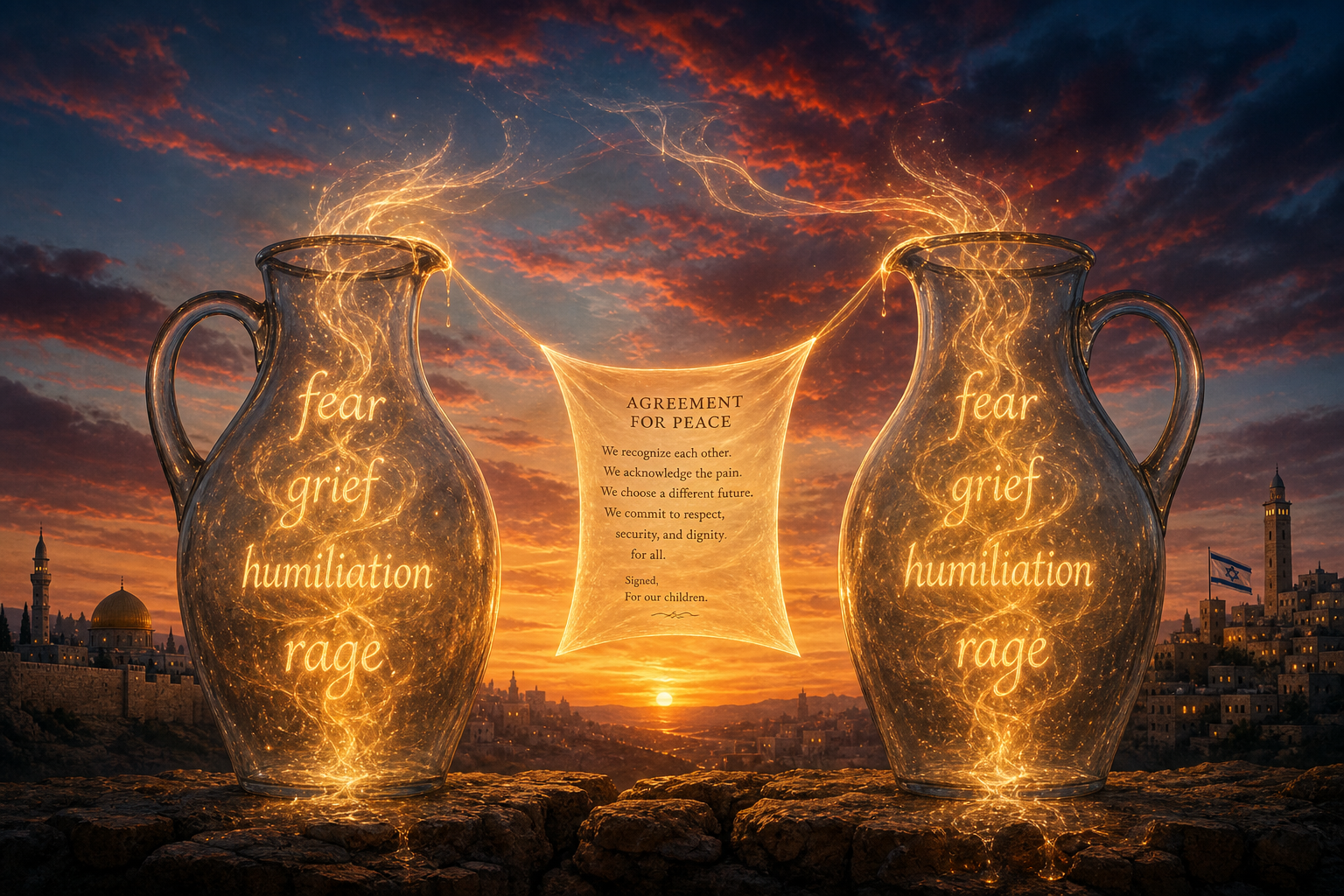
Illustrative. AI image created by the author.
Peace deals are supposed to change everything.
Maps get redrawn. Flags are raised. Hands are shaken for the cameras. Commentators talk about “historic moments” and “bold leadership.” For a few days, it can feel as if the future has finally arrived.
And then, sometimes slowly and sometimes all at once, the deal begins to come apart.
Terror attacks return. Rockets fly. Checkpoints remain. Settlements expand. Elections are lost. Street anger rises. Old narratives re‑emerge. Before long, the “historic” agreement is being spoken about in the past tense, as one more broken promise in a region that has already seen too many.
We usually explain these failures in familiar terms: security, borders, extremists, bad faith, weak leaders, foreign spoilers, bad timing. All of that matters.
But there is another reason peace deals often don’t hold—one we talk about much less.
Some agreements fail not only because of what sits on the map, but because of what sits in people’s hearts.
They fail when entire societies have come to live inside their grief.
They fail when pain has been carried for so long, and used for so much, that it hardens into identity.
When that happens, even a good agreement can feel like a threat.
The Emotional Jug, Scaled Up
For more than forty years, my life’s work has been teaching people how to repair relationships.
In PAIRS (“Practical Application of Intimate Relationship Skills”), the relationship education program founded by my mother and stepfather, Lori Heyman Gordon and Rabbi Morris Gordon, we teach something called the Emotional Jug. The idea is simple enough that we use it in workshops with teenagers and couples on the edge of divorce.
Each of us has an invisible jug inside. Into that jug go the feelings we never really got to express or have received: fear, grief, humiliation, rage, shame, loss.
When those feelings can be spoken aloud and met with empathy, the pressure in the jug drops. When they can’t, they don’t disappear. They accumulate. Eventually, they overflow.
That’s when people stop reacting only to what is happening right now. They start reacting through everything that ever happened to them.
In PAIRS workshops I’ve seen this countless times.
A couple comes in because they’re “fighting about money” or “arguing about the kids.” Within an hour, it becomes clear they’re not really fighting about the budget or bedtime. They’re fighting about a father who left, a betrayal from twenty years ago, a lifetime of feeling unseen. The present disagreement is carrying freight from much earlier.
At that moment, the problem is not that they lack information. The problem is that their jugs are full.
Nations can do something similar.
When Histories Live in the Room
Psychologists and historians have long described how societies marked by war, genocide, displacement, or oppression can develop powerful narratives around their suffering. Those narratives are not invented. They are born in real trauma.
Political psychologist Daniel Bar-Tal has called this an “ethos of conflict,” while Vamik Volkan described how groups can carry “chosen trauma” across generations.
But over time, they can become more than memory. They become a frame through which everything is seen.
In the Israeli–Palestinian conflict, it is impossible to miss this.
Many Jews carry the memory of centuries of persecution culminating in the Holocaust, followed by wars of survival, terror attacks, international hostility, and the shock of October 7. Beneath all of that lies a simple, urgent longing: to finally be safe enough to stop bracing for catastrophe.
Many Palestinians carry the Nakba, displacement, statelessness, occupation, humiliation, economic hardship, failed leadership, and the transmission of loss across generations. Beneath all of that lies a no less urgent longing: to live with dignity, recognition, belonging, and a future not permanently defined by dispossession.
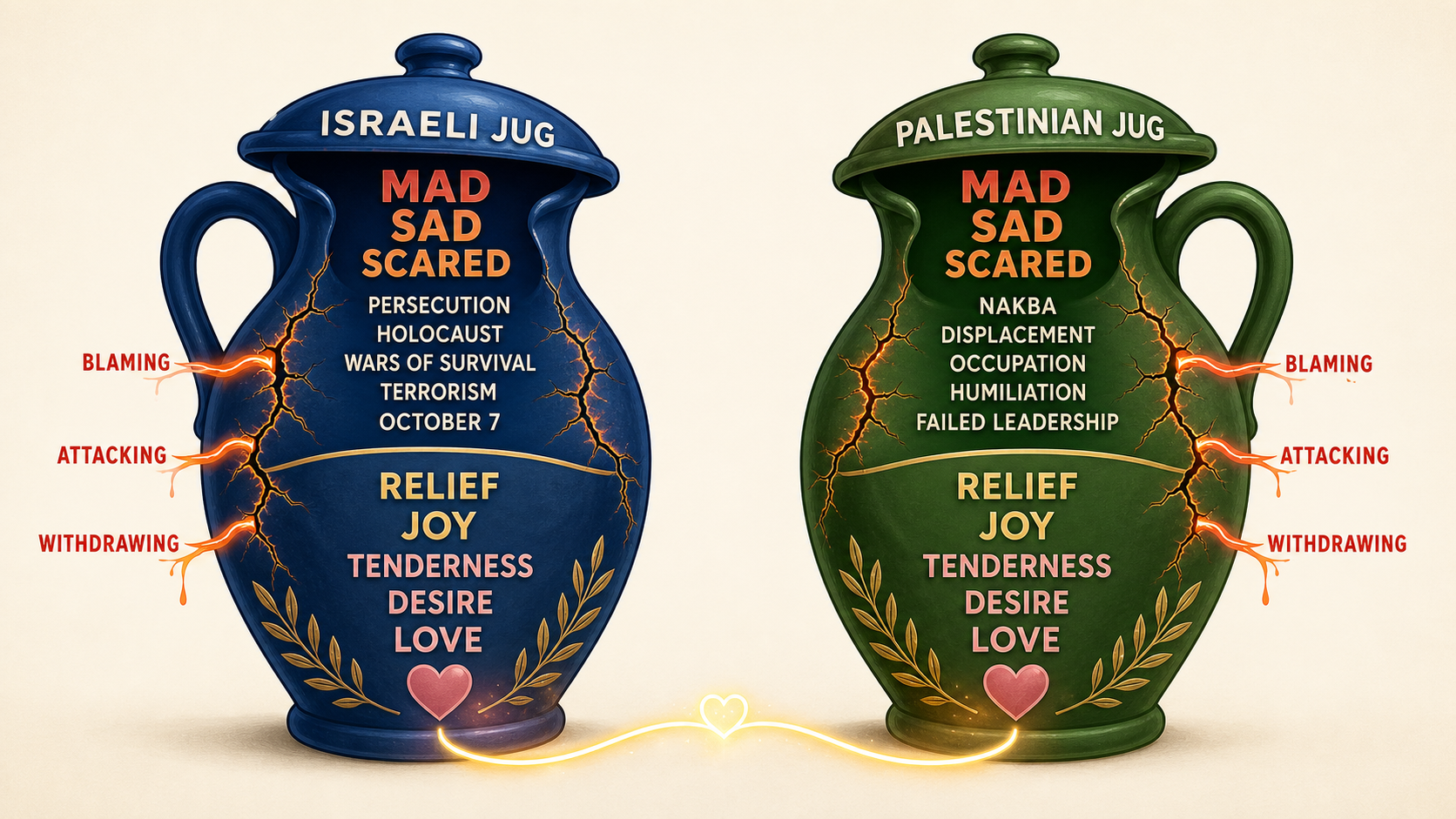
These histories are not equivalent. The circumstances are not the same. The degrees of power and responsibility are not the same.
What is similar is this: both peoples have very full emotional jugs.
Neither jug is imaginary. Neither jug is empty. And when whole societies live from full jugs, peace proposals do not land on neutral ground. They land on accumulated pain.
Why Good Agreements Still Break
A peace deal, at its best, answers hard questions: Who controls which land? Who protects which border? How are resources divided? What happens with refugees, with Jerusalem, with rockets, with settlements?
But even the best answers to those questions will not hold if the emotional reality underneath is untouched.
We saw this with Oslo. There were many reasons it failed: violence, terror, assassinations, incitement, settlements, political miscalculations, bad faith on more than one side. No one factor explains it. But one thing Oslo never really changed was how most Israelis and Palestinians felt about one another.
Negotiators reached understandings. Large parts of their publics did not.
We saw a version of this again with the Abraham Accords. Whatever one thinks about them politically, they were a significant geopolitical achievement. They ended taboos, changed regional alliances, opened new possibilities.
What they did not directly touch was the emotional infrastructure of the conflict between Israelis and Palestinians themselves. For most people between the river and the sea, and in the diaspora communities watching, very little changed in the jug.
That’s the gap we almost never talk about:
- Agreements can shift institutions overnight.
- Narratives, fears, and identities can take generations to move.
The Difference Between Grief and Grievance
It helps here to draw a distinction that has shaped my work with families and that becomes even more important when scaled to nations: the difference between grief and grievance.
Grief tells the truth about pain. It mourns what has been lost. It says, “This really happened, and it hurts.”
Grievance starts in the same place, but it doesn’t end there. Instead of being a feeling that can be honored and moved through, grievance becomes a place to live.
Grief asks: *What happened to us?*
Grievance slowly shifts into: *Who are we without what happened to us?*
Grief can sit alongside healing. Grievance often resists it.
When grievance takes root, the wound stops being only a wound. It becomes a passport to moral certainty, a source of status inside the group, a way to decide who is “with us” and who is a traitor.
At that point, letting go of grievance does not just feel like forgiving the other side. It can feel like erasing yourself.
That is why reconciliation can feel so threatening. The fear is not only, “What if they hurt us again?” It is also, “Who will we be if we are no longer defined by what they did?”
And that fear is not uniquely Israeli or Palestinian. You can see versions of it in Northern Ireland, in Rwanda, in the Balkans, in communities marked by slavery and racism, in any place where trauma has become a story people live inside.
The Politics of Pain
There is another hard truth here.
Unresolved pain is not just tragic. It is politically useful.
Humiliated people are often easier to radicalize than secure people. Frightened communities are more likely to tolerate extreme measures in the name of protection. Populations taught that their suffering is uniquely sacred may be more willing to excuse almost anything done in its name.
In any prolonged conflict, there are always actors—politicians, militants, media ecosystems, foreign funders—who benefit from keeping the emotional jug full.
So the wounds are fed. Images of atrocity are circulated without context. Stories of betrayal are repeated far more often than stories of courage or empathy. Every concession is framed as surrender. Every compromise is framed as betrayal.
Who loses in that arrangement?
Not the ideologues with microphones. Not the arms dealers. Not the politicians whose power depends on permanent emergency.
The people who lose are the parents burying children in Sderot and in Khan Younis, in Kiryat Shmona and in Beirut, the families who never get to sleep all the way through the night, the grandparents who have watched hope raised and dashed so often they no longer dare to believe in it.
They are not the beneficiaries of grievance.
They are its victims.
Why Politics Alone Isn’t Enough
None of this means that emotions are more important than politics. You cannot feel your way to a border line. You cannot process trauma into a security plan.
Disputes about land, sovereignty, demilitarization, refugees, Jerusalem, water, and international guarantees cannot be solved by a group dialogue circle, however well facilitated.
But the opposite is also true: you cannot simply legislate your way out of unprocessed trauma.
Political solutions still matter. They matter enormously. What this argument adds is that emotional readiness helps determine whether those solutions can endure.
A technically strong agreement can still fall apart if too many people experience it as existential humiliation. A somewhat flawed agreement can survive if enough people experience it as “good enough” and trust that they will have ways to fix its shortcomings over time.
That trust is not produced by signing ceremonies. It is produced by slow, unglamorous, deeply human work.
Where Real Peace Work Starts
If peace is more than an absence of shooting for a season, where does the real work begin?
It begins wherever people learn to tell the truth about their pain without turning it into a weapon.
There are already glimpses of this.
Groups like the Parents Circle–Families Forum, made up of Israelis and Palestinians who have lost immediate family members to the conflict, create spaces where grief can be expressed before it is conscripted into grievance. These are not people untouched by tragedy. They are people who know it intimately.
When they sit in the same room and tell their stories, something rare happens. The wound does not vanish. No one forgets. No one signs away their political beliefs at the door.
But for a few hours, the story in the room is not, “Our suffering proves we are right and they are wrong.” The story becomes, “We are both human, and we are exhausted from burying our children.”
Will such meetings, by themselves, end the conflict? Of course not.
What they can do is widen the emotional imagination. They show that another kind of relationship is mentally possible, even if politically distant. They produce teachers, clergy, journalists, parents, and teenagers who have experienced something other than the standard script.
That is where cultural change begins: not by persuading everyone at once, but by changing what key people in a society believe is even imaginable.
Political agreements can set new rules. Culture determines what people do with those rules.
What We Almost Never Ask
Imagine, for a moment, that tomorrow morning negotiators, backed by the region and the great powers, somehow produced a genuinely promising agreement for Israelis and Palestinians. Imagine that it addressed borders, security, refugees, Jerusalem, demilitarization, guarantees—all of it.
Two questions would immediately follow:
1. Is this agreement fair enough?
2. Are the people on both sides able to live inside it?
We talk endlessly about the first question. The second question is often treated as an afterthought.
Yet that second question may be the one that decides everything.
Are we asking people whose jugs are overflowing to behave as if they are empty? Are we assuming that a population organized around grievance for decades can, in a matter of months, suddenly organize itself around a shared future?
If not, what would it mean to prepare people emotionally for peace, not only politically?
Choosing a Future Over a Wound
In PAIRS, genuine repair requires three things that cannot be faked:
- Honest acknowledgment of what happened.
- Real accountability for what was done or left undone.
- A shared commitment to a future worth choosing over a past worth avenging.
Nothing about the Middle East makes these tasks easy. Nothing about the Middle East makes them less necessary.
At some point, if there is to be another serious attempt at Israeli–Palestinian peace, leaders and societies will have to confront questions that sound more like therapy than diplomacy:
- Can inherited fear be acknowledged without being endlessly reproduced?
- Can grief be honored without becoming permanent identity?
- Can we remember our dead without making them the only compass we follow?
These questions do not replace border talks, security arrangements, or economic plans. They determine whether any of those things can endure long enough to matter.
For Israelis and Palestinians, for Iranians and Americans, and for everyone living in the blast radius of their decisions, success may not look, at first, like grand ceremonies or Nobel Prizes.
It may look like children who do not know the sound of running to a shelter by heart.
It may look like teenagers whose first experience with the “other side” is not through a missile strike or a viral video of a beating.
It may look like a generation that inherits its people’s history without inheriting all of its emotional burdens.
The goal is not a future without pain. No society receives that gift.
The goal is a future compelling enough that, over time, more and more people choose it over the familiar power of their wounds.
Peace deals can open doors. They can draw lines, create institutions, and unlock resources. But they cannot, on their own, carry the full weight of reconciliation.
That work falls to parents and teachers, clergy and journalists, therapists and activists, neighbors and leaders, and the children who are asked to inherit history without being imprisoned by it.
A peace process can be signed.
A future has to be built.
Related Topics
Related Posts