
Writing on Jewish life, relationships, trauma, and resilience
The Politics of Making Others Weep

Beneath debates about security and deterrence lies a quieter struggle over what grief will become in Israeli life. AI image created by the author.
This essay is part of an ongoing series on “peace preparation” — the emotional, relational, and narrative work that political agreements cannot do. Drawing on decades of work with couples, families, and dialogue programs, I’m exploring how grief, identity, and daily cooperation shape whether negotiated ceasefires and treaties can become something more than pauses between wars.
We often talk about borders, missiles, hostages, ceasefires, and deterrence when we talk about peace. We talk much less about the emotional realities beneath them: the reservoirs of grief that have been filling for generations, and the ways grief can either be honored—or hardened into grievance.
A peace agreement can redraw borders, exchange prisoners, and quiet guns for a time. It cannot, by itself, transform the emotions of parents who have buried children. It cannot make loss gentler than it is. That work is separate: psychological, moral, cultural. And when it is not done, grief easily becomes something else. It becomes grievance: a way of living in which loss is no longer only something we carry, but something we become.
Grief and grievance are not the same
Grief tells the truth about loss. It sits in living rooms and hospital corridors, in WhatsApp groups and memorial days, in empty chairs at Shabbat tables. It wants comfort, meaning, justice, and safety. It may never disappear, but it can be witnessed, supported, and gradually integrated into life.

Grief says: “I hurt. I need witness, safety, meaning.”
Grievance says: “Because I hurt, you must hurt more.”
Congruence says: “I can honor my pain without surrendering my humanity.”
Israelis, Palestinians, Lebanese, Americans after 9/11, Serbs and Bosniaks after the Balkan wars, Catholics and Protestants in Northern Ireland — all have faced moments when grief could be honored or weaponized. No community is immune from turning pain into identity or identity into justification for harming others.
Ben Gvir and grievance politics
Recent statements by Israel’s Minister of National Security, Itamar Ben Gvir, offer an unusually clear example of grievance politics in action.
Following the deaths of four Israeli soldiers in Lebanon, Ben Gvir declared that “all of Lebanon must burn” and that “for every tear of an Israeli mother, a thousand Lebanese mothers must weep,” as reported by multiple outlets. In subsequent remarks, he repeated the same logic, saying that not a single tear from an Israeli mother could be tolerated even if it meant tears from a thousand Lebanese mothers, and describing Lebanon as a place that should become Israel’s “playground.”
These were not slips of the tongue. They were repeated expressions of a worldview in which security is measured not only by protection, but by the scale of suffering imposed on others.
The temptation is not confined to Israel. When President Trump warned that “a whole civilization will die tonight, never to be brought back again” in Iran and later said he was “fine with it,” he used the same emotional move: shifting from the language of deterrence to the fantasy of erasing an entire society. In both cases, grief and fear are invoked not only to justify defending citizens, but to imagine destruction on a civilizational scale. That is grievance politics: it takes real loss and stretches it into a vision in which safety seems to require making others weep forever.
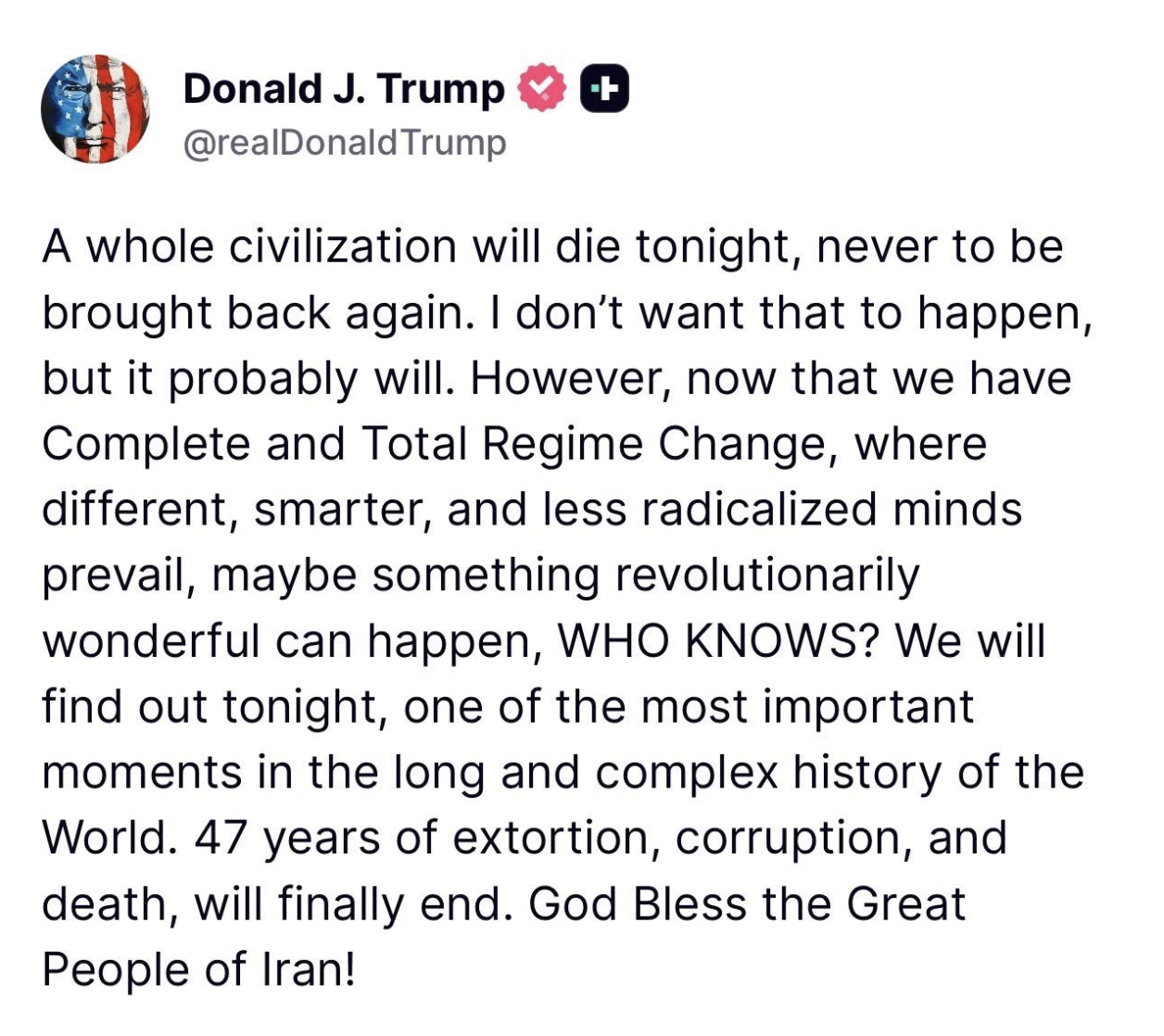
The problem is not that such rhetoric is insufficiently angry. It is that it confuses deterrence with escalation. Deterrence seeks to shape an adversary’s behavior by making costs clear and predictable. Grievance seeks emotional satisfaction through disproportionality. When a leader moves from saying “we will stop attacks” to saying “all of Lebanon must burn,” the objective is no longer merely security. It becomes symbolic retaliation.
In that frame, the tears of bereaved Israeli families are no longer treated with humility and care. They are weaponized. Their pain becomes a justification for imagining the destruction of an entire neighboring society.
That is what grievance does. It takes real loss and builds an identity around vengeance.
Why some Israelis find this language compelling
Supporters of Ben Gvir would likely argue that critics misunderstand the context in which such statements are made. Israel is not facing an abstract policy challenge but repeated attacks from organizations that openly celebrate Israeli deaths and, in some cases, seek Israel’s destruction. From this perspective, expressions of overwhelming force are not primarily about vengeance. They are about deterrence.
They would argue that Israelis have repeatedly been told to show restraint, only to face renewed violence. The lesson many draw is not that Israel has been too forceful, but that its enemies often interpret restraint as weakness. In that framework, harsh rhetoric serves a purpose: to convince adversaries that the cost of attacking Israel will be unbearable.
Some would also argue that outrage over statements such as “all of Lebanon must burn” ignores a broader regional reality in which Israeli civilians are frequently targeted and their suffering minimized. They might ask why Israeli anger is subjected to moral scrutiny while rhetoric calling for Israel’s destruction receives less attention internationally.
Those fears are real. But fear becomes dangerous when leaders transform it from a warning system into a moral permission slip.
The distinction matters because grief and grievance can sound similar in moments of acute pain. Both speak in the language of loss. Both emerge from fear, anger, and vulnerability. The difference lies in where they lead. Grief asks how a society can protect life after tragedy. Grievance asks how suffering can be repaid. When leaders begin to blur those paths, the consequences are felt not only across borders, but within their own communities.
What it does to Israel
The first cost is paid inside Israel itself. A society under immense pressure—fear, trauma, anger, exhaustion—needs leaders who can help discipline those emotions into moral seriousness. When senior officials invite the public to equate security with obliteration, they normalize the language of collective punishment. Over time, that language reshapes conscience. It nudges citizens toward believing that safety requires putting empathy aside.

It also narrows what it means to be Israeli. Instead of a complex identity built from history, culture, resilience, creativity, argument, memory, democracy, and survival, the identity being offered is simpler and more dangerous: we are the ones who will make others weep. Those who recoil from that language can be made to feel naive, weak, or disloyal. The space in which one can grieve deeply and still insist on restraint begins to shrink.
You can see the moral cost not only in public language, but in how it lands on the next generation. I saw that danger clearly when my 16-year-old son read Ben Gvir’s words. He asked how anyone could explain them, let alone defend them. He did not need a seminar on international law to recognize that something was wrong. His reaction reminded me that many young people still hear the moral obscenity in such language plainly. The danger is not that they fail to understand it. The danger is that too many adults have grown accustomed to it.
What it gives Israel’s enemies
Grievance politics also hands Israel’s enemies a powerful gift. Movements hostile to Israel work constantly to portray it not as a flawed democracy defending its citizens, but as a project animated by collective hatred. When a minister responsible for national security says that “all of Lebanon must burn,” they do not need to invent an indictment.
Across the border, many hear such words not as a narrowly targeted response to Hezbollah or specific attacks, but as confirmation of a deeper fear: that Israelis do not see Lebanese civilians as human beings with their own grief, dignity, and dead, but as a population whose suffering may be escalated at will.
And so grievance deepens there too. When people are told that their tears do not count—or that the proper moral balance is a thousand of theirs for every one of ours—the temptation to freeze grief into permanent identity grows stronger. Armed groups and leaders who thrive on permanent war feed on that feeling. They present themselves as the only honest guardians of a wounded people, and they cast any talk of restraint or de-escalation as betrayal.
This is how cycles of violence renew themselves emotionally, not only militarily. One side’s grievance-based identity calls forth the other’s. A declaration that “all of Lebanon must burn” strengthens the conviction that Israel is irredeemably murderous. That conviction, in turn, makes Israeli grief more likely to harden into grievance: look how they describe us; there is no partner, only enemies.
Agreements negotiated on top of that emotional terrain can be signed and photographed. They rarely hold.
Why agreements are not enough
Peacebuilding scholars have long argued that agreements alone rarely resolve conflicts rooted in identity and damaged relationships. John Paul Lederach argues that lasting peace requires working on the relational patterns beneath violence, not only negotiating political terms. Psychiatrist Vamik Volkan’s work on large-group identity similarly describes how historical wounds can become part of collective identity across generations when they are not sufficiently mourned.
The American Civil War is one example. The surrender at Appomattox and the formal end of hostilities restored the Union by force of arms, but animosities did not simply vanish. Efforts at reconciliation—reunions of Union and Confederate veterans, shared commemoration at places like Gettysburg—helped some former enemies embrace one another as “brothers,” yet deep grievances around race, memory, and power persisted, especially in the defeated South, where humiliation and loss were layered onto the abolition of slavery. Failures of Reconstruction and compromises over white supremacy allowed unprocessed grief and humiliation to harden into narratives that fueled violence and resistance for more than a century.
The lesson is not that war never ends. It is that ending the fighting on paper does not, by itself, transform the identities and wounds that made it possible.
The same is true in the Middle East. Agreements can stop shooting for a time. Without work on grief and grievance, they rarely change what people believe about themselves and each other.
The language differs, but the warning is similar: when grief becomes collective identity, it becomes much harder to imagine a future not organized around the injuries of the past.
Deterrence with limits
None of this means deterrence is unnecessary. Israel must be able to defend its citizens decisively against real threats. No serious peace preparation can pretend otherwise.
The question is not whether Israel should deter its enemies. The question is whether deterrence is strengthened or weakened when it sounds indistinguishable from collective revenge.
Effective deterrence says: if you attack us, the cost will be clear, predictable, and unacceptable. It draws red lines, targets specific hostile actions, and seeks to prevent war by making aggression too costly.
Vengeance without limits says: if we are hurt, we may burn your entire society. That is not stability. It is panic dressed as strength. It invites escalation, isolates allies, recruits enemies, and teaches Israelis that their safety depends on becoming less humane. A country can defend itself fiercely without turning grief into permission for indiscriminate destruction. In fact, over time, it must.
What different leadership would do
The alternative is not sentimental. It is disciplined. Different leadership would name grief clearly and honor it fully. It would stand with bereaved families without promising that their tears will be answered by the burning of another society. It would insist that defending Israelis never requires abandoning the distinction between combatants and civilians, between necessary force and the exaltation of destruction.
If peace is ever to be more than a pause between wars, it will have to rest on something other than competing grievances. Peace preparation has to begin there.
-
On the first track, healing and emotional safety, it means investing in trauma care, listening spaces, bereaved family support, and public rituals that allow grief to be expressed without being turned into a weapon.
-
On the second track, narrative and memory, it means telling stories of loss without freezing identity around grievance. It means recognizing that the other side’s grief is real even when we reject its political conclusions or dispute its causes.
-
On the third track, daily cooperation, it means building enough shared interests and practical projects that identity is slowly enriched by experiences of solving problems together, not only by memories of harm.
What grief will become
The question is what grief will become.
Will we let grief tell the truth about loss and ask, with humility, how to live after it? Or will we allow grievance to define who we are, and trap the future inside the worst moments of the past?
Before we speak from pain, we might ask:
Am I protecting life, or proving injury?
Am I making contact, or making enemies?
Can I own my grief without making another mother pay for it?
This article is part of an ongoing series on “peace preparation” — the emotional, relational, and narrative work that political agreements cannot do. Across these essays, I draw on decades of work with individuals and couples, dialogue programs, and conflict research to explore how grief, identity, and daily cooperation shape whether ceasefires and treaties become more than pauses between wars. I welcome your comments, criticisms, and perspectives. Thank you.
Related Topics