
The Erosion of the American Shield: A Crisis of Our Own Making
For decades, the cornerstone of Israel’s national security strategy has been the unshakeable, bipartisan support of the United States. It was a consensus built on shared values: democracy, the rule of law, and a mutual commitment to liberal ideals. Today, that foundation is not just cracking—it is crumbling. And as we look toward the upcoming U.S. election cycle, we must confront the uncomfortable reality that this erosion is being accelerated by the very people tasked with protecting the state: Prime Minister Benjamin Netanyahu and his extremist cabinet.
The Blur of Extremism: From Washington to Jerusalem
The threat to Israel’s standing in the American political sphere is no longer a singular, predictable phenomenon. It has become a pincer movement, fueled by emboldened white supremacists on the far-right and a rising, anti-Israel orthodoxy on the far-left.
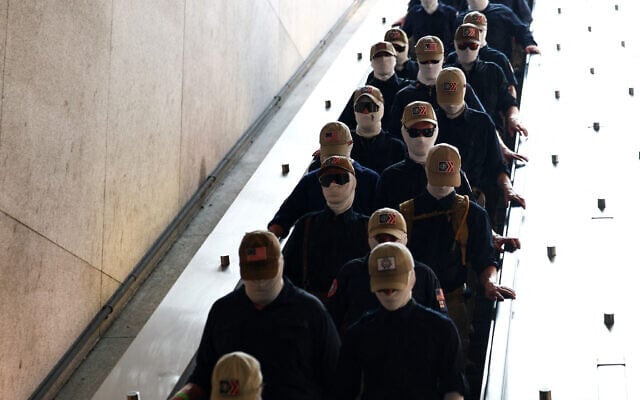
Consider the chilling visuals from Washington, D.C., where masked members of the Patriot Front—a white nationalist hate group—marched through the nation’s capital on Independence Day. It is a mistake to view such groups as merely a domestic American problem. When the Israeli government includes ministers who openly flirt with ethnonationalist rhetoric and challenge the democratic rights of minorities, the visual and ideological distance between the Jewish state and these hate groups begins to blur in the eyes of the global public. Extremism, by its nature, creates a permissive environment for hatred. When the “pro-Israel” government in Jerusalem is perceived as synonymous with illiberalism and religious exclusionary policies, it strips away the moral clarity that has traditionally acted as a shield against antisemitic tropes in the U.S.
The Mainstreaming of Anti-Israel Orthodoxy
Simultaneously, the political center in Washington is being hollowed out. We are witnessing the mainstreaming of anti-Israel sentiment in electoral politics. The recent victory of an anti-Israel candidate in a Colorado primary, running on a platform of ending “genocide” in Gaza, is a canary in the coal mine. This is not the fringe discourse of a campus protest; this is a candidate for high office utilizing the language of delegitimization to win votes in a party that has historically been Israel’s most reliable ally.
This realignment is starkly visible in the Michigan Senate primary, where the race has narrowed into a referendum on Israel. The fact that the U.S.-Israel relationship is now a wedge issue—pitting a traditional pro-Israel establishment, represented by AIPAC-backed efforts, against a progressive wing defined by its open hostility toward the state—is a strategic failure of the highest order.
A Strategic Failure of Our Own Making
For years, the Netanyahu government has operated under the delusion that Israel could alienate the American liberal-democratic base while simultaneously maintaining the loyalty of the American political establishment. They gambled that a “Netanyahu-style” nationalism would align perfectly with a certain brand of conservative American politics. They were wrong.
By tying Israel’s fate to this radical domestic agenda—characterized by the assault on the judiciary, the inclusion of arsonists and racists in the cabinet, and a complete abandonment of a horizon for peace with the Palestinians—the current government has turned Israel into a partisan football. When Israel ceases to be a cause of shared democratic values and becomes, instead, a symbol of illiberalism, it becomes fair game for the political fringe on both sides of the aisle.
The Cost to the Diaspora
The consequences for the Jewish Diaspora are immediate and visceral. As the political discourse in the U.S. turns increasingly toxic, American Jews find themselves caught in the crossfire. They are forced to defend a government whose policies are fundamentally at odds with the liberal, pluralistic values that the vast majority of American Jews hold dear. This dissonance is not just a PR problem for Israel; it is a security threat. A shrinking base of support in the U.S. means that the strategic military, economic, and diplomatic aid that Israel requires will eventually be subject to the whims of domestic polarization.
Rebuilding the American Shield
We are witnessing the unraveling of the “American Shield.” The rise in antisemitic rhetoric—whether it arrives wrapped in the white hoods of the Patriot Front or the progressive, academicized jargon of political candidates in Colorado—is the byproduct of a global retreat from the liberal order.
If we want to reverse this tide, we cannot simply blame the American electorate or point fingers at the “woke” left or the “radical” right. We must look at the damage being done from within. Netanyahu’s government has actively traded Israel’s status as a beacon of democratic resilience for a short-sighted strategy of political survival. In doing so, they have made the state of Israel an outlier, vulnerable to the shifting winds of American political extremism.
The upcoming elections in the United States will be a stress test for the U.S.-Israel relationship. But the outcome will not just be decided in Washington; it is currently being written in the cabinet meetings in Jerusalem. If we continue on this path, the damage may soon be irreversible. It is time for a drastic change in course—before the shield we rely on is dismantled entirely.