
The Escape Artist Who Could Not Escape Time
When I was a youngster, I was fascinated by magic.
I can still remember the excitement of opening a magician’s kit that my parents bought for me. Inside was everything a budding magician could want: a black cape, a magic wand, a top hat, and a collection of simple tricks that allowed me to amaze family members and friends.
Magic was a big part of childhood. At birthday parties, it was not uncommon for parents to hire a magician who would entertain a room full of wide-eyed children with card tricks, disappearing coins, and seemingly impossible feats. We knew there had to be a secret behind the tricks, but that only made them more captivating. The mystery was part of the fun.
As I got older, my interest in magic evolved into a fascination with the man widely regarded as the greatest magician and escape artist of all time: Harry Houdini.
Born Erik Weisz in Budapest, Hungary, in 1874, Houdini immigrated to America with his family as a young child. He later adopted the stage name Harry Houdini and spent years struggling to make a living as a performer before achieving worldwide fame. What set him apart was not simply his skill as a magician but his remarkable ability to escape from situations that appeared utterly impossible.
Houdini became famous for challenging police departments around the world to lock him in handcuffs, jail cells, and prison wagons. Crowds gathered wherever he performed, eager to see whether this seemingly ordinary man could accomplish the impossible.
And time after time, he did.
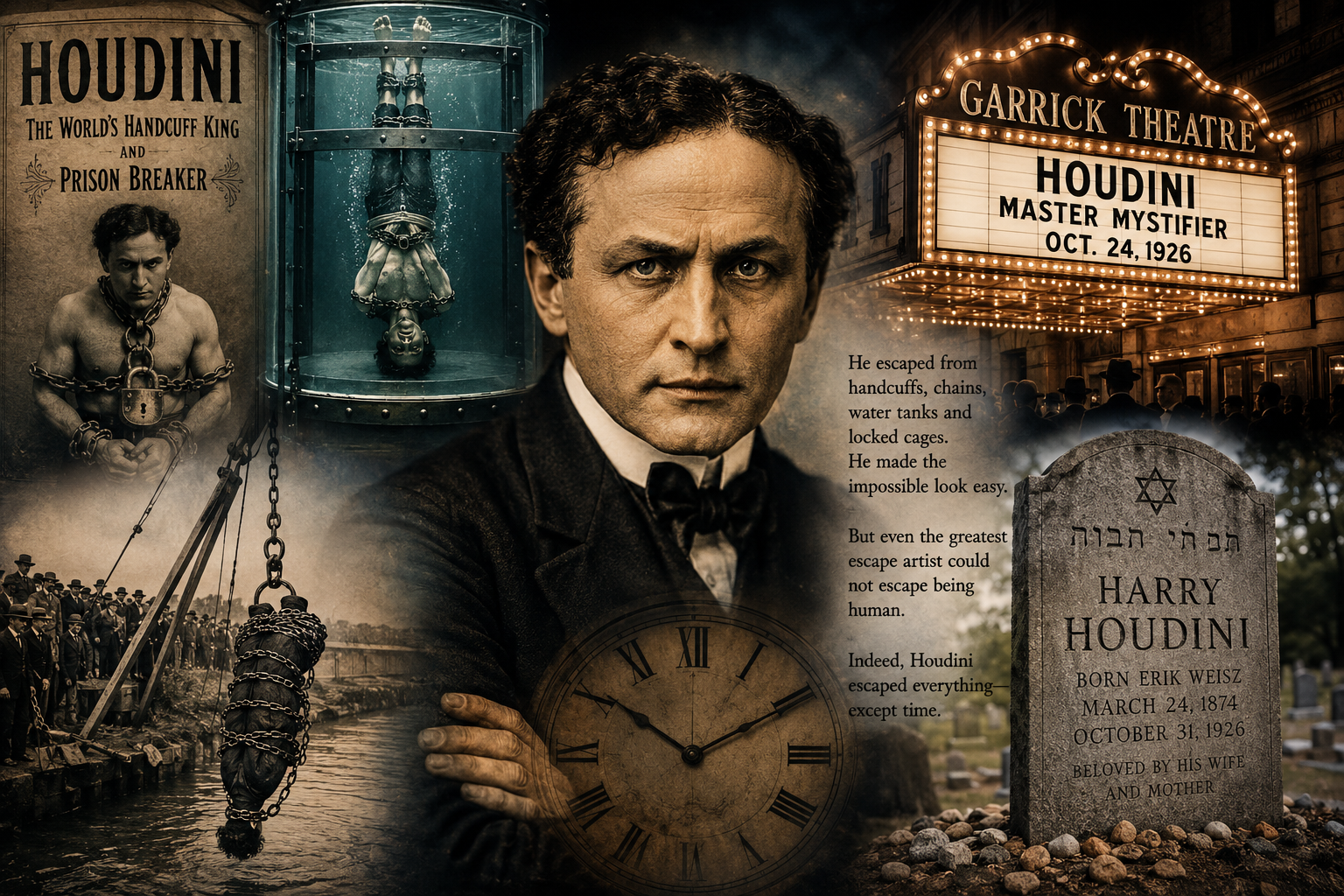
One of his most celebrated feats was the Chinese Water Torture Cell, introduced in 1912. In this death-defying illusion, Houdini was suspended upside down, his ankles locked in stocks, and then lowered headfirst into a glass tank filled with water. The tank was secured, curtains were drawn, and audiences sat in suspense. Moments later, Houdini would emerge alive and triumphant, leaving spectators wondering how such an escape could possibly be accomplished.
Another famous stunt involved the Milk Can Escape. Houdini would be handcuffed and sealed inside a giant milk can filled with water. The can was locked shut and hidden from view. Minutes later, he would emerge unharmed, while the audience gasped in amazement.
Perhaps most dramatic were his public escapes. Newspapers eagerly covered events in which Houdini was shackled and thrown into rivers or suspended from tall buildings while wrapped in chains and restraints. Huge crowds gathered to witness what appeared to be certain disaster. Yet somehow, he always escaped.
Part of Houdini’s appeal was that he seemed invincible. He placed himself in situations that appeared hopeless and emerged victorious. He made the impossible look easy.
But for all his extraordinary abilities, Houdini was still human.
One of the most fascinating—and tragic—stories about Houdini involves what turned out to be his final performance.
In October 1926, while on tour, Houdini suffered from severe abdominal pain. Earlier, he had reportedly been punched in the stomach by a college student who was testing Houdini’s claim that he could withstand powerful blows to his abdomen. Whether that incident directly caused his medical condition remains a matter of debate among historians, but there is no question that Houdini became seriously ill.
Doctors diagnosed him with acute appendicitis and urged him to stop performing and undergo immediate treatment.
Houdini refused.
When he arrived at the Garrick Theater in Detroit, Michigan, on October 24, 1926, he was already gravely ill. His temperature had reached an astonishing 104 degrees Fahrenheit. Most people would have gone straight to a hospital.
Houdini went on stage.
For two hours, he performed despite the pain, the fever, and the danger. Audience members had little idea that the man before them was fighting for his life.
At one point during the performance, he reportedly collapsed backstage. Yet he completed the show.
Only afterward was he taken to Detroit’s Grace Hospital. By then, it was too late. Peritonitis resulting from a ruptured appendix had spread throughout his body. On October 31, 1926—Halloween, appropriately enough—the world’s greatest magician died at the age of fifty-two.
As we mark the 100th anniversary of Houdini’s death, there is something deeply poignant about that story.
For decades, Houdini had escaped from handcuffs, chains, prison cells, water tanks, and locked containers. He had built an entire career around overcoming seemingly impossible obstacles. He became a symbol of resilience, ingenuity, determination, and human willpower.
Yet in the end, he encountered something from which there could be no escape.
What lessons can we learn from Houdini’s death?
One lesson is that courage and stubbornness are not always the same thing. The determination that helped Houdini achieve greatness may also have prevented him from recognizing his own limits. There are times when perseverance is admirable and times when wisdom requires us to stop, seek help, and acknowledge our vulnerability.
Another lesson is that no amount of talent, success, or fame exempts us from our humanity. We often imagine that exceptional people somehow operate by different rules. Yet even the most accomplished individuals are subject to the same physical realities as everyone else.
Most of all, Houdini’s story reminds us that life itself has limits.
We live in an age that celebrates mastery and control. We admire people who overcome obstacles and conquer challenges. There is much to admire in that spirit. But there is also wisdom in recognizing that some realities cannot be conquered.
Harry Houdini spent his life escaping from situations that seemed impossible. He dazzled audiences by finding a way out when no way out appeared to exist. He became a legend because he could free himself from chains, locks, and cages.
But even the greatest escape artist could not escape being human.
In the end, Houdini was able to escape everything—except time.