the Eternal Jew's biographer
The Eternal Jew’s Tale, #189, Noah’s tale, 6
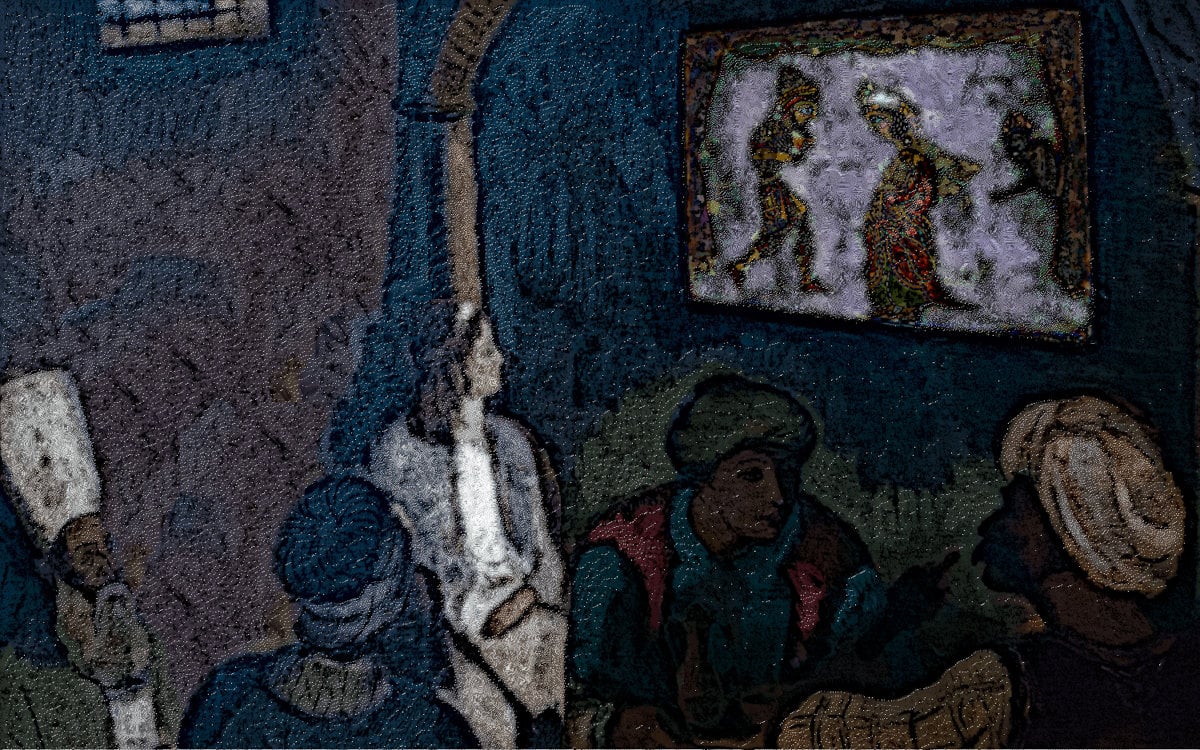
Karagoz puppet show; image colorized and modified by the author, obtained from Wikimedia Commons, Bursa Karagöz Museum-7521a, in the public domain.
In this episode, theatrics and melodrama. {Warning: this episode contains rude language.}
The Eternal Jew’s Tale
Twenty Second Era, Part 4, Constantinople
1504 C.E., 5264 from Adam
Then from out behind the stage with a howl like a Mongol horseman leading a charge, up leaps a puppet with maniac eyes — rubies set in a cavernous murk — and a mop of hair surrounding his head like the spiky bristles of a porcupine; a ragged shirt, all patches and holes, and his puffy pants with a hole in the crotch. Scratchin’ his ass, he pulls up his pants and with a wicked laugh he points and says,
“Here comes that pompous Saadia-Haj*…”
* ‘haj’ usually refers to someone who has made pilgrimage to Mecca
And now appears a wrinkly old coot, his turban tall, embroidered, ornate, his beard abundant, grizzled, gray, his caftan draggin’ along the ground, an ancient relic from Khagan times.
Agitated, I turns to Batkol.
“Did I hear a-right? Did he call that guy Saadia-haj, or am I nuts? Sure sounded like that to me.”
And she cocks her head and wrinkles her nose, rummagin’ deep in her memory of faces, voices, gestures, physique, to see if someone percipitates.
Now that Saadia-haj begins to incant some ancient verses of a Turkic tune, holy no doubt, but dense and obscure, and I couldn’t understand a word of it. Of course, I weren’t listenin’ close, dredgin’ my head for all I was worth, workin’ up images, tryin’ to find a face to match that puppeteer’s, when sudden, here come that Karagoz* with a bludgeon, whackin’ Saadia-haj,
* Turkish for ‘black eyes’
“Shut up, you hairy face old fart. What an enormous waterfall of shit be pourin’ outta your rancid mouth.”
“Curses on you, you demon beast; may Allah turn you into a worm to eat dung all your days.”
And away he runs with a piteous yowl.
“That’s my nuncle. I love him so, so long as he stays far away from me.”
Now clip-clops are heard from off-stage.
“Ho! The night watchman makin’ his rounds, my friend and partner in wickedness. I see he’s bringin’ me a gift. Yo, friend, whose load have you made light?”
The watchman now appears on stage, haulin’ a heavy sack on his back.
“Ah! Karagoz, you wicked wart, why are you prowlin’ about so late? Only pimps and thieves and skunks like to skulk about at night.”
“True enough, old friend, but say, you forgot the vilest beasts of all, the night watchman and coggerroach.”
At that they both pull out clubs. Bash and batter, bellow and bawl. And while they fight, here comes a thief on tippy toes up to the bag the watchman had dropped when he saw Karagoz. Rummagin’ thru the sack in delight, he pulls out silver candlesticks, a pouch of coins, a gold ring, bracelets and necklaces, a dead cat. He’s so absorbed he doesn’t see the watchman and Karagoz sneakin’ up. They pummel him senseless and tie him up, the watchman explainin’ cleverly:
“You keep the pouch of gold coins and I’ll take him and the rest of the goods to the sultan’s guard and collect reward for all the stuff I’ll say this shitball stole, which you, as witness will confirm. And maybe, notin’ my bravery, there may be permotion from the guard, as well.”
And arm in arm like best friends the two of them drag their prisoner away.
Thru all this scene the rowdy crowd be hootin’ and shoutin’ back at the play,
“Yeah, ain’t it the truth…”
“Our watchman’s the same…”
“Deck him Black Eyes till he can’t get up…”
Then booin’ and jeerin’ for that poor thief who been victimized like many they know.
Now here come Karagoz back on stage, one hand holdin’ a jug of wine, the other holdin’ some woman’s jugs.
“Most of my money goes to women and wine. The rest of it I just squander away.”
(And I dasn’t tell you more of this scene, which might cause your ears to go up in flame, and turn your outrage against poor me, who’s only an innocent messenger.) Well, maybe I ain’t so innocent but they done things right there on stage I never done, nor thought to do. But if that crowd been noisy before, the din nearly blown out the canvas walls set up to celebrate Ramadan.
That be the last scene of the play. One by one the puppets appear, last of them all Karagoz, takin’ a bow with fond farewells. The curtain closes and once again Batkol’s yankin’ the sleeve of my coat.
“Let’s find that puppeteer behind stage and learn his name. We know him for sure.”
The crowd be swillin’ and millin’ about, and a group of his friends or wannabes are gathered around as he breaks down the stage and carefully packs each puppet away. The nook be strangely quiet now, like a battlefield when the armies have withdrawn, and all the carcasses, horse and man, have been hauled away, and all you hear be the sorrowful cry of distant birds. Then only Batkol and me be left with that puppeteer, him down on his knees packin’ the last of his poles and props. He looks up weary and somewhat annoyed, and turns back to tie up the last box.
“Say fella, that were some kinda show.”
(That’s Batkol pertendin’ she liked what she seen.)
“There somethin’ you want? I’d like to go home.”
“Just wonderin’ if maybe we met before.”
“I doubt it. I ain’t from around these parts.”
he says as he loads a hand-pulled cart, and begins to wheel it thru the maze. And that’s when Batkol remembers.
“Yacoob!”
A long silence. Shoulders sag. Then,
“Batkol, please just leave me alone. That sweet little boy you once knew, he died. And from his forgotten grave a twisted and gnarled vine now grows that feeds on the poison of the human soul.”
A dismal quiet. Then Batkol says,
“If you ever need a place to sleep, our door be always open to you.”
We never seen Yacoob again, tho he gained some renown for his Karagoz. And tho his name has been lost in the muck and rubble and lies of history, in his time the puppeteer’s guild and related craftsmen, artists, and guilds all acknowledged that Yacoob shaped the repertoire of the Karagoz play.
And yet, the sorrows of Yacoob compiled. Like many another, by serving his heart, he was led astray, *zonim akherahem,* down to a drear and miserable end, and the voice of his Jewish soul deceased.
*-* Bemidbar/Numbers: 15:39-40, ‘do not follow your eyes and your heart’ to be corrupted by them
~~~~~~~~~~
Dear reader, this is the last episode of The Eternal Jew’s Tale in chronological form. From here on, the story escalates to a montage of episodes, connected by theme. There will be a delay of a month or more as I translate these new episodes from their poetic form, with its highly altered English, into standard prose. But my purpose remains the same: to bring new insights into history and to create new midrash to expand, enrich, and elevate the Soul.
Related Topics
Related Posts