
the Eternal Jew's biographer
The Eternal Jew’s Tale, #200, Crystal Haggadah, 11
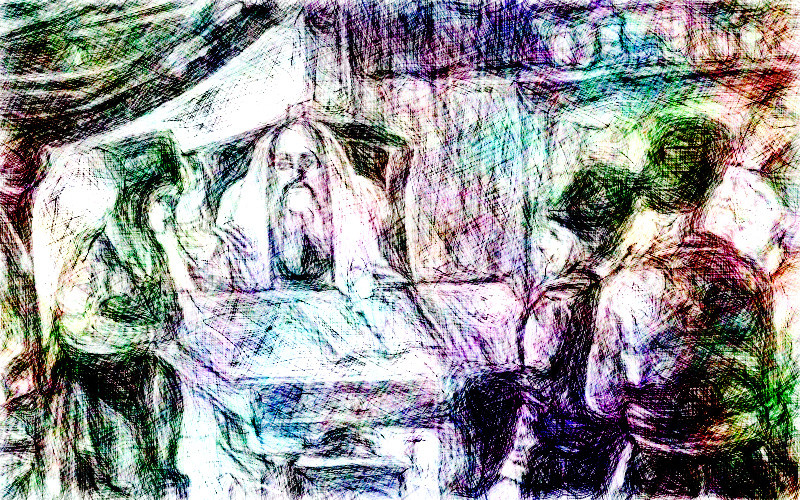
The Ari with Disciples; image colorized and modified by the author, obtained from Wikimedia Commons, Isroel Hopsztajn, in the public domain.
In this episode, kisses and rejections, drashes and derisions at Isaac Luria’s seder.
The Eternal Jew’s Tale
A Pesakh Montage, The Crystal Haggadah
Midrashbase
Lurianic Seder Midrashim, Tsfat, 1570 CE
Now here presented is a summary of the logics and mystic analogs that the sages at the Ari’s* seder devised to answer his question,
“Who is the one who desires the kisses of your lips and yet is urging you to depart?”
* Isaac Luria, “the Lion of God”
It seems that those who know the least desire most to have a say. The Ari’s disciple, Yisri Sarug breaks the contemplative mood, hoping to prove his own word is equal in light to the others here.
“Surely, this is a voice well known. Shlomo, full of the urgings of youth, woos the kisses of the wild doe. But nearing his end and weary of life he urges us to reject this world and turn our steps towards Neshama.”
Rav Cordovero, aged and ill, yet responds with a patient smile.
“My son, Yisroyel, your word is true. Shlomo wrote both The Song and Kohelet, and yet, surely, our esteemed sage and visionary leader, Rav Luria, wants us to delve beyond the p’shat.* Still, I commend your willingness to open the door to our ascents.”
* obvious or literal level
Moshe Alshikh makes the next move, knowing the sages will tear his word like a loaf of challah, torn to shreds at Shabbat meals, but also knowing his midrash will shape all the rest, and lay the foundation for the palace they build.
“Surely this is the Lor’s commands, to each and all of Hem folk, Yisroyel. The ‘kisses of our lips’ are the prayers of our mouth. The ‘command to depart’ like Abraham from his father, Terah, and his home, Haran, and like Yisroyel from Egypt land, from slavery and idolatry. Merciful God brings us near to fill our Neshama with awe, and God the Judge sends us forth to embed Hem moral Law in the worlds.”
Then Rabbi Alshikh looks around to see who will strike the first blow against his elegant edifice of thought.
Who else but Yosef Karo would speak?
“Oh, my Moshe, my student, my son, your interpretation is sweet, honey from dates, like fruit of the Tree in Aden’s midst. But the Ari’s quest has a sharper edge, and is not all sweetness; there’s dripping blood. This word is human and tinged with vengeance. It’s Moshe confronting that rebel clan, the sons of *Yitzhar and Eliav.*
*-* Bemidbar/Num. 16:1
“First he pleas with them to kiss his hand and honor him and show loyalty. But when he sees their inner heart, he calls the Lor to drive them out:
“‘Maw of the earth, devour them! And may I see them nevermore.'”
“This meshal* is for every Jew that would reject our Halakha.
* parable
Then a smile briefly lights his face, a smile tinged with a cutting edge.
“Ah, you have taken us halfway there, my revered friend, distiller of codes…”
So begins Shlomo Alkabetz.
“But we all know that Moshe’s word is the breath of the Lor as Hem enters the world, which shatters into the ten Sefirot to reconfigure all the elements. Not Moshe but broken shells and husks are shaping the contradictions here, Khesed to soften the yoke of Din, Malkhut resisting Tiferet’s kiss, Shekhina exiled into the word thru the disarray of matter and mind.”
As Rav Alkabetz ends his word a shadow of smugness crosses his face, tho quickly suppressed into humbleness.
But Khayyim Vital is not impressed.
“You know, my khaver, I am much impressed with the way you transform philosophy and its abstract ideas into human forms that desire kisses of women’s lips, and quicksilver-like with a change of heart, cast their loved ones into the night. But Khesed has no human hands; Tiferet has no ruby lips, nor anoints itself with seductive perfumes. This is not a matter of philosophy, nor the weighing of souls in the Sefirot. No. This is the work of that treacherous one, that seductress, Lilith, who comes in the night, arousing men with her musky smell, who serves her pleasure and flies away leaving men in her sinful grip. This is Lilith, her words and her ways.”
Around the table a few gasp. and many faces have a look of shock, or was it a look of awakening? Surely this word was daring and brash, if not downright blasphemous. And yet, who could disagree that the agent here must be physical and not a mystic working of the soul?
And then the elder sage of us all, Rabbi and Judge Cordovero, breathless, weary, feeble of voice, yet bright with fire and consternation:
“For the strong of heart, for prophet and sage, Lilith is merely a buzzing fly, swatted away with no consequence. But the kiss of these lips no one resists, as they bring on exiles without relent. This one is the Angel of Death.”
He says no more. What more to say?
And the Ari sits, nodding his head, his eyes slowly circling the room, piercing the soul of each sage where he sits, weighing the light and the husk of their words.
“Your logics oscillate back and forth from humans working their misguided ways to Divine powers that shape and control. Who is controlling the human beast? From above or below, it’s still the same: rebellion persists thru all our lives.
“But there is another model, my friends:
“The spirit expanding its inner light and the mind exposing the deeper mind.
“This contradiction is the truth of you:
“The inner pharaoh, the atzmi* of us, that tiny, liminal point of us, ever wanting to control our ways, ever contriving to serve itself.
* Hebrew: self
“But deeper still, that pharaoh-of-you wants and needs to be subdued by that deeper You, a transparent You, a wider, spectral, expansive You that binds together the atzmi-you with the us and the them and the not-us You, the whole expansive bodysoul, the prophetic Anokhi* Divine Eye with its many bodies that see and hear, with its many lifetimes that grasp and know. Our inner pharaoh atzmi us ever rebelling against Anokhi, yet longing to bear the yoke and serve.”
* Hebrew: I (emphatic)
~~~~~~~~~~
In the next episode, the existential demands of the Kotsker… are they too hard to bear?
Related Topics
Related Posts