
the Eternal Jew's biographer
The Eternal Jew’s Tale, #215, Messiahs, 10
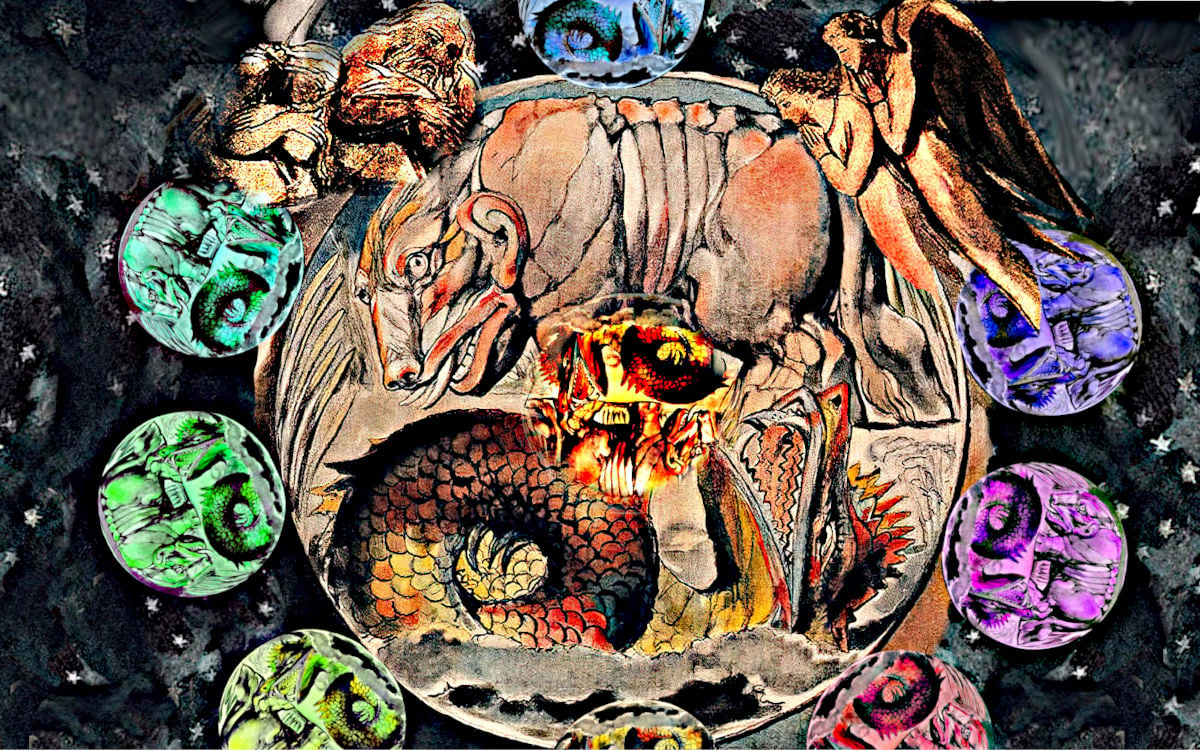
Looking into Malkhut; image composed, colorized and modified by the author, all layers obtained from Wikimedia Commons from the image, Blake - Behemoth and Leviathan 1826, in the public domain.
In this episode is The Ari passing the mantle to Khiyyam Vital?
The Eternal Jew’s Tale
Messiah Tractates, a Montage
Luria, Glorious, 2 of 3
So the Ari pushes the envelop; walking the hills with his coterie, he stops;
“Listen. Do you hear that? Shush, shush. Is that wind or words?… Is it really? Mercy, Lor!… This very place is a forgotten tomb of the Talmud tzaddik Benjamin, him praying here these thousand years til someone would hear his soul’s plea to mark this place where he began the casting off of materia.
“‘Holy Tzaddik, I have heard. May your spirit reveal to me wisdom locked in treasuries beyond the reaches of human thought.’”
And there and then he builds a cairn and has a mason carve a slab to mark the mound, where even now it sits, for supplicants to pour out prayers. And not only this place and not only this voice alone does he find, but many a one among these hills where throngs of the dead call from every jutting crag,
with psalms of penance and revenge, psalms of broken hearts and cruel deceits, psalms of mercy, human and divine, and psalms of failures and loss of faith…
Ay, many a day he walks these hills with his khevra, a saintly troupe, fasting til the sun sets; with every step they say a prayer, spontaneous and prayed aloud. And the Ari, that penetrator of hearts, seeing lives behind their lives, gilguls* hiding in memories, memories buried in barren fields down thoughtways lost and overgrown; he hears their prayers in broken tropes and recognizes their gilgul voice.
* transmigrant spirits
Such prophetic visions enlighten him on any day for any of them, his khevra.
Once he pointed to Khiyyam Vital,
“I see you have been eating dates at God’s right hand; you choked but the Lor revived you…
“(that bowl of dates once proffered to me)….
“I hear Shlomo Molkho’s voice in you,
“his same darga,* his same etnakhta;*
* these are the names of tropes, short musical phrases developed to chant holy verses; they also convey grammatical meaning and emphasis; etnakhta acts as a semi colon following the word sung with that trope; darga acts to link phrases.
“his work is yours to finish now; he’s laying the messiah mantle on you.”
Shaken, Vital rushes home to record Luria’s mystic eyes…
… he told me what I dreamed last night,
eating dates in the Lor’s court…
but in my dream I didn’t choke; and then he said those very dates were once offered to him by God. Does this mean I usurped his place as God’s right hand, and does it mean that this work will choke my soul to death?…
… and does he know the fears I feel?…
And then a knock, and there he stands, that Lion of God, looking down into the eyes and into the heart, and down beyond, into the soul, and still further, to gilgul souls… and he smiles and says,
“Sephirot; learn their workings and you will see your turbulence is like wind on a lake, simple ripples with no impact on the deeper waters that are clear and pure in your soul; and there, reason prevails with Divine causes that Torah reveals.”
But reason is merely a primitive tool, like children picking posies in a field…
‘Oh, I like this one and this one and this; don’t they make a pretty bouquet?…’
facts we gather to serve our needs…
‘I’ll prove my point with a fine array of effects and causes to make you believe….’
Oh, such fine resemblances we can construct of reality; two dimensions that look like three. But look what happens when we step into it…
torn by currents and thrown under waves, storm and drang on emotional seas; when comes the morning, ruins ashore.
~~~~~~~~~~
In the next episode Elijah comes to The Ari with a new Kabbalah.
Related Topics