
This Way Up: Spiritual Means to Psychological Ends
The Etrog’s Chinese Secret
Every year before Sukkot, observant Jews become fruit connoisseurs.
We inspect etrogim. We turn them this way and that. We examine them for blemishes. We worry about the pitom. We pay astonishing sums for particularly beautiful specimens. For one week of the year, an ungainly yellow citrus fruit becomes a Jewish celebrity.
But here’s something I certainly wasn’t taught in Hebrew school:
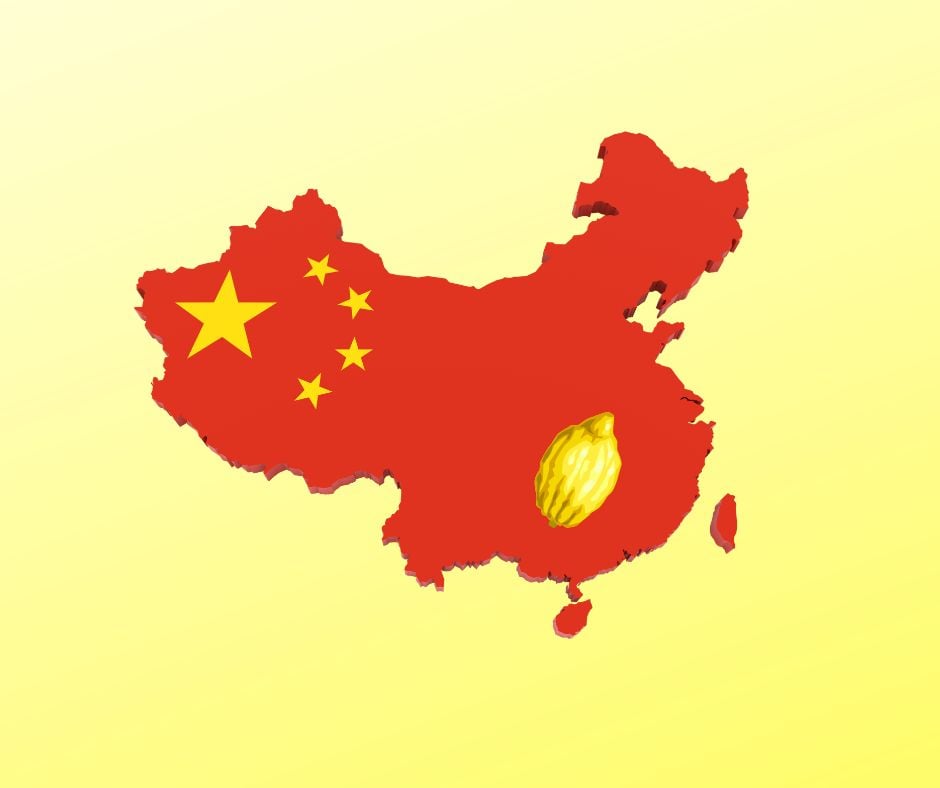
Our etrog, it turns out, has Chinese roots.
According to Rabbi Dr. David Z. Moster, author of Etrog: How a Chinese Fruit Became a Jewish Symbol, the citron’s evolutionary home was in Yunnan, in southwestern China. From there, he traces an extraordinary journey westward, through India and Persia, eventually reaching the Land of Israel.
And then something remarkable happened.
This immigrant fruit became Jewish.
The Torah instructs us on Sukkot to take a pri etz hadar, usually translated as the “fruit of a beautiful tree.” But the Torah does not actually say “etrog.” Moster traces the citron’s arrival in the Land of Israel to the Persian/Second Temple era and argues that, during the Second Temple period, it came to be identified with the Torah’s pri etz hadar.
The Chinese newcomer became so thoroughly naturalized that today it is difficult to imagine Sukkot without it.
I find this delightful.
For the past year, I have been involved in an unusual project exploring the resonances between Jewish and Chinese civilization. Again and again, I have gone looking for one thing and stumbled over another.
There are the familiar parallels: two ancient civilizations with extraordinary reverence for learning, family and continuity; two cultures that place enormous value on education; two traditions that survived enormous historical upheavals while maintaining recognizable civilizational identities.
There are more intriguing echoes as well. Both traditional Chinese and Jewish calendars are lunisolar, refusing to choose completely between the rhythms of the moon and the sun.
At a program of our Chinese-Jewish Exchange, Professor Xu Xin, the pioneering Chinese scholar of Jewish studies at Nanjing University, referred to many of our commonalities and suggested that many Chinese perceive Jews as “soulmates.”
Soulmates?
It is a startling word for two peoples who developed thousands of miles apart.
And yet I keep playing a kind of civilizational Where’s Waldo. I look at something Jewish and, unexpectedly, China peeks out from behind it.
This Sukkot, it isn’t hiding. We’re holding it in our hands.
Of course, none of this proves that Jews and Chinese possess some mysterious primordial connection. History is full of trade, migration and cultural borrowing. Fruits travel. Ideas travel. People travel.
But perhaps that is precisely the point.
Civilizations do not flourish behind hermetically sealed walls. They encounter. They receive. They transform. They give back.
The etrog may be a particularly beautiful example. Something that originated in one civilization traveled across continents and eventually became sacred within another. Its foreignness did not diminish its holiness.
Moster himself finds meaning in this migration. At the conclusion of his study, he wonders whether the etrog’s extraordinary journey might actually add another dimension to its hadar, its beauty: a fruit that left its original homeland, traveled across cultures and continents, and found another home where it came to be treasured.
There is something deeply Jewish about that story.
And perhaps there is a message hiding in that journey for our own time. Maybe the question is no longer simply: What do Jews and Chinese have in common? Maybe it is: What might we be able to give one another?
The etrog made the first journey. Perhaps now it is our turn to make a journey in the other direction. Can we share what Jewish civilization has learned about covenant, responsibility and survival, while becoming curious about what another ancient civilization might have to teach us?
Perhaps the resonances I keep encountering are simply coincidences. Or perhaps they are little divine hints.
Either way, this Sukkot, when I pick up my etrog, I will see something I never saw before.
A fruit can cross civilizations and become beloved.
Maybe people can, too.
Related Topics
Related Posts