

Executive Director at Advocacy Edge Consulting
The EU and the Question of Designation
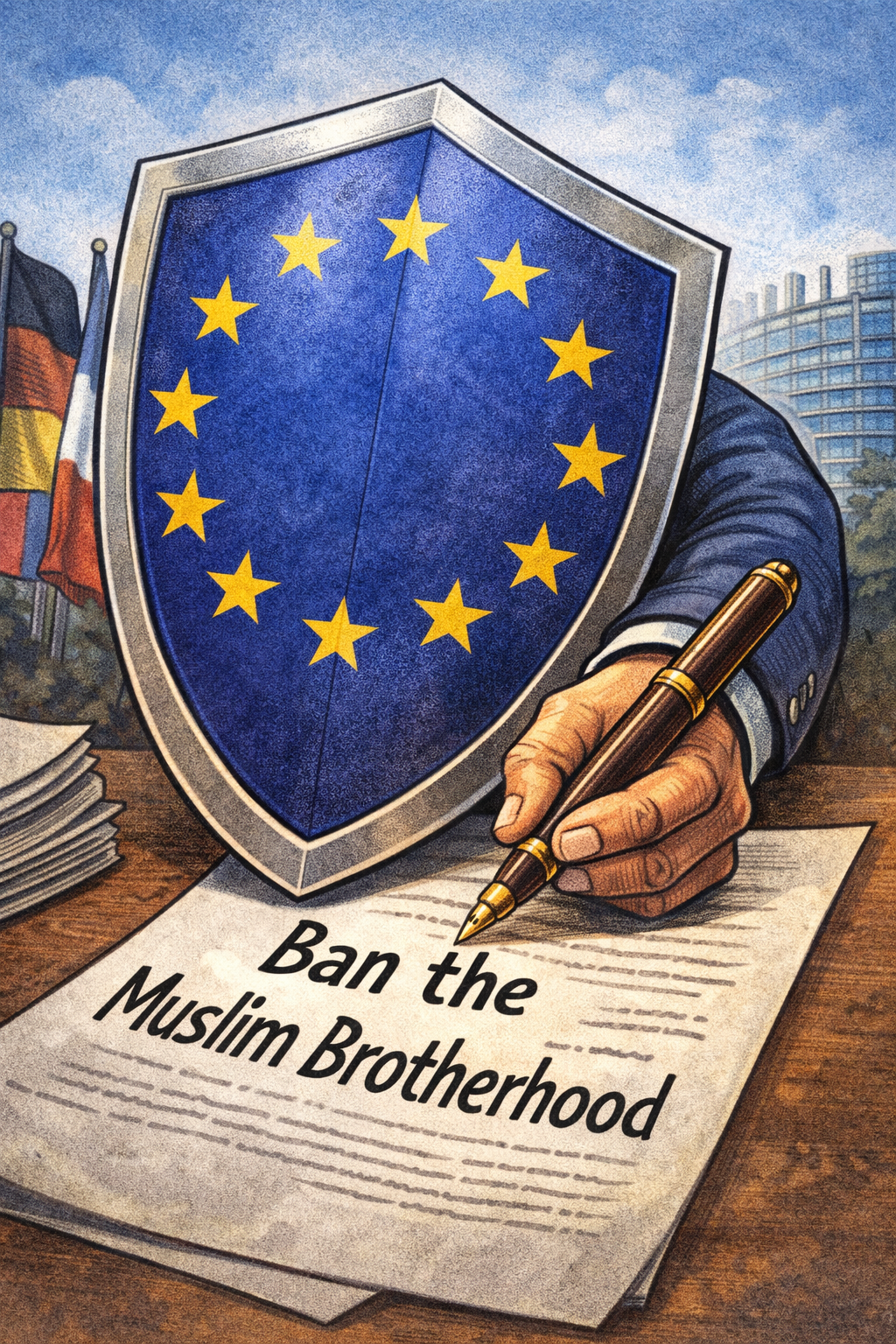
The EU moves to ban the Muslim Brotherhood
For many years, Western governments operated under a reassuring assumption: extremism announces itself through violence, and movements that work through courts, charities, and civic institutions must therefore be part of the democratic bargain. It was a tidy distinction, administratively convenient and morally comforting. But history has a way of exposing conceptual shortcuts. Recent moves to designate the Muslim Brotherhood as a terrorist or national-security threat reflect not panic or repression, but something far more important: clarity.
The Muslim Brotherhood has never relied primarily on bombs or bullets. Its strength lies elsewhere – in patience, discipline, and an ideological confidence that time is on its side. For nearly a century, the Brotherhood has pursued a strategy of gradualism: building influence incrementally through social organisations, educational initiatives, legal advocacy, and political participation. Much of it lawful and unthreatening. And together, they advance a worldview fundamentally incompatible with pluralism, equality before the law, and liberal democracy itself.
Western security thinking has not always been well suited to this kind of challenge. Counter-terrorism doctrine evolved to confront overt threats: armed groups, clandestine cells, and state sponsors of violence. Iran, ISIS, and Al-Qaeda fit neatly into that paradigm. The Muslim Brotherhood does not. It operates openly, often respectably, and speaks the language of rights and inclusion. That is not an accident. It is the strategy.
What has changed in recent years is not the Brotherhood’s behaviour, but Western willingness to assess its cumulative effects honestly. Official reviews and court cases across Europe have identified a recurring pattern. Brotherhood-linked organisations publicly affirm democratic norms while quietly encouraging communal separation, parallel authority structures, and scepticism toward democratic legitimacy – unless, of course, democratic outcomes align with their goals. Participation is conditional. Loyalty is instrumental.
This strategy now extends far beyond traditional institutions. Brotherhood-aligned ideas increasingly circulate through non-obvious media ecosystems: podcasts framed as social commentary, Instagram and TikTok channels blending activism with lifestyle branding, and “independent media outlets” that present a veneer of corporate professionalism while advancing remarkably consistent narratives. These platforms are rarely explicit. They do not announce ideological allegiance. Instead, they normalise grievance, relativise terrorism, and reframe antisemitism as political critique. The result is not persuasion through argument, but saturation through repetition. Influence becomes amorphous, deniable, and difficult to regulate – precisely the point.
This dynamic is not confined to Western societies. I recently spoke at an urgent briefing in the European Parliament on Muslim Brotherhood networks and activity in Sudan. There, the consequences of ideological capture are not abstract or incremental. Brotherhood-linked actors played a central role in hollowing out state institutions, embedding themselves within civilian and military structures alike, and accelerating Sudan’s descent into chaos. The devastation that followed – mass displacement, economic collapse, and staggering civilian suffering – is what gradualism looks like when it succeeds unchecked. Sudan should not be viewed as an outlier, but rather as a warning.
Since October 7, the implications of this ideological ecosystem have become stark even closer to home. Across Western capitals, mass protests rapidly crossed from criticism of Israeli policy into open glorification of Hamas violence and intimidation of Jewish communities. Jewish schools required police protection. Synagogues were defaced. Antisemitic rhetoric resurfaced with a confidence not seen in decades. These developments did not arise in isolation. They reflect the long-term normalisation of ideas that excuse violence, instrumentalise grievance, and treat democratic norms as contingent rather than foundational.
Hamas itself provides the clearest illustration of this continuity. It is not a historical fluke or a deviation from the Brotherhood tradition. It is, in fact, a formal branch of the Muslim Brotherhood, shaped by the same absolutist theology and antisemitic conspiracism. While not every protester chanting Hamas slogans is organisationally connected to the Brotherhood, the intellectual framework that renders such chants morally acceptable did not emerge spontaneously. It was cultivated patiently, seminar by seminar, platform by platform.
Arab governments learned this lesson earlier than the West. Where the Brotherhood was granted political space, it did not integrate into stable pluralism. It competed for dominance, polarised societies, and undermined state authority. That experience explains why many Arab states designated the Brotherhood as a national-security threat years ago. The decision was not merely ideological, but plainly empirical.
Seen in this light, recent Western designations are not an abandonment of liberal principles, but their defence. They do not criminalise belief or suppress religion. They draw a necessary distinction between genuine civic participation and ideological movements that exploit democratic freedoms in order to erode them. Liberal societies are not required to extend permanent benefit of the doubt to actors who have made clear, through word and deed, that democracy is a means rather than an end.
For Europe, the strategic case is particularly compelling. Fragmented national approaches allow transnational networks to adapt quickly, shifting leadership, funding, and operations across borders. An EU-wide designation would therefore be less a symbolic act than a matter of policy coherence, reinforcing the capacity of democratic institutions to respond to a decentralised and adaptive challenge. It would signal that openness and vigilance are not in tension, and that tolerance does not preclude judgement.
The West is not abandoning its principles. It is applying them within a changing strategic environment. Whether this approach is sustained through consistent policy and coordination will matter far more than the designation itself.
Heath Sloane is Director of Geopolitical Intelligence at B&K Agency, a Brussels-based public affairs and geopolitical intelligence consultancy.
Related Posts


Comments