
The EU still can’t do Middle Eastern Foreign Policy
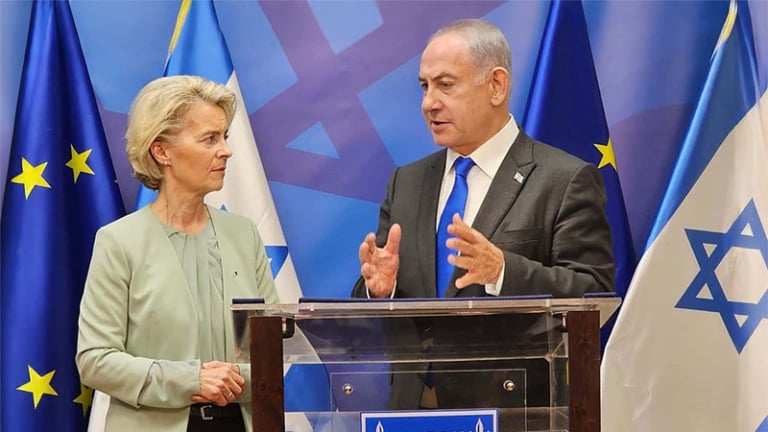
The EU’s recent diplomacy towards Israel has consisted mainly of lectures on international law and proportionality. The failure of Brussels to confront the ongoing obstruction to the Great Sea Interconnector (GSI) project – a strategic energy project to bind Israel, Cypress, and Greece – shows the limits of moral posturing in the Middle East. It is time the EU adopted a serious approach to the region.
On the surface, the GSI is a model European project. It is green, cross-border, commercially useful, and strategically attractive. The EU committed substantial funds, including a €657 million grant, with wider EU investment of around €800 million in the €1.94 billion project. On paper, this is the regional architecture that Brussels wants. It ends Cypriot isolation from the European electricity grid, and Israel would be tied more closely to EU-aligned infrastructure in the Eastern Mediterranean. Greece would strengthen its role as a gateway between Europe and the Middle East.
But, as is common in the Middle East, the region’s politics intrudes. Turkey has objected to the cable’s route, arguing that it crosses waters under Turkish jurisdiction and disregards Turkish Cypriot interests. In July 2024, Turkey sent five warships to surround an Italian-flagged research vessel near Kasos, a Greek island, leading to a 40-hour stand-off with Greek ships sent in response. Again, in November 2024, Turkey sent four frigates to the same area, based on a “misunderstanding” that the same research vessel had come back into the area. An entire naval fleet was sent to intercept a single undersea cable based entirely on a rumour. In April 2025, EU officials were reportedly “strongly displeased” by Turkish warnings that Ankara would disrupt the project, with Turkish defence officials calling the cable provocative and threatening to use methods previously used against maritime work. And so, the project has stalled. This is not solely because of Turkey, with cost disputes and regulatory uncertainty. Nonetheless, the EU was unable to make the Eastern Mediterranean obey European assumptions.
The EU refuses to apply this lesson to Israel. If it cannot defend a basic infrastructure project against coercion, then it should not judge a state whose enemies are not merely obstructing cables, but attempting to destroy it.
The EU threatens to suspend the EU-Israel Association Agreement, demands “proportionate” military response, and has a foreign policy chief who argues that flooding Gaza with aid will prevent it from being misused by Hamas. This applies the same flawed logic as it applied to the GSI, that legality and institutional pressure can substitute for power. In Europe, this might be true (although Russia has undermined that assumption). In the Middle East, it is definitely not.
The EU was born into a post-1945 world with weakened sovereignty, integrated markets, and lowered borders, with international law as the governing framework. This created unprecedented peace. This is why, even in 2024, Charles Michel said at the G20 that peace is “the most powerful and sustainable security guarantee.” The universalization of EU history ignores that in the Middle East, peace often has to be secured by deterrence, before it can serve as a guarantee. Israel knows this. In 2014, Hamas kidnapped three Israeli boys and killed them. Israel launched Operation Protective Edge, and eight days later, Hamas offered a 10 year ceasefire. The EU does not understand deterrence, because since its establishment in its current form in 1993, it has not had to remember it.
The Great Sea Interconnector should serve as a clear reflection of everything wrong with the EU Middle East policy. It is only possible to impose a rules-based order in the Middle East when it is protected by power. The EU should learn this before speaking as though Israel’s security choices are made in western arenas where international law exists, rather than where enemies fire from behind civilians.