
The crocodile: Israel’s latest candidate for public service
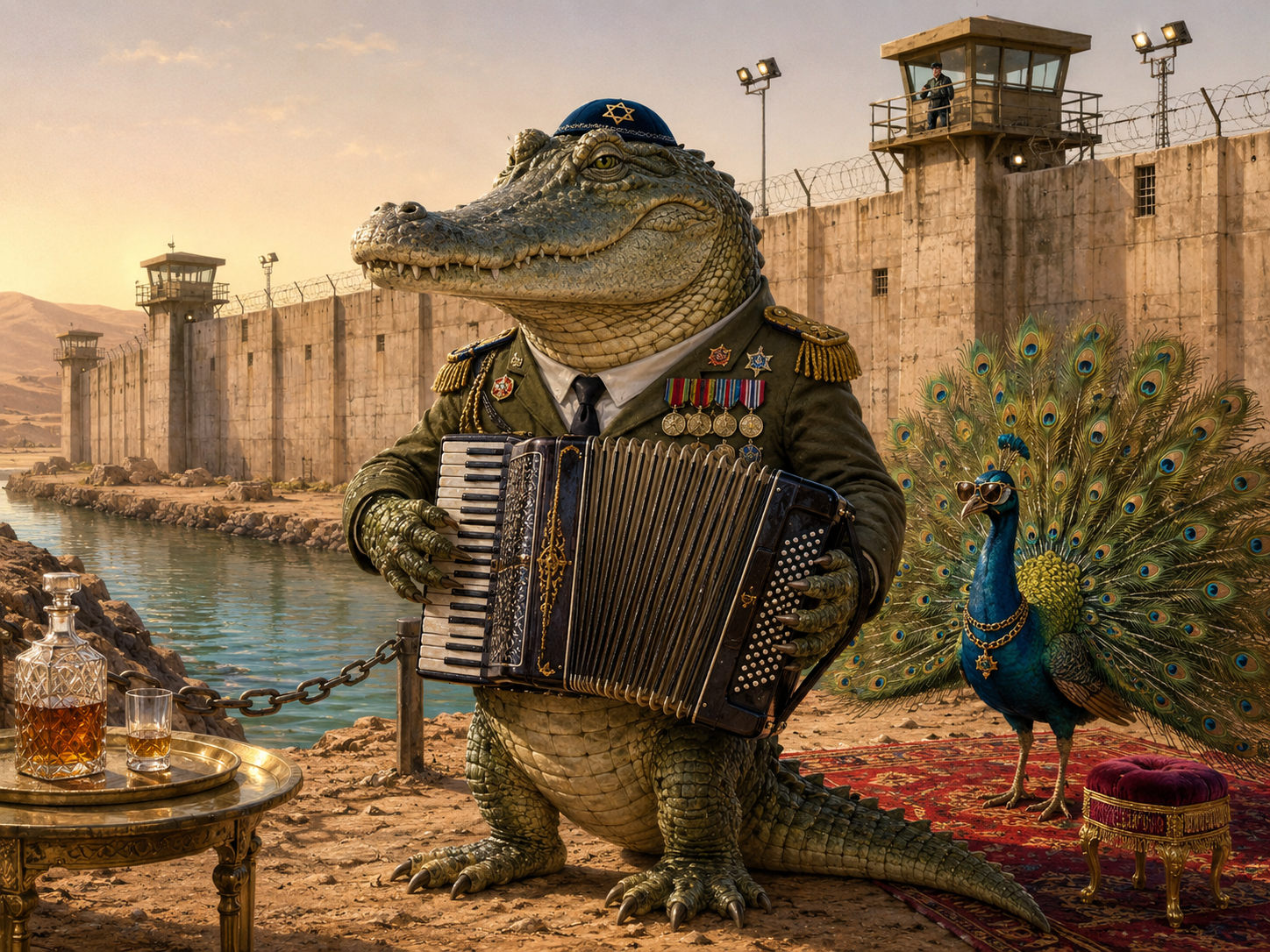
Several thousand years after the Exodus from Egypt, the Nile crocodile has finally been offered employment in the Israeli public service. It will not return as one of Pharaoh’s creatures, an emblem of ancient empire, or an 11th plague omitted by the Torah’s editors because the plot was already overcrowded. This time, the crocodile is expected to serve as prison infrastructure, because history has come full circle and submitted an invoice for NIS 21 million ($7 million), an excavator and a ministerial decree.
A trench began to be dug beside Ketziot Prison for the intended deployment of Nile crocodiles. Prison officials visited a crocodile farm, public money was allocated, the administrative machinery started moving, and lawyers, wildlife experts and the Israel Nature and Parks Authority raised objections. The crocodile itself displayed exemplary professional discipline: it gave no interview, signed no open letter and did not accuse the minister of politicizing the civil service.
The legal difficulty was that the crocodile appeared in the regulations as a wild animal rather than a prison officer. Environmental Protection Minister Idit Silman therefore altered its status so that the reptile could enter national service without excessive attachment to zoology. The crocodile remained the same creature, equipped with powerful jaws, limited interest in constitutional law and no declared opinion about the coalition’s survival, but its paperwork became patriotic.
This is the beauty of governing by classification. When reality does not fit a ministerial fantasy, there is no need to abandon the fantasy; reality can simply be corrected on the appropriate form. The state apparatus did not encounter absurdity and stop. It politely asked whether absurdity possessed a tax-identification number and three certified copies of its fitness to perform deterrence.
The possibilities for further modernization are almost unlimited. Pigeons could be reclassified as urban surveillance platforms, geese as border-security units, jackals as nocturnal reconnaissance patrols, ibexes as high-altitude vehicles and jellyfish as an autonomous coastal-defense system. The donkey deserves a senior advisory position, having spent several thousand years carrying burdens imposed by people with magnificent ideas and poor judgement, while the peacock plainly merits a cabinet portfolio: it creates an enormous display, occupies considerable space and solves no material problem whatsoever.
The hyena could become government spokesperson, since at least its laughter would be sincere. There is, however, one crocodile considerably better prepared for Israeli public service and immediately recognizable to many Russian-speaking citizens: Crocodile Gena, Cheburashka’s elegant and melancholy friend, who played the accordion and worked at the zoo “as a crocodile.”
Gena required no ministerial reclassification. His species, occupation and public identity were in perfect alignment, which in modern administration might be considered a dangerous form of radicalism. He did not guard a prison moat but helped build a House of Friendship, allowing the Soviet Union, not usually remembered as a laboratory of administrative tenderness, to win this particular comparison.
Moscow created a crocodile who played music, looked for friends and possessed enough self-awareness to practice a profession appropriate to his species. Jerusalem now proposes crocodiles as instruments of political intimidation, because Gena had an accordion while Ketziot has a procurement budget. He would probably fail the current Israeli selection process: he smiles too often, forms emotional attachments and might be suspected of uncontrolled humanitarianism.
For many Russian-speaking Israelis, Gena is not an arbitrary joke borrowed from a foreign cartoon. He belongs to the cultural memory of people familiar with the distance between an official announcement and reality, between a heroic slogan and the clerk stamping it, and between the Great Historical Project and the queue outside the office where it has stalled for lack of a second attachment. Many grew up in a world where a crocodile could be melancholy, musical and more emotionally intelligent than the authorities surrounding him.
Soviet animation working under censorship could imagine a crocodile building friendship. Israeli politics operating under free elections has imagined crocodiles guarding prisoners, which confirms that historical progress does not always choose the shortest route. Gena might perhaps serve as a consultant, although his accordion would first require security clearance and the House of Friendship would probably be rejected as insufficiently deterrent infrastructure.
The plan also possesses excellent American compatibility. American politicians have spent years promising to “drain the swamp,” whereas Israel, as an inventive strategic ally, has developed the reverse doctrine: dig a swamp, import predators and hold a press conference. In the United States, the animals would normally be alligators, but there is no reason to become trapped in zoological legalism when the appropriate minister can reclassify an alligator as a crocodile, a ditch as strategic infrastructure and political vaudeville as defense doctrine.
An impressive international coalition has therefore emerged. Egypt supplies the species, America the swamp, Russia the cultural adviser, and Israel the budget, the regulation and the photographers. The only participant who appears dangerously overqualified is Gena, who can play an instrument, build friendship and understands that the best occupation for a crocodile may occasionally be simply to remain a crocodile.
The moat is not primarily a security device but a camera position. The minister stands beside the trench, the operator selects the angle, sovereignty waits for the delivery of water, and the crocodile need not catch anyone, improve prison conditions or protect the staff. It merely has to appear in the headline, because its true habitat is not the canal beside Ketziot but the media cycle running between Jerusalem, Washington, Moscow, London and the Israeli voter’s telephone.
The crocodile is an ideal functionary of mediated power. It is threatening, photogenic and asks no questions about tenders, publishes no dissenting opinion, leaks no documents to journalists and declares no conflict of interest. Its loyalty is unconditional, at least until the minister finds himself on the wrong side of the fence.
Every expression of disbelief abroad can then return to Israel as evidence that the world once again refuses to understand Israeli security. The more ridiculous the proposal appears internationally, the easier it becomes for its authors to present themselves at home as heroic opponents of foreign pressure. Moral outrage can therefore become nourishment for this form of power, granting it drama, grandeur and the flattering impression that history itself has stopped to engage it in combat.
Laughter works differently because it removes the costume before power can finish its speech about sovereignty. Jewish humor has spent centuries reducing Pharaoh, the czar, the bureaucrat, the general, the rabbi and the committee chairman to human proportions by exposing their absurdity. A man standing beside a trench intended for crocodiles does not thereby become Churchill. He remains a man standing beside a trench intended for crocodiles, which may be dangerous for passers-by but does not yet constitute a doctrine of state.
Perhaps Israeli politics has not entirely lost its Jewish sense of humor. Perhaps the ministry has merely reclassified it as a strategic threat and replaced it with crocodile tears, which will flow when the court blocks the project, experts identify the risks and animal-welfare organizations ask whether the Nile has now been formally annexed to the Negev. We will then hear of wounded sovereignty, weakened deterrence and discrimination against reptiles seeking equal access to public employment.
The Jews left Egypt without crocodiles, and there is no reason to bring them back merely because several ministers have confused the State of Israel with a theme park. The court will decide whether crocodiles may be transferred to Ketziot, while Israelis must decide whether they wish to remain the audience for a government that digs its own swamp, places a reptile inside it and then asks to be remembered as Moses. Gena, at least, knew who he was and worked at the zoo as a crocodile; the ministers are still looking for an occupation.