The Fallen Sukkah of David
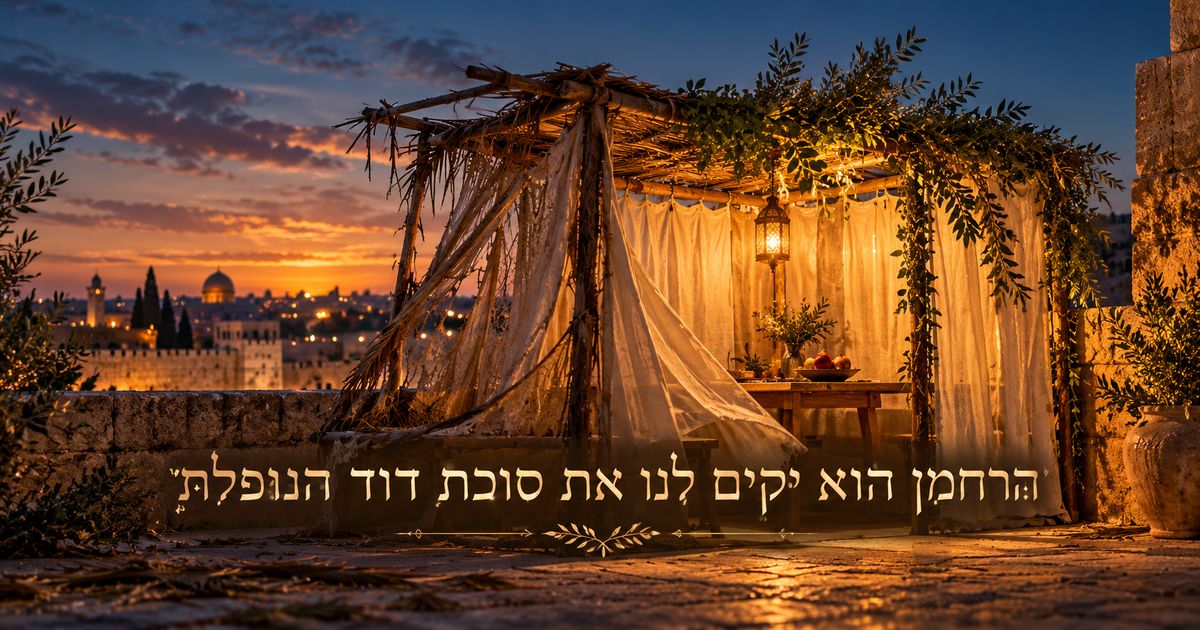
Every year on Sukkot, I add a Harachaman to Birkat Hamazon that I had never really stopped to understand: הרחמן הוא יקים לנו את סוכת דוד הנופלת. “May the Merciful One raise up for us the fallen sukkah of David.”
I knew the words. I knew they belonged to Sukkot. But I had never asked what the “fallen sukkah of David” actually is, or why the future of the Jewish people should be pictured through one of the flimsiest structures we ever build.
Once I looked at the source, the whole festival began to look different.
The words come from the prophet Amos: בַּיּוֹם הַהוּא אָקִים אֶת סֻכַּת דָּוִיד הַנֹּפֶלֶת וְגָדַרְתִּי אֶת פִּרְצֵיהֶן וַהֲרִסֹתָיו אָקִים וּבְנִיתִיהָ כִּימֵי עוֹלָם. “On that day I will raise up the fallen sukkah of David; I will repair its breaches, raise up its ruins, and rebuild it as in days of old” (Amos 9:11).
Metzudat David, which focuses on the straightforward meaning of the text, explains that God will restore the kingship of the House of David, which fell and was brought low in exile. This is not a poetic reference to a hut. It is a prayer for redemption.
The Gemara goes further. Rav Nachman asks Rabbi Yitzchak whether he has heard when bar nafli, “the son of the fallen,” will come. Who is bar nafli? Mashiach, derived from this very verse (Sanhedrin 96b). The Messiah himself is named after the fallen sukkah.
Which raises the obvious question. Why a sukkah?
The Malbim gives a remarkable answer. Originally, he explains, the House of David was a בית קבוע, a permanent house, with the monarchy passing from generation to generation. When Davidic sovereignty disappeared but some form of Davidic leadership remained, it was reduced to a סוכת עראי, a temporary sukkah. Eventually even that sukkah fell. Amos promises that God will raise it again and restore it from something temporary back into something permanent.
So Amos does not call it a sukkah because a sukkah is grand. He calls it a sukkah because something once permanent has been reduced, weakened and made temporary.
But a sukkah is not a ruin. A ruin stays fallen. A sukkah is the one structure we build again every year.
Pesach takes us back to the Exodus. Shavuot takes us to Sinai. Both commemorate a single foundational moment. Sukkot is different. It takes us into a whole period of life: forty years of journeying, dependence and survival. The Torah tells us why we sit in the sukkah: לְמַעַן יֵדְעוּ דֹרֹתֵיכֶם כִּי בַסֻּכּוֹת הוֹשַׁבְתִּי אֶת בְּנֵי יִשְׂרָאֵל, “so that your generations will know that I caused the Children of Israel to dwell in sukkot” (Vayikra 23:43). From the very beginning, the sukkah was designed to carry memory from one generation to the next.
Whether those wilderness sukkot were physical booths, as Rabbi Akiva holds, or the Clouds of Glory, as Rabbi Eliezer holds (Sukkah 11b), the point is the same. The sukkah represents not a single flash of history but everyday Jewish existence: living, moving, depending, surviving.
And we do not just remember it. We build it. We put up the walls, lay the schach, carry in the table and chairs, decorate it, eat in it and, for some, sleep in it. Many of us take enormous pride in it, which is saying something for a people not famous for DIY. Then, a week later, we take it all down, only to build it again the following year.
The Radak adds a beautiful dimension. David’s kingdom is called a sukkah, he writes, כי היא סוככת על העם, “because it shelters the people.”
The Ushpizin bring that idea to life. The first guest traditionally welcomed into the sukkah is Abraham, and the last is David. Abraham sat at the entrance of his tent and ran out to bring strangers in, to give them water and feed them. His tent was not a fortress keeping people out. It was shelter offered to others. David’s kingdom, at its best, was the same thing on a national scale: a covering spread over the whole people.
We enter the sukkah with Abraham, whose tent sheltered strangers, and leave it with David, whose kingdom sheltered a nation.
A fortress says strength. A palace says power. A Temple says sanctity. A sukkah says something different: vulnerability and shelter at the same time. It reminds us that protection does not always look like thick walls.
There is an even stranger contrast here. David longed to build the House of God, but it was Solomon who built it. The Beit HaMikdash was destroyed almost two thousand years ago and has not been rebuilt. The Davidic monarchy fell even earlier and has not been restored.
But the sukkah? We rebuild that every single year.
This, I think, is why the image is so precise. The sukkah is the diminished form, the shape David’s house took once the palace was gone. But a diminished thing that is rebuilt every year is a promise being kept alive. We cannot yet restore the house. What we can do, every autumn, is refuse to let the sukkah stay fallen, until God returns it to its full size.
That is why I now find the phrase סוכת דוד הנופלת so moving. The verse does not pretend the sukkah never fell. There are breaches and ruins. And then come the verbs of Amos: אָקִים, I will raise it. וְגָדַרְתִּי, I will repair its breaches. אָקִים, I will raise its ruins. וּבְנִיתִיהָ, I will rebuild it.
That is a very Jewish sequence. It does not claim that nothing bad ever happened, or that enough faith prevents things from falling. Things do fall. People fall. Families struggle. Communities fracture. Nations suffer.
What matters is what happens next.
We rebuild.
I have said that Harachaman for years without really understanding it. Now I think it contains the whole story of Sukkot, and perhaps of the Jewish people.
The sukkah is temporary. The rebuilding is not.