NAnews - Nikk.Agency Israel News
The False ‘Nazi Salute’ and the Trap Set for Israel and Ukraine
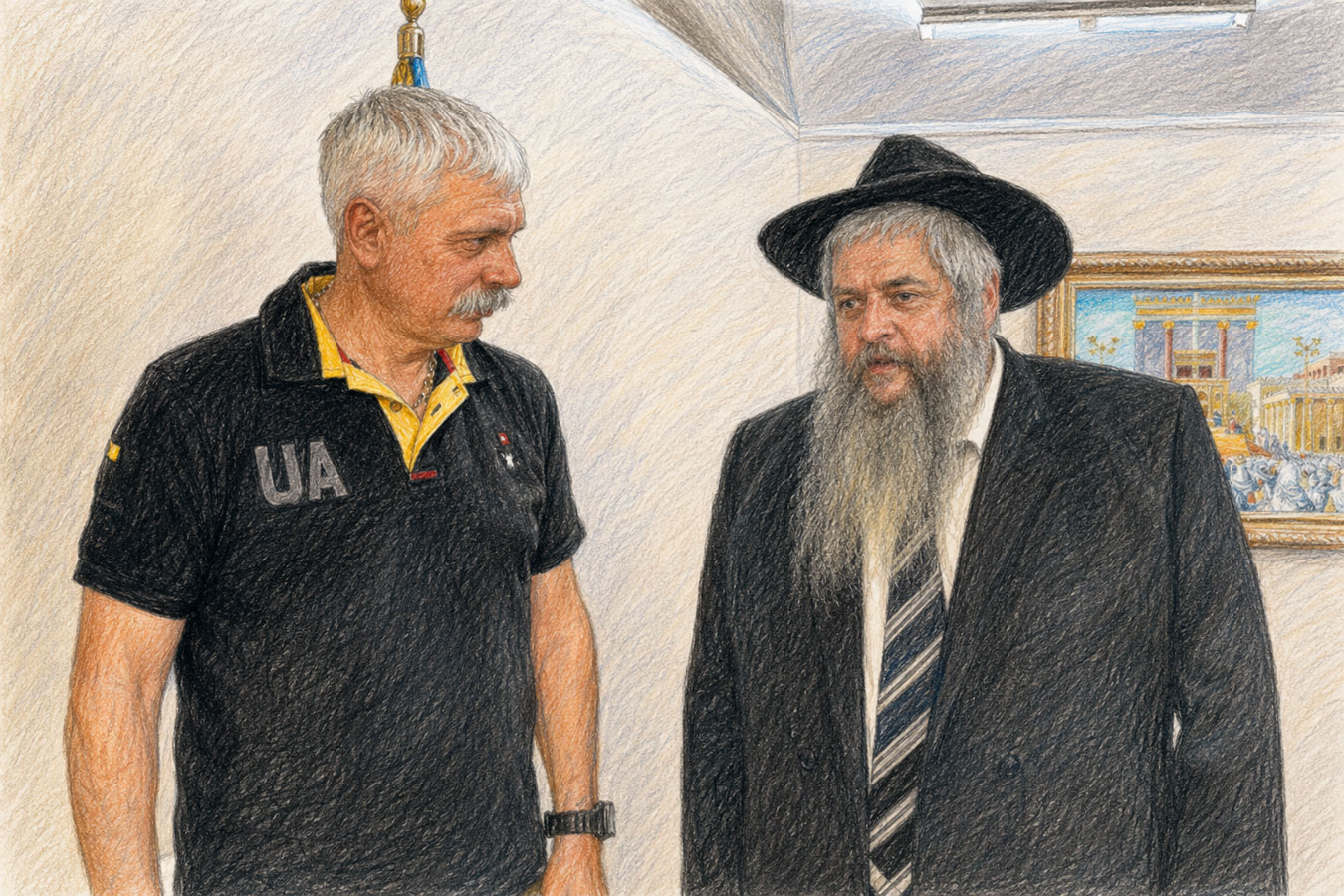
The False “Nazi Salute” and the Trap Set for Israel and Ukraine. The image was created using AI.
“It Was a Misunderstanding,” Chief Rabbi of Ukraine Moshe Asman Publishes a Statement and Video with Korchynsky After the Scandal Around “Bratstvo” and the Israeli Embassy in Ukraine.
There are stories that should never be treated casually in Israel.
Anything connected to Nazi symbols, Nazi slogans, or Nazi gestures belongs to that category. For Jews, for Israelis, for the families of Holocaust survivors, and for every society that still understands what the twentieth century taught us, this is not a matter of political taste. It is a red line.
That is exactly why the recent scandal around an alleged “Nazi salute” on Kyiv’s Maidan should be examined very carefully.
Not emotionally. Not automatically. Not through the lens of Russian propaganda. And not through viral fragments detached from context.
On June 29, 2026, Chief Rabbi of Ukraine Moshe Asman published a statement and a video with Ukrainian public figure Dmytro Korchynsky after the controversy around “Bratstvo” and the statement by the Embassy of Israel in Ukraine.
The story began after claims that a video allegedly showed participants of “Bratstvo” shouting Nazi slogans and demonstrating Nazi gestures during a protest on June 21 on Maidan Nezalezhnosti in Kyiv. The Israeli Embassy reacted. The issue immediately became more than a local Ukrainian dispute. It became a sensitive matter for Israel, Ukraine, and the Jewish community.
But then Rabbi Asman said something very important: he did not rush to conclusions.
He met with Dmytro Korchynsky directly.
And after that meeting, he published a statement saying that the video circulating on social media had, according to his information, no connection to the June 21 protest.
In his words, translated into English:
“After the statement by the Embassy of Israel regarding the video allegedly filmed during the protest on June 21, where alleged participants of ‘Bratstvo’ shouted Nazi slogans and demonstrated Nazi gestures, we did not make hasty conclusions and decided to meet with Dmytro Korchynsky directly.”
Then came the key point:
“The video that was circulated on social media has nothing to do with the above-mentioned event. It was filmed much earlier.”
Rabbi Asman also wrote that, according to the information available to him, the people in the video were not members of “Bratstvo” or other Ukrainian patriotic organizations.
He added:
“We are talking about underage provocateurs who, probably, could have been used by Russian special services interested in such provocations, having paid them money.”
This sentence matters.
Because if the video was not connected to the protest, if the people in it were not members of the organization accused, and if the context was manipulated, then the story is no longer only about an alleged gesture.
It becomes a story about information warfare.
And Israel must understand that battlefield too.
Russia has spent years trying to sell the world the narrative of a “Nazi Ukraine.” This narrative was used to justify aggression, occupation, mass violence, deportations, and the destruction of Ukrainian cities. It is not simply propaganda. It is a weapon.
And Israel, because of Jewish history, is a particularly important target for that weapon.
When Moscow or pro-Russian networks can create even a small appearance that Ukraine is connected to Nazi symbolism, they know exactly where to push. They know that in Israel, such images are not neutral. They know that Jewish memory is not abstract. They know that the word “Nazi” can trigger an immediate moral reaction.
That is why verification is not a technical detail. It is part of moral responsibility.
Rabbi Asman also addressed Dmytro Korchynsky and the participants of “Bratstvo” directly. He wrote that he does not consider them antisemites.
In his statement, translated into English, he said:
“Dmytro Korchynsky and the participants of ‘Bratstvo’ are Ukrainian patriots who respect all nations, religions and denominations. They are not antisemites.”
He also wrote that Korchynsky separately emphasized his respect for the Jewish people and the State of Israel.
“Dmytro Oleksandrovych separately emphasized that he has great respect for the Jewish people and the State of Israel and values the help that the Jewish community and Israel have provided to Ukraine from the first days of russia’s full-scale invasion.”
This is not a small clarification.
In today’s information environment, an accusation can travel faster than a correction. A video can become a verdict before anyone checks where it came from, when it was filmed, who is in it, and who benefits from its distribution.
That is especially dangerous when the subject is antisemitism.
Antisemitism must be taken seriously. Nazi gestures must be condemned. Holocaust memory must never be relativized. But the seriousness of these issues requires accuracy. Otherwise, the memory itself becomes vulnerable to manipulation.
In the video published by Rabbi Asman, he appears together with Korchynsky in the Brodsky Synagogue in Kyiv. The symbolism of that setting is important. This was not a random street argument. It was a conversation in one of the most recognizable Jewish places in Ukraine’s capital.
Rabbi Asman says in the video:
“This was not a conflict. It was a misunderstanding that the Israeli Embassy made a statement.”
Korchynsky responds by thanking Rabbi Asman for the meeting and for trying to resolve the situation.
“It was a very pleasant meeting. And I know you as a great patriot not only of Israel, but also of Ukraine, who does a lot for Ukraine,” Korchynsky said.
Then he addresses the central accusation directly:
“Nazi aesthetics are not the aesthetics of ‘Bratstvo.’”
He adds:
“‘Bratstvo’ is a religious community. Our people read Psalms, not Mein Kampf.”
This phrase is important because it is not a technical denial. It is a moral positioning. Korchynsky is saying that Nazi symbolism is not merely “inaccurate” in relation to his movement, but alien to it.
He also said:
“For Ukraine, the two greatest disasters of the twentieth century were communism and Nazism.”
And then he added:
“All of this is disgusting to us — both the first and the second.”
These words are a direct response to the meaning of the accusation. Korchynsky is trying to show that Nazi symbols and Nazi aesthetics are unacceptable to him and his supporters, while Ukraine itself was historically a victim of both Nazism and communism.
This point should be understood in Israel.
Ukraine’s twentieth century was marked by mass murder under both totalitarian systems. Ukrainians remember the Holodomor, Soviet terror, deportations, the destruction of religious life, the crimes of Stalinism, and the Nazi occupation. Jews in Ukraine suffered the Holocaust on Ukrainian soil, including Babyn Yar, one of the darkest places in Jewish history.
This history is complex, painful, and sometimes politically abused. But complexity cannot be replaced by Kremlin slogans.
That is why Russia’s attempt to reduce Ukraine to a caricature is so dangerous.
For Israel, the lesson should not be to ignore accusations of antisemitism. The opposite is true. Israel should examine them seriously — but also intelligently.
A serious response must ask: Who filmed the video? When was it filmed? Who are the people in it? Are they really connected to the group being accused? Who spread it? Why now? Who benefits if Israel and Ukraine are pushed into another public conflict?
These questions do not weaken the fight against antisemitism.
They strengthen it.
Because the fight against antisemitism must not be turned into a tool for Russian disinformation.
Rabbi Asman wrote that he had already spoken with Israel’s ambassador to Ukraine, Michael Brodsky, and explained his position. According to Asman, he told the ambassador that the embassy team had been misled.
“I have already had a conversation with the Ambassador of Israel to Ukraine, Michael Brodsky, during which I explained that the embassy team had been misled,” he wrote.
This is a serious diplomatic detail.
It means the story moved from social media outrage into a direct conversation between one of Ukraine’s most visible Jewish religious leaders and Israel’s diplomatic representation in Kyiv.
Rabbi Asman also expressed hope that law enforcement would find the provocateurs.
But his main conclusion was broader:
“Now it is very important not to allow provocations to quarrel Ukraine with Israel and the Jewish community around the world.”
This is the heart of the matter.
The goal of such provocations is not only to damage someone’s reputation. The goal is to create distance. To make Israelis suspicious of Ukrainians. To make Jews abroad doubt Ukraine. To make Ukrainians feel abandoned by Israel. To turn misunderstanding into resentment.
And in a war, resentment is also a weapon.
Israel and Ukraine do not have identical political circumstances. Israel has its own wars, its own security calculations, its own regional threats, and its own internal debates. Ukraine is fighting for survival against Russian aggression. These realities are different.
But there is one thing both societies should understand: Russian information warfare does not stop at borders.
It works inside democracies. It exploits trauma. It uses history. It weaponizes memory. It turns legitimate Jewish pain into a political trap. It turns Ukrainian vulnerability into a propaganda target.
That is why Rabbi Asman’s final words deserve attention.
“We are on the same side — the side of Light, Ukraine and truth. Glory to Ukraine! Glory to Israel!”
One may agree or disagree with every political figure involved in this story. One may have many questions about Ukrainian politics, Israeli diplomacy, or the language used by different groups. But the central issue here is larger.
Israel must not allow itself to be manipulated by those who want to poison relations with Ukraine.
Ukraine must also understand how deeply sensitive Nazi imagery is for Israelis and Jews worldwide.
Both truths can exist at the same time.
Yes, every sign of antisemitism must be confronted.
And yes, every accusation must be checked before it becomes a diplomatic conclusion.
That is not weakness. That is responsibility.
For Israel, this case is a reminder that moral clarity requires factual discipline. For Ukraine, it is a reminder that in a war against russia, every symbol, every video, every provocation can become an international front. And for the Jewish world, it is a reminder that Holocaust memory must be protected not only from denial, but also from cynical manipulation.
Related Topics