The views expressed herein are solely mine.
The “Faroe-Israel Alignment” Europe Ignores
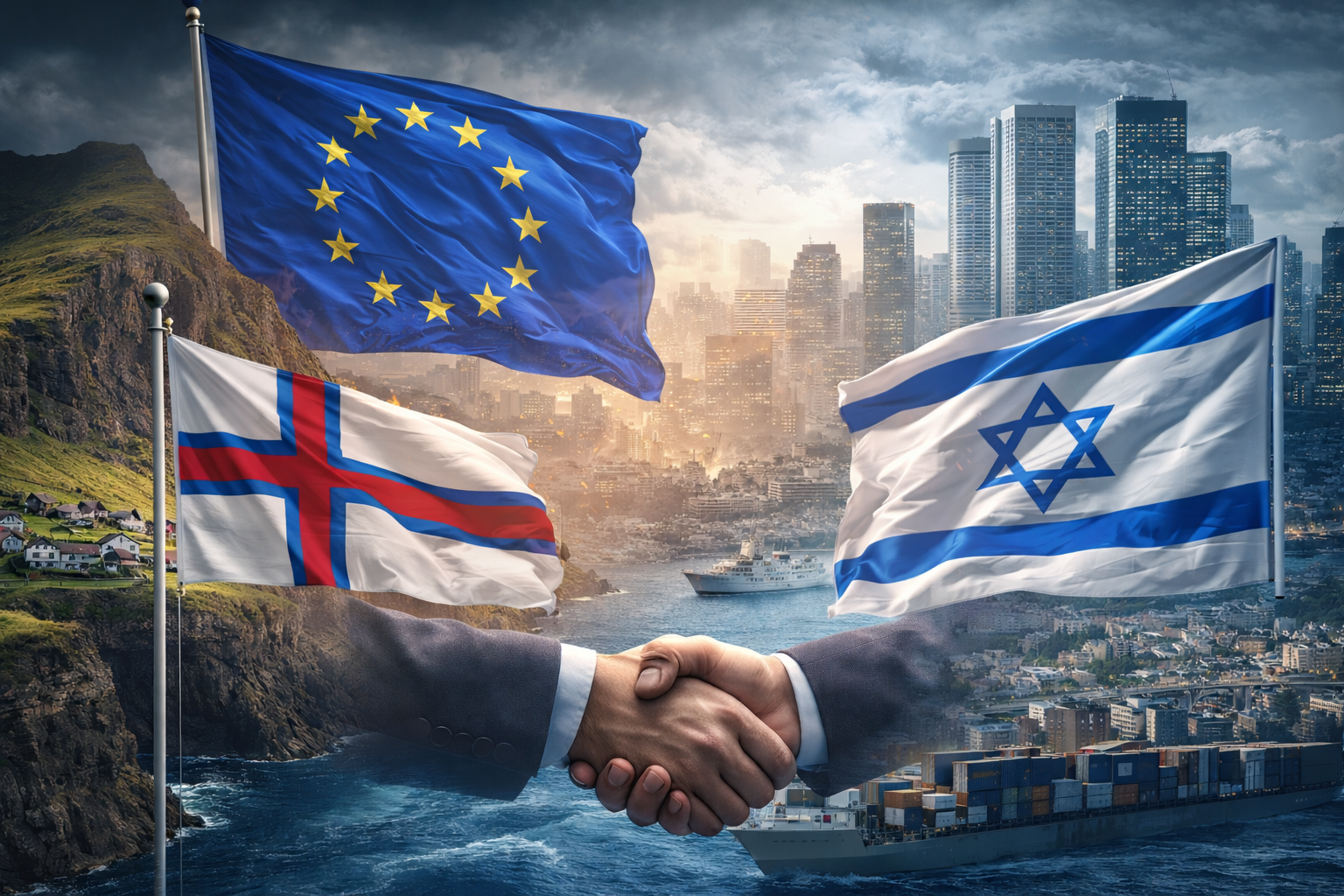
Credits: AI-Generated.
Europe loves lecturing the world about “values.” Meanwhile, power is being consolidated in the shadows—far from Brussels, beyond the EU’s moral pageantry, and increasingly outside its grasp.
One of the most telling examples? The quiet yet strategically consequential alignment between the Faroe Islands and Israel. No press conferences. No virtue signaling. Just cold, calculated geopolitics.
This is what sovereignty actually looks like in the twenty-first century: small actors hedging, strategic states partnering, and interests driving outcomes while Brussels stages another seminar on norms. In the Trumproe era, performative diplomacy makes headlines while geostrategy reshapes the map.
The Faroes are not a state. They are not part of the EU, and they are certainly not a global megaphone—and that is precisely why they matter.
As an autonomous territory within the Danish Realm, the Faroes operate in a gray zone: politically constrained, economically ruthless, strategically positioned, and ideologically free. They practice what Brussels fears most—a functional sovereignty without permission. Act where it counts. Ignore the applause meter.
Israel understands this instinctively. Long before the Faroes opened a representation in Tel Aviv in 2021, Jerusalem had already internalized a hard lesson of survival: legitimacy follows power, not panel discussions. States that secure food, trade routes, and technological superiority do not beg for validation.
Thus, when the Faroes deepen ties with Israel in fisheries, trade, and innovation, this is not symbolism. It is strategy. The Faroes export high-value protein to global markets. Israel builds resilient supply chains and technological edge. It is an innovative alignment of interests suited to the Trumproe era in which we now live.
And alignment—not sentiment—is the hard currency of geopolitics.
What unsettles Europe is not the scale of this partnership. It is the precedent. The Faroes demonstrate that EU membership is not a prerequisite for relevance. Israel demonstrates that universal recognition is not a prerequisite for function. Together, they dismantle the post–Cold War fantasy that legitimacy flows downward from institutions in Brussels rather than upward from nations capable of sustaining themselves.
Faroese political culture is conservative, communitarian, and survivalist. It was forged in North Atlantic winds, not in seminar rooms wrestling with post-imperial guilt. That mindset aligns more naturally with Israel’s security realism than with Western Europe’s moral abstractions. Where Brussels sees “norms,” Tórshavn and Jerusalem see vulnerability, dependence, and risk.
Meanwhile, Denmark sits awkwardly in the middle. Copenhagen controls foreign policy on paper, but ideological cohesion within the realm is thinning. The Faroes’ outreach to Israel exposes the limits of Denmark’s moral authority—and Europe’s ability to discipline its periphery. Power today is modular. It flows around weak centers.
Geostrategically, this aligns with Israel’s broader shift: away from chasing legitimacy in hostile multilateral arenas and toward building networks of functional nodes—states and territories that prioritize security, trade, and technology over ideological conformity. The Faroes are not an anomaly. They are a prototype.
And this matters because Europe is contracting: energy insecurity, demographic decline, military dependence on Washington. The aura of leadership is fading.
In the emerging order, survival will reward resilience, diversification, and strategic autonomy—not compliance with decaying power centers. The Faroes see it. Israel has lived it.
This is not romance. It is realism.
And realism is back.
Related Topics
Related Posts