
The Fast Day Beneath the Fireworks
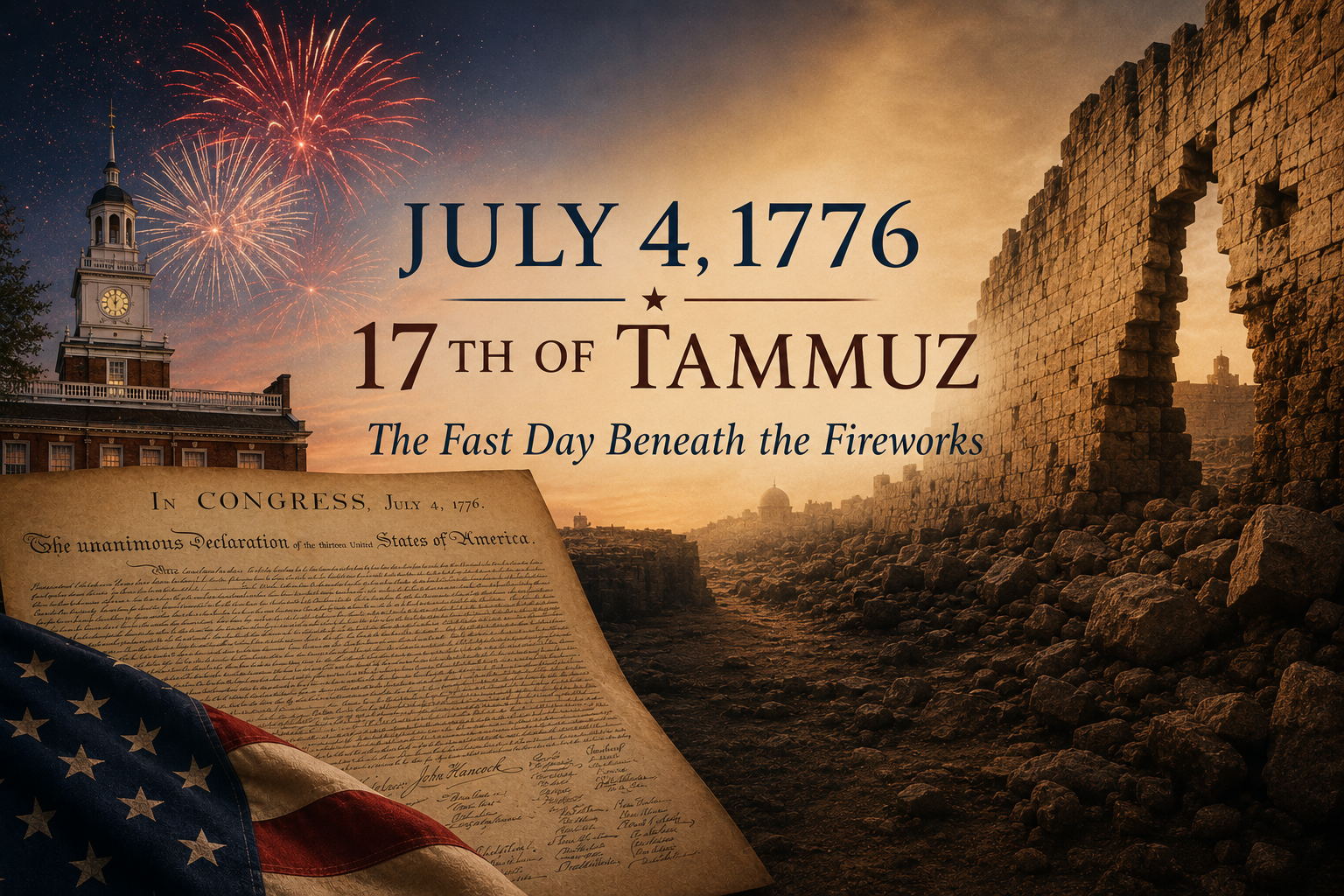
Before America had fireworks, it had a Hebrew date.
July 4, 1776, the day the Declaration of Independence was adopted in Philadelphia, fell on the seventeenth of Tammuz, the Jewish fast day that remembers the breach of Jerusalem’s walls. It is a striking overlap: America’s founding declaration was adopted on the very day Jewish memory begins its slow descent toward Tisha B’Av.
One date fills the streets with flags and celebration. The other turns Jews inward, toward fasting, memory, and the echo of collapsing stone.
The seventeenth of Tammuz is not only a sad anniversary. It marks a clash between two ways of seeing the world. Rome did not come to Jerusalem with battering rams alone. It came with a worldview. Power defined reality. Empire created order. The state stood above the person. The sword settled arguments. Conquest gave life its meaning.
When Jerusalem’s walls were breached, Rome had every reason to think it had won more than a battle. It had crushed a small and stubborn people whose greatest treasure was not land, wealth, or armies, but an idea: that the human being answers to a truth higher than Caesar.
Rome destroyed the Temple. It scattered the Jews. It turned Jerusalem into a compass carried from country to country. The stones fell, but the covenant traveled. The flames rose, but Sinai was not reduced to ash.
And perhaps this is where the calendar’s hidden meaning begins to emerge. The fact that July 4 fell on the seventeenth of Tammuz need not be read as a dark sign over America’s birth. On the contrary, it may carry the mark of Divine Providence: on the very date when Jewish memory recalls the breach of Jerusalem’s walls, a new nation would declare that power itself must answer to a truth higher than government.
The Declaration put it this way:
“We hold these truths to be self-evident, that all men are created equal.”
The line is so familiar that it can start to sound like patriotic wallpaper, brought out each July and then put away again. But its power rests in one word: created.
With that word, the Declaration did something extraordinary. It placed human dignity before government. Rights were not presented as gifts from rulers, privileges of class or rewards for strength. They were endowed by the Creator. Government entered the story afterward, not as the owner of those rights, but as their guardian.
That is the great American break from the Roman imagination.
Rome made power sacred. The Declaration did the opposite. It made power answerable.
The Founders were not rabbis, and America was not founded as a Jewish commonwealth. The American experiment belongs to its own history, language and political tradition. Still, the moral foundation beneath its noblest sentence is deeply biblical. Long before Philadelphia, the Torah taught that every human being is created b’tzelem Elokim, in the image of G-d.
That phrase may sound gentle to modern ears. In its time, it was revolutionary.
For most of human history, equality was not treated as self-evident. Kings were born above others. Slaves were born beneath them. Then the Torah entered the world with a different claim: every person carries a sanctity no empire can create and no empire can erase.
The Declaration gave that claim political language.
Of course, America’s founding generation lived with contradictions large enough to stain the page. A nation that proclaimed equality still tolerated slavery. The sentence that became America’s creed was proclaimed by men who did not fully live by it.
But that is precisely why the creed mattered. A shallow ideal flatters a nation. A serious ideal can confront it.
“All men are created equal” became the line later generations could throw back at America when America failed to live up to itself. It stood in judgment over slavery, segregation, antisemitism, racism and every system that treated human beings as tools for someone else’s power. The words were never only a celebration of what America already was. They became a summons toward what America had promised to become.
As the United States celebrates its 250th birthday, there will be no shortage of patriotic ritual. America knows how to celebrate. There will be parades, anthems, backyard grills, and fireworks over public parks.
Freedom becomes thin when it is cut off from responsibility. Equality becomes fragile when it is detached from the sacredness of the Creator. Rights become negotiable when they depend only on courts, parties, polls or power. The genius of the Declaration was that it placed the human being beyond the reach of political ownership. Government could protect rights because government did not invent them.
This was not a call for theocracy. Part of America’s greatness is that it refused to establish one faith as the law of the land. Its achievement was more subtle and more profound: it placed government beneath a moral reality higher than government itself. That move made religious liberty possible. It gave Jews, and so many others, the ability to live not as tolerated guests, but as full citizens.
George Washington expressed this beautifully in his letter to the Hebrew Congregation of Newport. He did not describe Jewish life in America as a favor granted by a generous majority. The government of the United States, he wrote, gives “to bigotry no sanction, to persecution no assistance.”
Across much of the diaspora, Jewish life depended on the mood of rulers, bishops, mobs, princes and bureaucrats. America, at its best, offered a different arrangement. Jewish rights were not favors to be renewed. They were part of the republic’s moral architecture.
That is why Jewish gratitude to America is real. In this country, Jews built synagogues, schools, charities, businesses, neighborhoods and lives of open Jewish dignity. America has been, as the Lubavitcher Rebbe would often refer to it, a malchus shel chesed, a kingdom of kindness, in ways that are rare in the long story of exile.
But gratitude is not the same as complacency.
The hidden Hebrew date beneath America’s birthday asks American Jews to think about freedom more deeply. Freedom is not only the ability to live as we choose. It is the opportunity to choose a life that matters. The Exodus did not end at the sea. It led to Sinai. Liberation was followed by responsibility, law, covenant, memory and moral purpose.
America’s 250th birthday should be celebrated with real gratitude. The American experiment has given freedom and refuge to millions, including generations of Jews. But the calendar adds a Jewish whisper beneath the national song: remember the source.
On the seventeenth of Tammuz, Rome breached Jerusalem’s walls and imagined that power had conquered covenant.
On the seventeenth of Tammuz in 1776, America gave political form to a truth Rome never understood: the human being stands before the state because the human being stands before G-d.
That truth animated the best of America.
Remaining faithful to it may be the great American task now.