When Removing a Road Barrier Becomes Terrorism
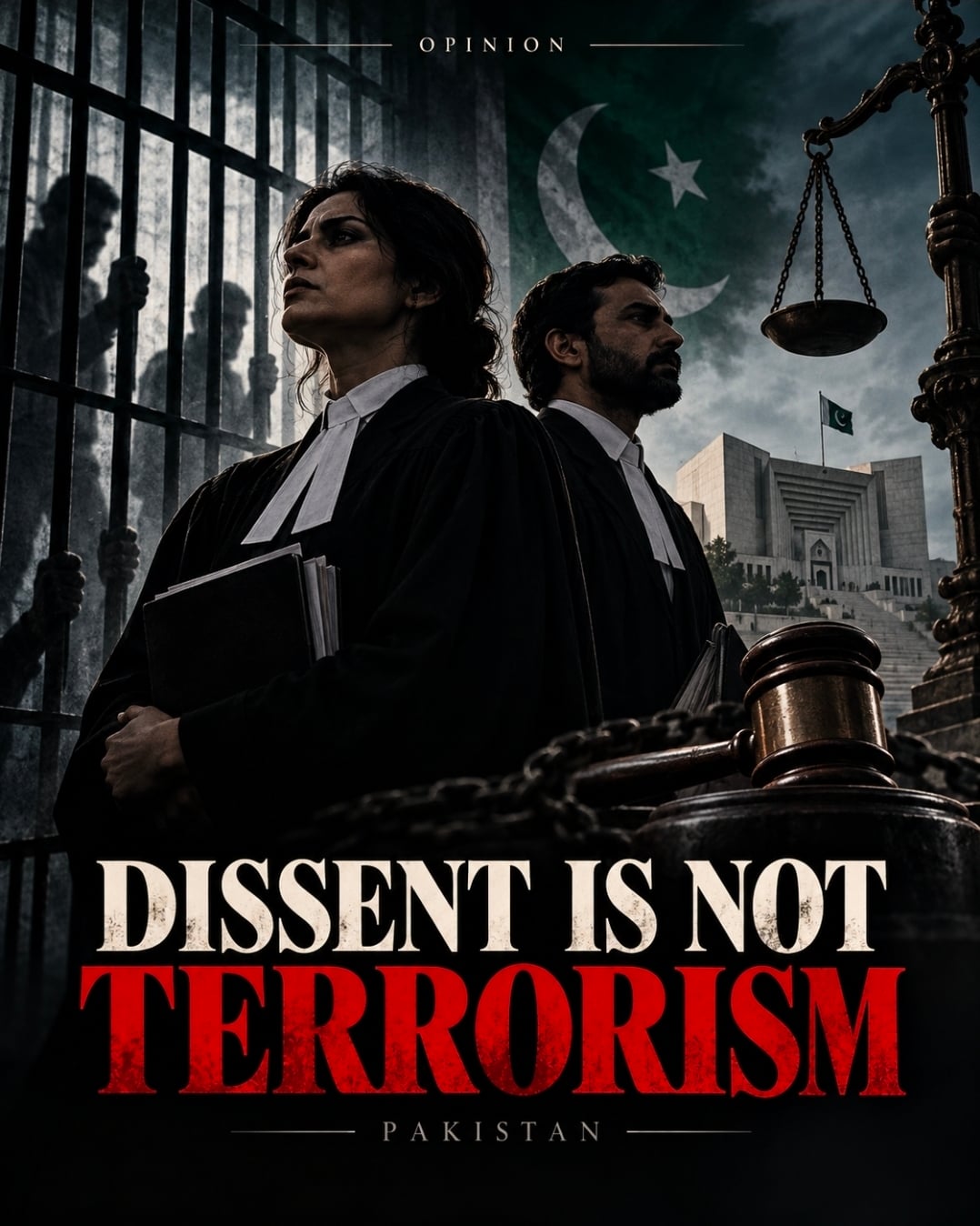
When Removing a Road Barrier Becomes Terrorism: Pakistan’s War on Human Rights Defenders
The ten-year prison sentences handed to Imaan Mazari and Hadi Ali Chattha raise disturbing questions about judicial independence, constitutional protections, and the criminalization of dissent in Pakistan.
Islamabad legal fraternity to rally today against Pakistani lawyer couple’s sentence. On October 29, 2026, Pakistan delivered another deeply troubling message to its human rights defenders: challenging state authority can carry consequences more severe than many violent crimes.
An anti-terrorism court sentenced human rights lawyers Imaan Zainab Mazari and her husband, Hadi Ali Chattha, to ten years in prison each over an October 2024 confrontation involving security barriers on a road reserved for England’s visiting cricket team.
The prosecution argued that their conduct endangered security arrangements and obstructed public officials. Both lawyers denied the charges. The court nevertheless convicted them under Pakistan’s Anti-Terrorism Act and additional criminal provisions. Dawn +1
Think about that.
A confrontation over a road barrier has resulted in a decade behind bars under anti-terrorism legislation.
Even the court’s judgment reportedly acknowledged that removing a barrier appeared, on its face, to be an ordinary incident. Yet it treated the security context as sufficient to establish terrorism. Front Line Defenders
That extraordinary legal leap demands scrutiny.
When the Law Becomes a Weapon
I know something about the cost of dissent in Pakistan.
My father, Ghulam Mohammad Laghari, spent decades in prison for challenging oppression and defending peasants and marginalized communities. Religious extremists declared him an unbeliever. State authorities imprisoned him. He died in custody.
I grew up watching what happens when powerful institutions begin treating independent voices as enemies.
Decades later, I see deeply familiar patterns.
Imaan Mazari and Hadi Ali Chattha have represented people confronting some of Pakistan’s most serious human rights problems: enforced disappearances, extrajudicial killings, arbitrary detention, and allegations of blasphemy.
Their legal work has brought them into conflict with powerful institutions. Their supporters contend that the prosecutions are retaliation for that work; the authorities maintain that the couple committed criminal offenses.
The question is not whether lawyers are above the law. They are not.
The question is whether terrorism legislation is being applied proportionately and fairly, or stretched to punish individuals whose advocacy has embarrassed the state.
Article 10A: A Constitutional Promise Under Examination
Pakistan’s Constitution guarantees the right to a fair trial and due process under Article 10A.
Yet serious questions have emerged about whether these protections were adequately respected.
According to Reuters, Mazari’s family alleged that the defendants were denied access to their chosen legal representation and essential legal documents. Front Line Defenders also reported restrictions on their ability to communicate with counsel and prepare their defense. Reuters +1
These allegations deserve independent investigation.
A country cannot credibly claim to uphold constitutional justice if defendants cannot effectively participate in their own defense.
Nor should an accusation involving obstruction of public officials automatically become terrorism merely because the defendants are politically inconvenient.
A security breach may warrant investigation. Obstructing police may constitute an offense if proven. But terrorism carries a fundamentally different legal and moral meaning.
Conflating these categories risks turning extraordinary counterterrorism legislation into an ordinary instrument of political control.
The International Community Cannot Look Away
Pakistan frequently seeks international recognition as a constitutional democracy committed to the rule of law.
That claim must be measured against the treatment of its critics.
Human rights lawyers are not enemies of the state. Their role is to ensure that state power remains subject to legal accountability.
When lawyers defending victims of enforced disappearances are themselves imprisoned under terrorism laws, it creates a chilling effect far beyond the individuals involved.
Who will represent the next disappeared student’s family?
Who will challenge allegations of torture?
Who will defend a religious minority accused of blasphemy?
And who will stand before a court when the act of challenging powerful institutions may place the lawyer’s own liberty at risk?
These questions concern more than Pakistan. They concern the international credibility of human rights protections everywhere.
I have consistently argued that the principles of human dignity and justice cannot depend on religion, nationality, or political allegiance. Those principles must protect Jews, Muslims, Christians, Hindus, dissidents, and political opponents alike.
The same standard I demand in confronting antisemitism and religious persecution must apply when Pakistani human rights defenders face allegations of judicial persecution.
Human rights cannot be selective.
My Position Is Clear
I condemn these sentences and call for an urgent, independent review of the convictions and the proceedings that produced them.
Pakistan’s superior courts should rigorously examine the application of anti-terrorism legislation, the proportionality of the punishment, and the defendants’ constitutional rights.
International bar associations, United Nations human rights mechanisms, and democratic governments should closely monitor the case and advocate for due process.
A functioning judicial system must be capable of correcting its own errors. Its legitimacy rests not on unquestioning obedience but on impartiality, transparency, and accountability.
When a road-barrier dispute results in ten years of imprisonment under terrorism legislation, the world has every reason to ask whether justice is being served—or whether dissent itself is on trial.
Pakistan does not become stronger by silencing its human rights defenders.
It becomes stronger when its courts can protect even those whom powerful institutions would prefer to silence.
And until those rights are secure, the struggle for justice in Pakistan remains unfinished.