
The First Collective Effervescence
When the Torah portion restarts and we begin again, I always pay attention to the firsts.
Adam and Eve: the first people.
The fruit: the first temptation.
The picking of the fruit: the first sin.
The aftermath: the first shame and the first banishment.
Cain and Abel: the first rivalry and the first murder.
The flood: the first destruction.
I believe, as many of our sages do, that these stories are paradigmatic. Beyond being histories, they are mythologies — designed to teach us about the patterns of human experience and existence.
There is another first in Parashat Noach, one of my favorite firsts: the Torah’s first record of collective effervescence.
Collective effervescence is a term coined by sociologist Emile Durkheim. “Once the individuals are gathered together,” wrote Durkheim, “a sort of electricity is generated from their closeness and quickly launches them to an extraordinary height of exaltation.”
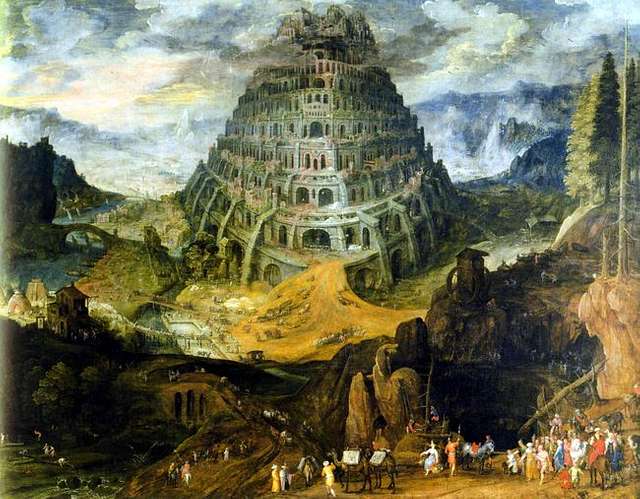
To me, the Tower of Babel isn’t as fascinating as the surge toward it.
On a Sunday last year, we stumbled into the beginning of the New York Marathon on the Upper East Side. My husband held my toddler as we stood watching — and suddenly cheering, and jumping up and down — with hundreds of other spectators. I was cold and heavily pregnant, and despite the contagious energy I could only handle a few minutes. But when I tried to pry my family away, my daughter started to scream: “I’m not leaving! They need me to cheer!”
Max and Mila remained there for another hour while I sipped coffee inside the warmth of Mellow Yellow. I found I couldn’t stop smiling. The rest of the day was filled with this verve and this feeling that I was part of this special, magical experience, was woven into the tapestry of what it means to be a New Yorker and a human being. It felt, I realized, like a religious experience.
I had another almost-religious experience when the Knicks won this year. Still a Michigander when it comes to sports, I’m not sure I even knew the Knicks were a New York team until the playoffs. But suddenly everyone was in gear and I was following the games and swept up like everyone else. The day the streets filled, I told my husband this must be what aliyah l’regel felt like in Ancient Israel — festive, uncontained, exuberant, overpowering.
Durkheim uses the concept of collective effervescence to define the sacred as the place where people have suppressed the self and become part of something larger and all-encompassing. Something sacred, then, happens in this parashah: a group of people gather and decide to create something and it becomes bigger than they are.
But what’s interesting is contrasting Durkheim’s definition of sacred with the Torah’s understanding of it. In Jewish thought, the sacred — the kadosh — is definitionally “separate” or “distinct.” Durkheim’s sacredness is where the boundaries between us begin to disappear. But the Torah’s sacredness is where those boundaries intensify.
The sacredness of Judaism rests in separation. Kedushah is found in the space between meat and milk; between person and person; between God and human; between weekday and Shabbat. It is in upholding these boundaries.
But Durkheim and the Torah aren’t at odds, precisely. Notions of collective effervescence — of the power to overcome the individual, to transcend into the divine — are baked into the idea of the minyan and the beit din. At Mount Sinai, we received the Torah, so united as a nation we are referred to with a singular verb tense. Sometimes, even our Shabbat tables become a space where the space between human beings starts to disappear.
The Tower of Babel captures this tension. In its building process, the person stopped existing and became part of the people. This, more than the tower itself, is what threatened God. The surge was profane because it violated the boundaries of the universe, the mortal, and the divine. It was a collective effervescence that drove against God.
And how does God respond?
With separation.
With a return to the holy, the distinct, the unique.
The people, scattered, can no longer speak the same languages. And then they turn their collective effervescence toward one another instead of God.
But that is the story of another parashah and another first.