
The First Lesson After the Covenant – Build a Just Society
The First Lesson After the Covenant: God Wanted Abraham to Build a Just Society, Not Just Be a Holy Man
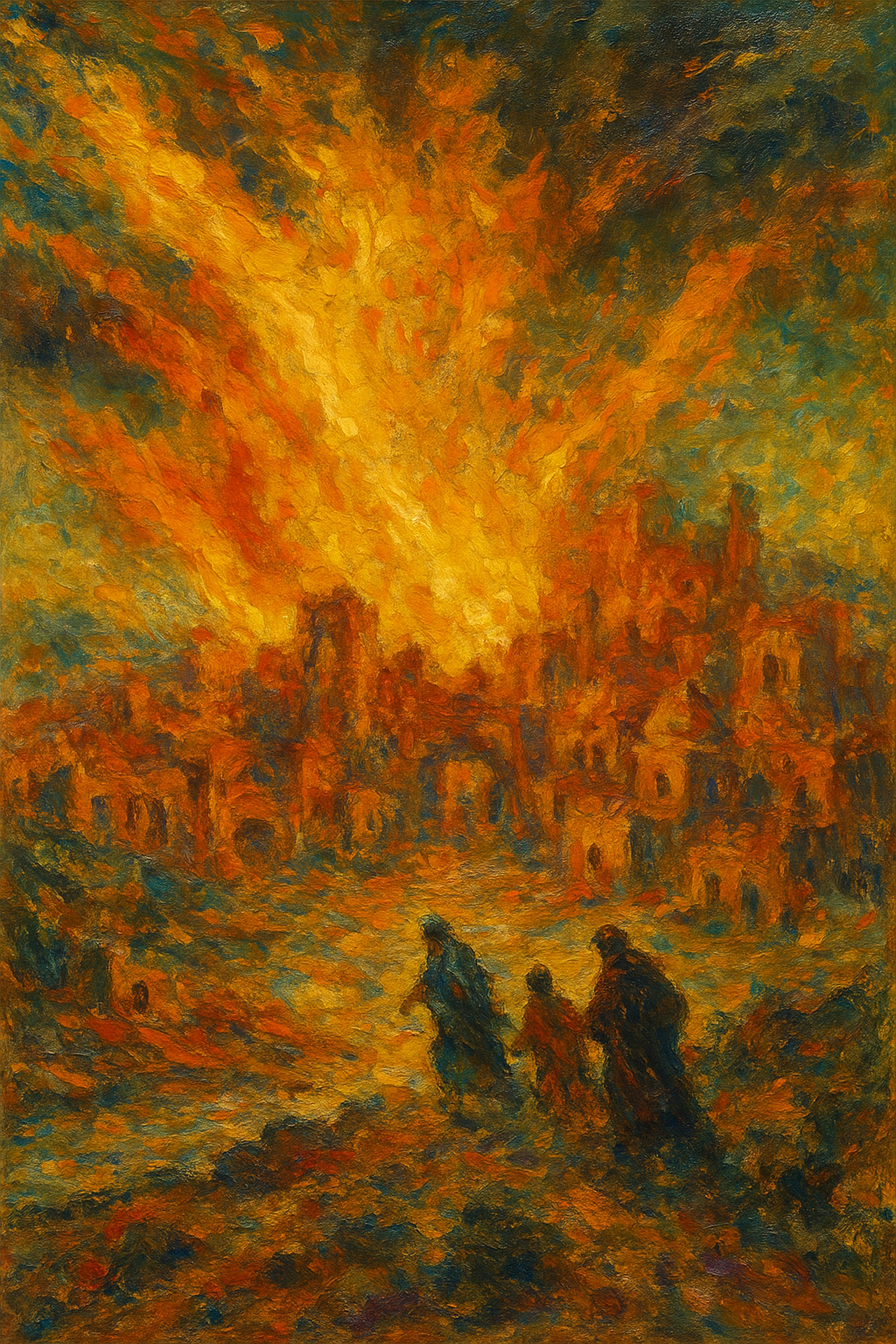
Right after promising Abraham a future, God shows him a society about to be erased. The message is stark: if the society collapses, the righteous inside it go down too. Covenant means public responsibility.
Parashat Vayera opens with hospitality and promise, but it quickly pivots to something harder: God decides to let Abraham in on His plan to destroy Sodom and Gomorrah.
That’s unusual. God doesn’t normally brief Abraham on everything He’s doing. But here He pauses: “Shall I hide from Abraham what I am about to do?” (Genesis 18:17). Why this, why now, right after the covenant?
Because this is the first practical lesson of the covenant. God has just said of Abraham:
“For I have known/chosen him, so that he will command his children and his household after him to keep the way of the Lord, doing righteousness and justice…” (Genesis 18:19)
God didn’t choose Abraham just to admire his faith. He chose him to found a people that can sustain a just society. To teach that, God shows him the opposite — a society that has become unsalvageable.
Not about a minyan — about a minimum
We usually focus on Abraham’s “bargaining” — 50, 45, 40, 30, 20, 10 — and turn it into a nice derash about ten. But the text is making a broader point: there is a minimum righteous core that can save the whole. If enough moral infrastructure exists, God will preserve the city. If it doesn’t, He won’t.
God is teaching Abraham to think societally, not just individually. God is not only in the business of rescuing lone tzaddikim; He is in the business of preserving or removing entire social orders. Abraham must understand that — because his descendants’ task is to build the kind that can be preserved.
The hard part: the righteous don’t always get spared
Abraham’s protest — “Will You indeed sweep away the righteous with the wicked?” — shows he knows what’s at stake (18:23–25). If the city goes, everybody in it is at risk. God does not promise that every good person will always be airlifted out of every collapsing culture. In Sodom, Lot is saved because of Abraham — that’s exceptional, not the rule.
Here is the hard biblical truth: bad things can happen to good people when the society they live in fails. There are no winners in a social collapse. Even the decent are harmed, displaced, or silenced. That is exactly why God shows Abraham this case right after the covenant — to say: your righteousness must express itself in public life, or your fate will still be tied to a corrupt society.
Fix the society — or leave
That leads to the second lesson: if a society cannot be repaired, the righteous must separate from it. Jewish history is a 2,000-year confirmation of that principle. Again and again, Jews survived not by redeeming every hostile environment, but by moving — forcibly or voluntarily — to a more hospitable setting and rebuilding community, law, and learning there.
That is not a failure of the covenant. That is the covenant at work: the people chosen “to do righteousness and justice” are not required to go down with every Sodom. They are required to build or join places where covenantal life is possible.
So what does this say to Israel — now?
Here is where the Sodom lesson bites.
For 2,000 years the Jewish answer to collapsing or hostile societies was: leave. That worked because there was always somewhere else — another empire, another port, another tolerant city, another immigration wave. Mobility was our survival tool.
But Israel is not supposed to be just another stop on the Jewish migration trail. The whole point of a Jewish state was to end the need for permanent Jewish contingency plans.
So if we take the Abraham lesson seriously, it says to Israel today:
- It is not good enough to say, “If it goes bad here, Jews can leave.” That’s Diaspora thinking.
- It is not good enough to let internal bickering, factionalism, religious-secular trench warfare, tribal politics, or institutional paralysis corrode the public square and then assume “the good people” will somehow be spared.
- It is not good enough to normalize a politics that keeps pushing us toward Sodom-like unrepairability and then hope covenantal merit will override civic decay.
Do we really want Diaspora 2.0 — Israelis scattering because the one Jewish society we finally control couldn’t figure out how to thrive together?
The whole point of God showing Abraham Sodom right after the covenant was to say: your mission is societal. If the society rots, the righteous pay. So don’t let it rot.
That is Israel’s call right now: get our act together, strengthen the minimum moral core, rebuild trust, protect the vulnerable, curb corruption, and stop the self-sabotage. A Jewish state cannot live on miracles and memory alone. It has to live on righteousness and justice — the exact words God used when He explained why He chose Abraham in the first place.
Covenant was never about producing a few holy individuals. It was about producing a people capable of building a society God would want to keep. Israel has no Sodom option, and no safe exile at the ready. So the choice is simpler, and sharper:
Fix the society. Don’t count on leaving. Don’t wait for the Messiah!